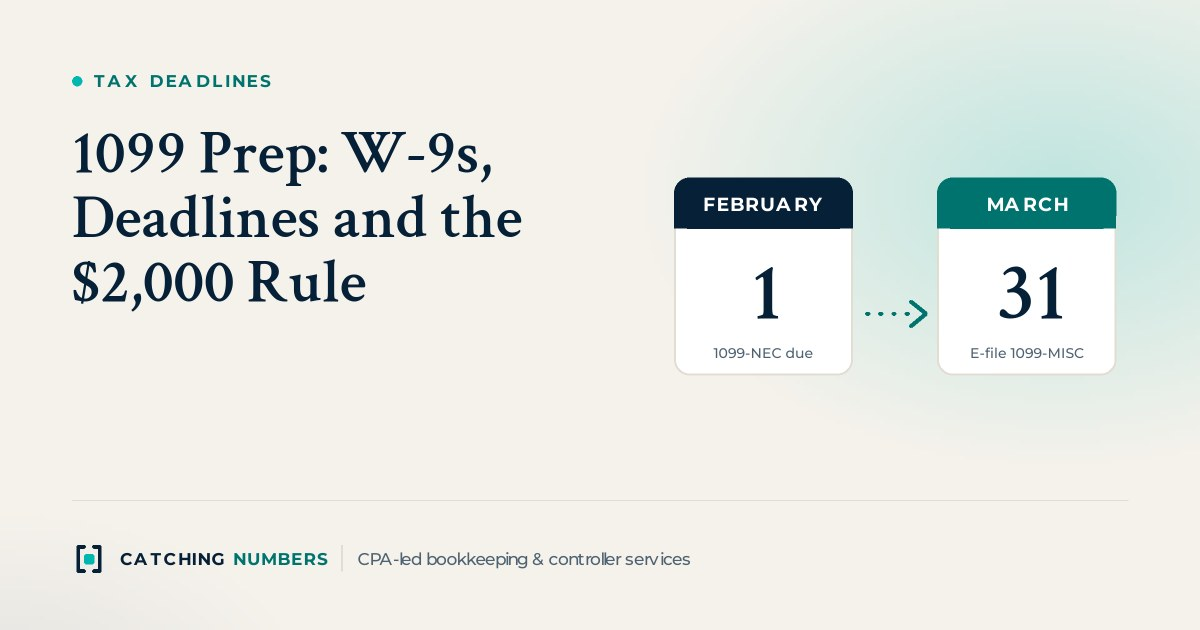
To get ready for 1099-NEC and 1099-MISC filing, collect a Form W-9 from every contractor and landlord you pay now, not in January, and clean up your vendor list in QuickBooks Online or Xero before year-end. For payments made in 2026, the IRS raised the main reporting threshold from $600 to $2,000, so fewer vendors will need a form. The deadline to send Form 1099-NEC to contractors and the IRS is January 31, which moves to Monday, February 1, 2027 because January 31 falls on a Sunday.
Key takeaways
- For tax years beginning after 2025, the threshold for nonemployee compensation, rents and most other 1099-MISC payments is $2,000, up from $600. It may be adjusted for inflation starting in 2027.
- Some thresholds did not change: $600 for gross proceeds paid to attorneys and $10 for royalties.
- Form 1099-NEC for 2026 payments is due to recipients and the IRS by February 1, 2027, with no automatic extension.
- FIRE is being retired. For filing season 2027, the IRS Information Returns Intake System (IRIS) is the only way to e-file, and you need an IRIS Transmitter Control Code (TCC) first.
- The work that makes January easy is bookkeeping: W-9s on file, vendors flagged correctly, and contractor payments coded to the right accounts.
What changed in the 1099 threshold for 2026?
The 2025 tax law (P.L. 119-21, often called the One Big Beautiful Bill Act) raised the minimum reporting threshold for many 1099 payments. According to the IRS Instructions for Forms 1099-MISC and 1099-NEC (Rev. December 2026), for tax years beginning after 2025 the threshold is $2,000, and it may be adjusted for inflation beginning in calendar year 2027. IRS Publication 1099 (2026) says the same.
In practice, that means the forms you file in early 2027 for payments made during 2026 use the new $2,000 test. The forms you filed in early 2026 for 2025 payments still used $600. Not every box moved, so check the payment type before you drop a vendor from your list.
| Payment type (2026 payments) | Form and box | Report if total for the year is |
|---|---|---|
| Nonemployee compensation, including attorneys’ fees for services | 1099-NEC, box 1a | $2,000 or more |
| Rents (office, warehouse, equipment) | 1099-MISC, box 1 | $2,000 or more |
| Prizes, awards and other income | 1099-MISC, box 3 | $2,000 or more |
| Medical and health care payments | 1099-MISC, box 6 | $2,000 or more |
| Royalties | 1099-MISC, box 2 | $10 or more |
| Gross proceeds paid to an attorney (for example, a settlement) | 1099-MISC, box 10 | $600 or more |
Who needs a 1099-NEC from your business?
The IRS gives four conditions. You generally report a payment as nonemployee compensation on Form 1099-NEC if all of these are true:
- The payee is not your employee.
- You paid for services in the course of your trade or business.
- The payee is an individual, partnership or estate (or, in some cases, a corporation).
- You paid that payee at least $2,000 during the year.
Two rules trip up a lot of growing companies. First, payments to a corporation (including an LLC taxed as a C or S corporation) are generally exempt, but the exemption does not apply to legal services or to medical and health care services. Your law firm gets a 1099 even if it is a professional corporation. Second, payments made with a credit card or other payment card are not reported on Form 1099-NEC or 1099-MISC at all. The card processor reports them on Form 1099-K. Contractors you paid by ACH, wire or check are the ones that count.
For ecommerce brands, that usually means freelance designers, photographers, ad agencies run as LLCs, 3PL or warehouse rent, and attorneys. For SaaS and AI companies, think offshore and domestic developers paid as contractors, fractional executives, consultants and office rent. Foreign contractors are a separate regime: they typically give you a Form W-8BEN rather than a W-9 and are not reported on Form 1099-NEC.
When are 1099-NEC and 1099-MISC due in 2027?
The standard due dates are January 31 for 1099-NEC (to both the recipient and the IRS) and for 1099-MISC recipient copies. The IRS copy of Form 1099-MISC is due February 28 on paper or March 31 if you e-file. Under Publication 1099, a deadline that lands on a weekend or legal holiday is met if you file on the next business day, which shifts two of the dates in 2027.
| Form (2026 payments) | To recipients | To the IRS | Extension? |
|---|---|---|---|
| 1099-NEC | February 1, 2027 | February 1, 2027 (paper or e-file) | No automatic extension |
| 1099-MISC | February 1, 2027 | March 1, 2027 on paper; March 31, 2027 e-filed | 30 days with Form 8809 |
Missing the date is not cheap. Under Revenue Procedure 2025-32, the penalty for returns required to be filed in 2027 runs from $60 per form if corrected within 30 days to $340 per form, and the same amounts apply separately to the recipient copy. Intentional disregard starts at $690 per form with no annual cap.
Do you have to e-file 1099s, and what is IRIS?
If you file 10 or more information returns in a year, counting all types together (for example, W-2s plus 1099s), you must e-file. That rule has been in place since 2024. What is new for this season is the system. Publication 1099 says that beginning with tax year 2026 and filing season 2027, the Information Returns Intake System (IRIS) will be the only intake system for information returns, and the older FIRE system will not be available for submissions after it shuts down in 2026.
IRIS is free and has a Taxpayer Portal where you can key in forms or upload a CSV file, up to 100 returns at a time. To use it, you need an IRIS Transmitter Control Code, and the IRS says a typical application takes up to 45 business days to process. If you plan to file directly rather than through your payroll provider, 1099 software or tax CPA, apply in the fall. A TCC requested in mid-January will not arrive in time.
How do you collect W-9s without a January scramble?
Form W-9 gives you the payee’s legal name, tax classification and taxpayer identification number (TIN). The current revision is dated March 2024. The best time to get one is before the first payment, because that is when you have leverage. If a payee will not give you a TIN, the IRS generally requires you to start backup withholding at 24 percent of what you pay them.
- Make W-9 a payment rule. No new vendor is set up for ACH, wire or check until a signed W-9 is on file. Bill pay and AP tools can enforce this at vendor onboarding.
- Request missing forms in October and November. Run a report of everyone you paid by non-card methods this year and chase anyone without a W-9 now, while you still have upcoming payments to them.
- Check name and TIN combinations. The IRS TIN Matching program lets payers check a name and TIN against IRS records before filing, which cuts down on rejected forms and penalty notices.
- Store W-9s where your team can find them. Attach the PDF to the vendor record in your accounting or AP system, not in someone’s inbox.
What should you clean up in QuickBooks Online or Xero before year-end?
The 1099 report in your accounting software is only as good as the vendor records and coding behind it. Here is what we work through with clients in the fourth quarter as part of the monthly bookkeeping and close:
- Flag every contractor and landlord as a 1099 vendor, and unflag corporations that do not need a form (other than law firms and medical providers).
- Merge duplicate vendors so one person’s payments are not split across two records and two thresholds.
- Map expense accounts to the right 1099 box: contract labor and professional fees to 1099-NEC, rent to 1099-MISC box 1.
- Separate card payments from ACH and check payments, since card payments are reported on 1099-K by the processor.
- Reconcile every bank and card account through December 31, so no contractor payment is missing or double counted.
- Review payments just under and just over $2,000, where a single miscoded bill can change whether a form is required.
Once that is done, handing a clean 1099 vendor report to whoever files the forms, whether that is your payroll provider, a 1099 filing service or your tax CPA, takes minutes instead of days. It also feeds directly into your year-end close, because contractor costs that are coded correctly now are the same numbers your tax CPA relies on for the return.
Frequently asked questions
Do I still need to send a 1099-NEC to a contractor I paid $1,500 in 2026?
Generally no. For payments made in 2026, the 1099-NEC threshold is $2,000 for the year, so a contractor paid $1,500 in total does not need one. You should still keep their W-9 on file, and remember the contractor must report the income either way.
Do I issue a 1099 to a contractor I paid through a corporate card?
No. The IRS instructions say payments made with a credit card or other payment card are not reported on Form 1099-NEC or 1099-MISC. The payment settlement entity reports them on Form 1099-K. Only count ACH, wire, check and cash payments toward the threshold.
Can I get an extension to file Form 1099-NEC?
Not automatically. Publication 1099 says no automatic extension is available for Forms W-2 and 1099-NEC. Other information returns, including the IRS copy of Form 1099-MISC, can get a 30-day extension with Form 8809.
Does the $2,000 threshold apply to attorneys?
It depends on the payment. Attorneys’ fees for services go on Form 1099-NEC at $2,000 or more. Gross proceeds paid to an attorney, such as a settlement paid through their trust account, still use the $600 threshold on Form 1099-MISC, box 10.
Want a clean 1099 vendor report before January?
We keep vendor records, W-9s and contractor coding tidy all year in QuickBooks Online and Xero, so your 1099s and your tax CPA’s work start from clean books. See our pricing or book a free consultation.