Most tax-exempt nonprofits file one of three annual returns, depending on size. If your gross receipts are normally $50,000 or less, you can file the Form 990-N e-Postcard. If gross receipts are under $200,000 and total assets are under $500,000, you can file Form 990-EZ. If gross receipts are $200,000 or more, or total assets are $500,000 or more, you file the full Form 990. All three are due by the 15th day of the 5th month after your year end, which is May 15 for calendar-year organizations (Monday, May 17, 2027 for 2026 returns, because May 15 falls on a Saturday).
Key takeaways
- Size decides the form: 990-N for gross receipts normally up to $50,000, 990-EZ under $200,000 with assets under $500,000, Form 990 above either line.
- The deadline is the 15th day of the 5th month after year end; Form 8868 gives an automatic 6-month extension for Forms 990 and 990-EZ.
- For calendar-year 2026 returns, the deadline is May 17, 2027, or November 15, 2027 with an extension.
- All three forms are now filed electronically.
- Missing three years in a row means automatic loss of tax-exempt status.
Which Form 990 do you file?
| Form | Who can file it | How it is filed |
|---|---|---|
| Form 990-N (e-Postcard) | Gross receipts normally $50,000 or less | Online only, through the IRS; there is no paper form |
| Form 990-EZ | Gross receipts under $200,000 and total assets under $500,000 | Electronically, for tax years ending July 31, 2021 and later |
| Form 990 | Gross receipts of $200,000 or more, or total assets of $500,000 or more | Electronically, for tax years beginning after July 1, 2019 |
Organizations that qualify for a smaller form can always choose to file a larger one. Some funders and state charity regulators ask for a full Form 990 regardless of size, so check your grant agreements and your state’s charity registration rules before choosing.
What does “normally $50,000 or less” mean for the 990-N?
Gross receipts are everything you received from all sources, before subtracting any costs. “Normally” depends on how old the organization is. According to the IRS, an organization in its first year qualifies if it received, or was pledged, $75,000 or less; one that is between one and three years old qualifies if it averaged $60,000 or less in each of its first two years; and one that is three or more years old qualifies if it averaged $50,000 or less over the preceding three tax years, including the current year (IRS: Form 990-N requirements, checked October 24, 2026).
When is Form 990 due, and how do you extend it?
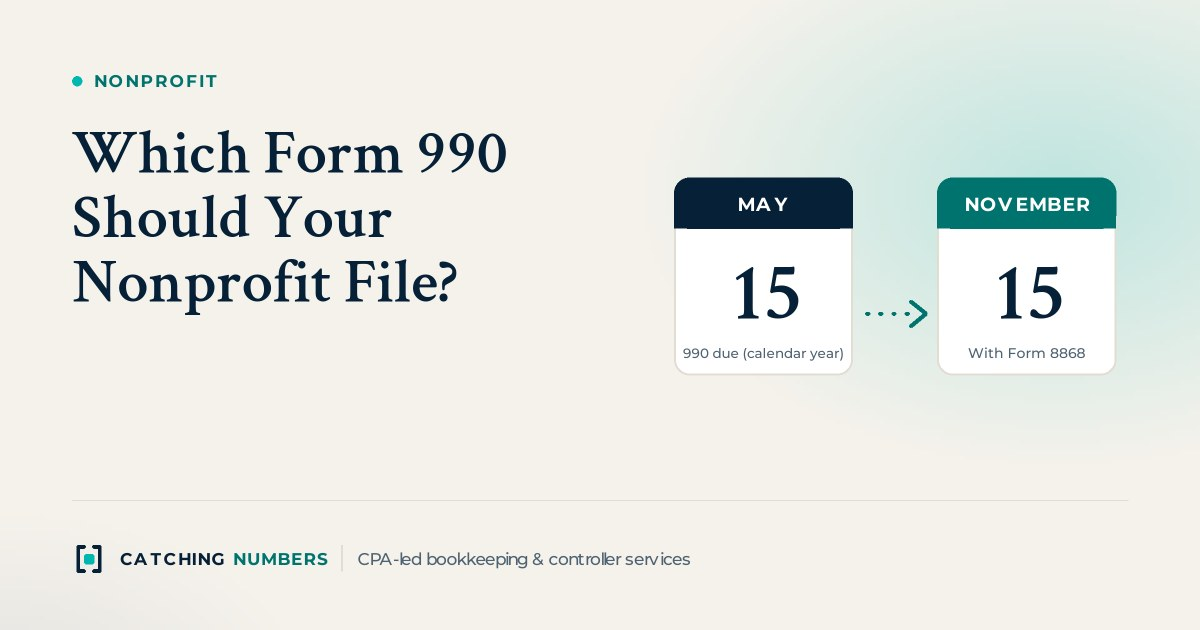
All 990-series returns are due by the 15th day of the 5th month after the end of your tax year: May 15 for a December 31 year end, and November 15 for a June 30 year end. If the date falls on a weekend or legal holiday, the deadline moves to the next business day. Form 990 and 990-EZ filers can get an automatic 6-month extension by filing Form 8868 by the original due date (IRS Form 990 overview, checked October 24, 2026). The 990-N can’t be filed before your year ends.
| Year end | Return due | With Form 8868 extension |
|---|---|---|
| December 31, 2026 | Monday, May 17, 2027 | Monday, November 15, 2027 |
| June 30, 2027 | Monday, November 15, 2027 | Monday, May 15, 2028 |
What happens if a nonprofit doesn’t file?
An organization that fails to file a required 990, 990-EZ or 990-N for three consecutive years automatically loses its tax-exempt status on the due date of the third return. This automatic revocation applies to small organizations that only needed the e-Postcard, too. Reinstating exemption takes a new application, so it is far easier to put the deadline on your calendar every year.
What do your books need to look like for Form 990?
Form 990 and 990-EZ pull directly from your financial statements, so clean books make the return faster and cheaper to prepare. Before your preparer starts, have:
- Reconciled bank, credit card and donation platform accounts for the whole year
- Revenue split by source: contributions, grants, program service revenue, events and investment income
- Net assets with and without donor restrictions, and a schedule of restrictions released during the year
- Expenses by function (programs, management and general, fundraising), which the full Form 990 reports
- Compensation details for officers, directors and key employees
- Fundraising event income and direct costs, and any in-kind donations with their values
- Your board minutes and policies, which the return asks about
We don’t prepare Form 990. We keep nonprofits’ books 990-ready all year and give the CPA who files the return the schedules they need. Read our guide to nonprofit bookkeeping and fund accounting, or see our nonprofit accounting services.
Frequently asked questions
What is Form 990?
It is the annual information return most tax-exempt organizations file with the IRS. It reports finances, governance, compensation and program activities, and it is public, so donors and grantmakers often read it.
When is Form 990 due in 2027 for calendar-year nonprofits?
Monday, May 17, 2027 for 2026 returns. Returns are due by the 15th day of the 5th month after year end, and because May 15, 2027 falls on a Saturday, the due date moves to the next business day.
How do I get an extension for Form 990?
File Form 8868 by the original due date. It gives Form 990 and 990-EZ filers an automatic 6-month extension, which moves the deadline for calendar-year 2026 returns to Monday, November 15, 2027.
Can a small nonprofit file Form 990-EZ instead of the 990-N?
Yes. An organization eligible for a smaller form can choose to file a larger one, such as 990-EZ or the full Form 990. Some do so because a funder or state regulator wants more detail.
Can Form 990 be filed on paper?
Generally no. Form 990 must be filed electronically for tax years beginning after July 1, 2019, Form 990-EZ for tax years ending July 31, 2021 and later, and the 990-N is only available online.
What counts as gross receipts?
All amounts received from all sources during the year, without subtracting costs or expenses. That includes donations, grants, program fees, event income and investment income.
Is there a penalty for filing the 990-N late?
The IRS says there is no penalty for a late 990-N, but failing to file any required 990-series return for three consecutive years means automatic revocation of tax-exempt status. Late Forms 990 and 990-EZ can bring penalties.
Do private foundations file Form 990?
No. Private foundations file Form 990-PF regardless of size, and it must also be filed electronically.
Who signs Form 990?
An authorized officer of the organization, such as the president, treasurer or executive director, signs the return under penalties of perjury. A paid preparer also signs if one prepared it.
Is Form 990 public?
Yes. Forms 990 and 990-EZ are public documents, with limited exceptions such as most donor names and addresses. Many donors and grantmakers review them before giving, so accuracy matters.
Do you prepare Form 990?
No. We focus on bookkeeping, the monthly close and controller work, and leave the return to the CPA or preparer you choose. We keep your books 990-ready and hand them the schedules they need.
Want your books ready before your 990 preparer asks? Book a free consultation or call +1 (646) 450-8036.