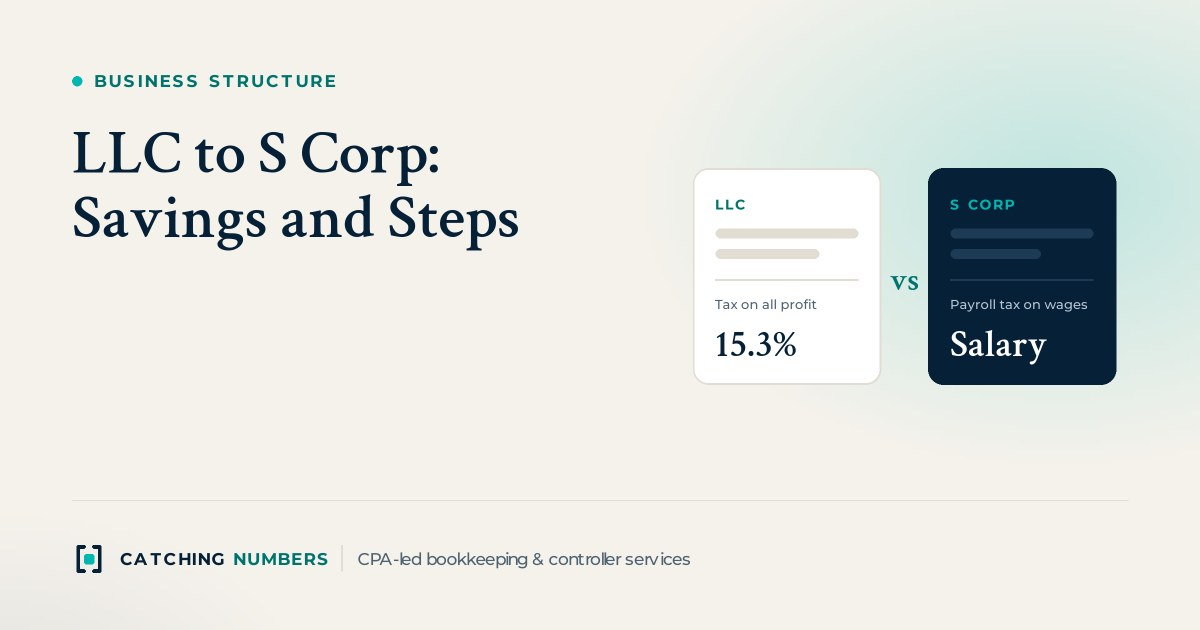
An LLC “converts” to an S corp by filing Form 2553 to be taxed as an S corporation; it stays an LLC under state law. The election can save self-employment tax because only the reasonable salary you pay yourself carries payroll taxes, while the rest of the profit comes out as distributions. It usually pays off once your profit is comfortably above a reasonable salary for your role and the savings beat the extra cost of payroll and a corporate return. For a 2027 election, a calendar-year LLC files by March 15, 2027.
Key takeaways
- As an LLC you pay 15.3% self-employment tax on 92.35% of profit; as an S corp you pay payroll taxes only on your salary.
- The Social Security wage base is $184,500 for 2026 and $192,300 for 2027.
- The IRS requires a reasonable salary before distributions, and a salary set too low is the biggest risk.
- File Form 2553 within 2 months and 15 days of the start of the tax year it should apply to: March 15, 2027 for a calendar-year business electing for 2027.
- An S corp means running payroll, filing Form 1120-S and tracking shareholder basis, so the savings have to beat those costs.
- It is a poor fit if you expect losses, plan to raise venture capital, have non-US or business owners, or operate in New York City or Washington, DC.
What does converting an LLC to an S corp actually mean?
Nothing changes under state law. Your LLC keeps its name, operating agreement and liability protection. What changes is how the IRS taxes it: an eligible LLC that files Form 2553 is treated as a corporation that has elected S status, and the IRS instructions confirm it does not need to file Form 8832 first. Profit still passes through to the owners, but each owner who works in the business becomes an employee paid through payroll.
How much can an S corp save you in 2026 and 2027?
As a single-member LLC or partnership, you pay self-employment tax of 15.3% on 92.35% of your profit. The 12.4% Social Security part stops at the wage base, which is $184,500 for 2026 and $192,300 for 2027, and the 2.9% Medicare part has no cap. As an S corp, the same taxes apply only to your salary. Pick the tax year and enter your own numbers:
Free tool
S corp tax savings calculator
Compare the self-employment tax you pay as an LLC with the payroll taxes on a reasonable salary as an S corporation, after the extra cost of running one.
Federal figures for one owner: 15.3% self-employment tax on 92.35% of profit, Social Security tax on wages and earnings up to the wage base ($184,500 for 2026, $192,300 for 2027), and federal unemployment tax of up to $42 per employee. The estimate is before income tax and leaves out state unemployment tax, state taxes on S corporations (for example California’s 1.5%, minimum $800), the 0.9% Additional Medicare Tax and the qualified business income deduction, which can shrink when part of your profit becomes salary. Results are estimates for general information only, not legal, tax or financial advice. Confirm them with your own CPA, tax adviser or attorney before making decisions. Using this tool does not create a client relationship with Catching Numbers Inc.
For example, with $120,000 of profit, self-employment tax as an LLC is about $16,955. As an S corp paying a $60,000 salary, payroll taxes are $9,180 plus $42 of federal unemployment tax. If payroll software, the extra return and state fees cost $2,000 a year, the saving is about $5,733 before income tax effects, in both 2026 and 2027, because those earnings sit below either year’s wage base. Once your earnings pass the wage base ($184,500 for 2026, $192,300 for 2027), the extra saving on each additional dollar shrinks to the 2.9% Medicare part. The calculator also has its own page: the S corp tax savings calculator.
What is a reasonable salary for an S corp owner?
It is what you would have to pay someone else to do the work you do. The IRS looks at your training and experience, your duties and hours, what comparable businesses pay for similar services and what the business can afford, and it can reclassify distributions as wages if the salary is unreasonably low. See the IRS guidance on S corporation compensation. Our guide to owner’s draw vs salary explains how owners of each entity type pay themselves.
When does an S corp election make sense?
- Your profit is steady and comfortably above a reasonable salary for the work you do.
- The calculator shows savings well above the cost of payroll and the extra return.
- All owners are US citizens or residents (or certain trusts and estates), and you have no more than 100 shareholders.
- Owners are happy to share profits strictly in proportion to ownership.
- You are willing to run payroll on time and keep cleaner books.
When should you not elect S corp status?
- Your profit is close to a reasonable salary. If almost all profit has to be paid as salary, there is little left to save and you still carry the extra costs.
- You expect losses. There is no self-employment tax to save on a loss, and S corp losses are limited by your stock and debt basis.
- You plan to raise venture capital. Investors generally want a C corporation, and an S corp cannot have business entities or non-US persons as shareholders. See S corporation vs C corporation.
- Owners want flexible profit splits. An S corp can have only one class of stock, so distributions must follow ownership percentages; an LLC taxed as a partnership can allocate profits differently.
- The business holds appreciating property. Distributing appreciated property out of an S corp generally triggers gain, which an LLC taxed as a partnership can often avoid, so many real estate investors keep property outside S corps.
- You operate in New York City or Washington, DC. Neither recognizes S status for its own business taxes, which can wipe out much of the benefit, and California taxes S corp income at 1.5% with an $800 minimum.
When is the deadline to elect S corp status?
Form 2553 is due no later than 2 months and 15 days after the start of the tax year the election should take effect, or any time during the tax year before. For a calendar-year LLC electing for 2027, that means any time in 2026 or by March 15, 2027. A newly formed LLC counts its 2 months and 15 days from the day its first tax year begins. An election filed after the deadline generally takes effect the following year, unless you qualify for late election relief under Rev. Proc. 2013-30, which is available within 3 years and 75 days of the intended effective date if you had reasonable cause.
What are the compliance steps after you elect?
- File Form 2553 with every shareholder’s consent. Your tax CPA files it; every shareholder signs, including spouses with a community property interest. Keep the IRS acceptance notice (CP261) with your permanent records.
- Check your state. Some states follow the federal election automatically and others need their own filing. New Jersey, for example, has treated federal S corporations as New Jersey S corporations automatically since December 22, 2022, unless the company opts out.
- Set up payroll. Register for state withholding and unemployment accounts, pay yourself a regular salary, file Form 941 every quarter and Form 940 every year, and issue yourself a W-2 by January 31.
- Change your books. Replace owner’s draw accounts with salary expense and shareholder distributions, and keep distributions in proportion to ownership.
- Handle health insurance correctly. Premiums the S corp pays for a more-than-2% shareholder go on the shareholder’s W-2; see our guide to the self-employed health insurance deduction.
- Reimburse expenses through an accountable plan instead of paying personal costs from the business. Our accountable plan guide explains how.
- Keep paying estimated tax on distributions. Salary has tax withheld, but distributions don’t. Our safe harbor tax calculator shows the quarterly payment that avoids a penalty.
- File Form 1120-S and the K-1s by March 15 for a calendar-year S corp, or extend with Form 7004; see our S corp extension guide.
- Track each shareholder’s basis. Shareholders attach Form 7203 to their returns when they claim a loss, receive a distribution or a loan repayment, or sell stock, so keep a running basis schedule.
What should you do next?
Run the calculator with a realistic salary, ask your tax CPA to confirm the income tax and state effects, and decide before the March 15, 2027 deadline if you want S corp status for 2027. If you elect, set up payroll before your first salary payment and make sure your books separate salary from distributions from day one. If your books are behind, a fixed-fee catch up bookkeeping project gets them ready first.
Frequently asked questions
Can a single-member LLC elect S corp status?
Yes. A single-member LLC owned by a US citizen or resident can file Form 2553. It is then taxed as an S corporation with one shareholder, and the owner is paid through payroll.
Do I need to form a new company to become an S corp?
No. Your existing LLC files Form 2553 and keeps its state registration, bank accounts and contracts. Some owners convert to a corporation under state law instead, but it is not required for the S election.
Is it too late to elect S corp status for 2026?
For an existing calendar-year LLC, generally yes: the 2026 deadline was March 15, 2026, unless you qualify for late election relief. An election filed now takes effect for 2027 if it reaches the IRS by March 15, 2027.
How much profit do you need before an S corp makes sense?
There is no single number. The savings depend on how much profit is left after a reasonable salary for your role and on what payroll, the extra return and state taxes cost you, so run your own figures in the calculator above.
Can I elect S corp status in the middle of the year?
An existing LLC’s election generally takes effect at the start of a tax year. If you file after the 2 months and 15 days deadline, the election usually applies from the next year unless you qualify for late election relief.
What happens if I miss the Form 2553 deadline?
The election normally starts the following tax year. If you meant to be an S corp from an earlier date and acted as one, Rev. Proc. 2013-30 lets you request late relief within 3 years and 75 days if you had reasonable cause.
Do S corp distributions get taxed?
Your share of S corp profit is subject to income tax on your personal return whether or not you take it out. Distributions themselves are not subject to payroll or self-employment tax, and are generally tax-free to the extent of your basis.
Does an S corp reduce my qualified business income deduction?
It can. Your W-2 salary from the S corp is not qualified business income, so moving profit into salary lowers the base for the 20% deduction. Ask your tax CPA to model both setups together.
Can I revoke an S corp election later?
Yes, with the consent of shareholders holding more than half the shares. After a revocation, you generally cannot re-elect S status for five tax years without IRS permission, so treat the decision as long term.
Can I still contribute to a retirement plan as an S corp owner?
Yes. Contributions to a Solo 401(k) or SEP IRA are based on your W-2 salary rather than total profit, so a lower salary also lowers the maximum contribution. Weigh that when you set your pay.
Do I need payroll software for just myself?
In practice, yes. A payroll service calculates withholding, pays the taxes, files Forms 941 and 940 and issues your W-2, which is hard to do reliably by hand and costly to get wrong.
Do you file the S corp election for us?
We don’t prepare tax returns or elections. We set up payroll, keep the S corp’s books with salary and distributions separated, and work alongside your tax CPA, who files Form 2553 and Form 1120-S.
Switching to an S corp?
We set up payroll, restructure your books for salary and distributions, and keep everything ready for your tax CPA. Monthly bookkeeping starts at $199 a month.