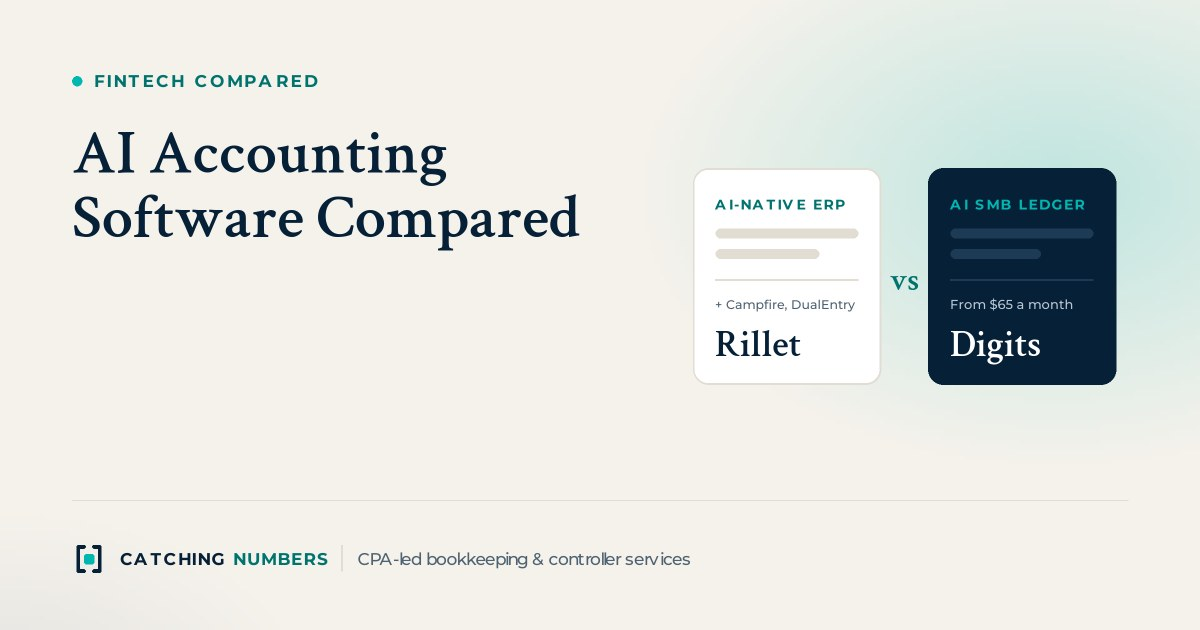
AI accounting software now comes in two flavors. Rillet, Campfire and DualEntry are AI-native ERPs built to replace NetSuite, Sage Intacct or an outgrown QuickBooks file at venture-backed and mid-market companies, with revenue recognition, multi-entity consolidation and close management in one ledger. Digits is an AI general ledger for small businesses that competes with QuickBooks Online and Xero at published prices from $65 a month. Our short verdict: an AI-native ERP is best for a SaaS or AI company with complex revenue, several entities or an audit coming; Digits is best for a simple small business that wants automation at a low price; and many companies are still better served by QuickBooks Online, Xero or NetSuite run with a disciplined close.
Key takeaways
- Rillet, Campfire and DualEntry target growing companies leaving QuickBooks or NetSuite; none publishes prices, so expect a quote.
- Digits is the only one with public pricing: $65 and $100 a month, with a $250 Pro plan listed as coming soon, as of October 19, 2026.
- The incumbents are adding AI too: Intuit Intelligence in QuickBooks, JAX in Xero, and Ask Oracle in NetSuite Next.
- Software does not close the books by itself. Someone still has to own reconciliations, review AI-suggested entries and sign off each month.
What is AI accounting software, and how is it different from QuickBooks or NetSuite?
Traditional accounting systems record what you enter and let you add automation with rules, apps and add-ons. AI-native systems are built around automation from the start: transactions arrive from bank, billing, payroll and card integrations, the software proposes categories, accruals and journal entries, and the team reviews exceptions rather than keying in data. The mid-market products also pull work that usually lives in separate tools, like revenue recognition subledgers and consolidation spreadsheets, into the general ledger itself.
The line is blurring. QuickBooks Online now uses Intuit Intelligence for tasks like drafting payroll from an uploaded spreadsheet, Xero has its JAX AI assistant, and Oracle says NetSuite Next, with its Ask Oracle conversational assistant, began rolling out with release 2026.2 in the U.S. and Canada. On October 15, 2026, Intuit also agreed to acquire Sequence, an AI revenue management platform, to strengthen its mid-market products. So the real question is not “AI or no AI” but which system fits your revenue model, entity structure and team.
How do Rillet, Campfire, DualEntry and Digits compare?
Everything below comes from each vendor’s own website, checked October 19, 2026. “Vendor-stated” means the company says it; we have not verified implementation times or certifications independently.
| Rillet | Campfire | DualEntry | Digits | |
|---|---|---|---|---|
| Built for | Series A to enterprise; SaaS, mid-market, PE-backed | Startups and mid-size tech companies | Mid-market and multi-entity scale-ups | Solopreneurs to growing small businesses |
| Pricing | Not published; request a demo | Not published; revenue recognition included at no extra cost | Not published; three tiers by entity count (up to 3, up to 20, unlimited); implementation included; no free trial | Essentials $65/mo, Core $100/mo, Pro $250/mo (coming soon); 30-day free trial; no setup fees |
| Revenue recognition | ASC 606 analysis from contracts; sales-led, product-led and usage-based models | ASC 606; subscription, usage-based and milestone billing; deferred revenue by customer and contract | Linear and usage on base tier; SSP and advanced modules on higher tiers | Automated schedules on Core; no ASC 606 module described on the pricing page |
| Multi-entity and currency | Consolidations, automatic intercompany eliminations and FX revaluation | Real-time consolidation; 180+ currencies | Multi-currency consolidation from the Plus tier | Not described on the pricing page |
| Implementation (vendor-stated) | CPA-led; go live in under 6 weeks | 8 to 12 weeks with dedicated support | About 4 to 8 weeks; CPA-led migration | Self-serve: connect banks and apps or import CSV; white-glove migration through partner firms |
| Security (vendor-stated) | AICPA SOC badge shown on site; ask for the report | SOC 1 and SOC 2, Type 1 and Type 2 | SOC 1 and SOC 2 Type II | Not stated on the pricing page; ask |
| Main alternative it replaces | NetSuite, Sage Intacct, QuickBooks | QuickBooks, NetSuite | NetSuite, Sage Intacct | QuickBooks Online, Xero |
What are the pros and cons of each?
Rillet
Pros: deep revenue recognition for SaaS pricing models, true multi-entity accounting with automatic eliminations and FX revaluation, native integrations with tools like Stripe, Salesforce, HubSpot, Ramp, Brex and Bill, and a CPA-led implementation. Cons: no public pricing, and it is built for companies with real complexity, so a simple business would pay for features it won’t use.
Campfire
Pros: strong revenue automation, including usage-based billing tied to metering tools and milestone billing, revenue recognition included in the price, an AI assistant (Ember) that drafts entries and runs flux analysis, and SOC 1 and SOC 2 reports. Cons: no public pricing, and its stated 8 to 12 week go-live is the longest of the three ERPs here.
DualEntry
Pros: a wide module list (AP, AR, fixed assets, subscription billing, planning), unlimited users and transactions on every tier, and implementation included in the subscription. Cons: no published prices or free trial, extra users beyond the plan cost more per month, and advanced revenue recognition sits on the top tier.
Digits
Pros: transparent pricing, a free trial, no setup fees, bill pay and invoicing built in, and firm tools for accountants who manage many clients. Cons: it is a small-business ledger, not an ERP, so companies with ASC 606 revenue, several entities or an upcoming audit will likely outgrow it.
What does AI accounting software mean for your books and month-end close?
This is where we spend our days, so here is what to check before you switch:
- Sync quality. Ask how bank, card, Stripe and payroll data arrive, how often, and what happens when a feed breaks. Duplicates and gaps are still the most common close problem.
- Review and approval. AI-proposed categories, accruals and journal entries need a human approver and an audit trail showing who accepted what. Your auditor will ask.
- Revenue recognition. Having revenue schedules inside the ledger removes a monthly tie-out between a subledger and the GL, which is a real time saver for SaaS companies. But the schedules are only as good as the contract data and revenue policy you set up.
- Reconciliations. “Continuous close” still means every balance sheet account gets reconciled and reviewed. The software can do the matching; someone has to own the exceptions.
- Cost of goods and gross margin. For AI companies, check how the system tags compute, inference and hosting costs so gross margin is reported consistently.
- Clean data in, clean data out. Migrating a messy ledger moves the mess. If your current books are behind or unreconciled, a cleanup before migration saves time on the other side.
When should you choose each, and when should you stay put?
- Choose Rillet if you are a venture-backed SaaS company with sales-led, product-led or usage-based revenue, more than one entity, and an audit on the horizon.
- Choose Campfire if usage-based or milestone billing drives your revenue and you want billing and revenue recognition in the same system as the ledger.
- Choose DualEntry if you want a full NetSuite-style module set (AP, AR, fixed assets, planning) with implementation bundled into the subscription.
- Choose Digits if you are a small, single-entity business with straightforward revenue and want automation at a published monthly price.
- Stay on QuickBooks Online or Xero if you have one entity, simple revenue and an app ecosystem that already works. Most close problems at this size come from process, not software.
- Stay on NetSuite if you rely on inventory, manufacturing, complex customizations or an industry module that the newer platforms don’t yet match. A re-implementation is expensive, so compare the cost of fixing your current setup first.
We are system-agnostic. Our team runs month-end closes on QuickBooks Online, Xero and NetSuite and supports clients moving to newer AI-native platforms, so our advice is about fit, not about which logo is on the login page. If you are weighing a switch, an outsourced controller can scope the migration, map your chart of accounts and run the first closes in parallel.
How we compared
We used only each provider’s own product, pricing and comparison pages, checked on October 19, 2026, plus Oracle’s NetSuite page and CFO Dive’s report on the Intuit and Sequence deal. We did not run hands-on tests, and we have no affiliate relationship with any vendor listed. Features, pricing and certifications change often in this category, so confirm the details in a demo and ask each vendor for its current SOC report before you sign.
Frequently asked questions
How much does AI-native ERP software cost?
Rillet, Campfire and DualEntry don’t publish prices, so you will need a quote based on entities, users and modules. DualEntry says implementation is included in every plan. Digits publishes its prices: $65 a month for Essentials and $100 for Core, as of October 19, 2026.
Can AI accounting software replace a bookkeeper or controller?
It can replace a lot of data entry and matching. It does not replace judgment: deciding revenue policy, reviewing proposed entries, approving reconciliations and explaining the numbers to founders, investors and your tax CPA. Most teams that switch still need someone to own the close.
How long does it take to move from QuickBooks or NetSuite to an AI-native ERP?
Vendors state roughly 4 to 12 weeks: under 6 weeks for Rillet, about 4 to 8 weeks for DualEntry and 8 to 12 weeks for Campfire. The biggest variable is the state of your current books, so reconcile and clean up before you migrate.
Not sure which system fits your company?
Book a free consultation. We’ll look at your revenue model, entities and close process and tell you whether to switch, what to fix first, and how we’d run the close on whichever platform you choose.