Payroll nexus is the duty to register, withhold and pay payroll taxes in a state because an employee works there. In most states, hiring someone who works from home in that state means opening a state income tax withholding account and, usually, a state unemployment insurance account there, even if your company has no office in the state. The main exceptions are reciprocity agreements between neighboring states, short-stay day thresholds in some states, and “convenience of the employer” rules such as New York’s.
Key takeaways
- State income tax withholding generally follows where the employee physically works, not where your company is based.
- Unemployment insurance is usually paid to one state per employee, chosen by four uniform “localization of work” tests.
- Some states give travelling employees a few days before withholding starts. Illinois, for example, applies a 30-working-day threshold for nonresidents.
- An employee in a new state can also create income tax or sales tax obligations for the company, so check those at the same time.
What creates payroll nexus?
The trigger is an employee performing work in the state. The most common cases we see are a new hire who lives and works remotely in another state, an existing employee who moves, and staff who travel into a state regularly for clients or projects. Independent contractors paid on a 1099 don’t create withholding obligations, but they can still matter for other taxes, as explained below.
Which state do you withhold income tax for?
Usually the state where the employee does the work. A designer in Texas working remotely for a New Jersey company has no state income tax withheld, because Texas has no wage income tax, while the same designer living and working in Illinois would need Illinois withholding. Three rules change that picture:
- Reciprocity agreements. Some neighboring states agree that their residents are taxed only by their home state. The employee files an exemption form with you and you withhold for their home state instead.
- Day thresholds. A few states don’t require withholding for nonresidents until they work there for a set number of days. In Illinois, wages of a nonresident are Illinois wages once they perform significant service there for more than 30 working days in the year.
- Convenience of the employer rules. New York taxes a nonresident’s days worked from home for a New York employer as New York days, unless the home qualifies as a bona fide employer office under TSB-M-06(5)I. A handful of other states have similar rules, so an employee can end up with withholding in two states.
Which state gets unemployment insurance?
Normally just one. Every state uses the same four tests, applied in order, so wages aren’t reported to two states for the same work: where the work is localized, the employee’s base of operations, where the work is directed and controlled from, and the employee’s home state. A remote employee who works only from their home state is localized there, so that state’s unemployment tax applies even though your office is elsewhere.
Can an employee create income tax or sales tax nexus too?
Yes, it can. An employee working in a state is a physical presence there, which can bring the company into that state’s corporate income or franchise tax and its sales tax rules, depending on what the employee does and what you sell. Federal P.L. 86-272 protects only the solicitation of orders for tangible goods, so most service, software and remote office roles fall outside it. Check both with our state income tax nexus checker and sales tax nexus checker.
What should you do when you hire in a new state?
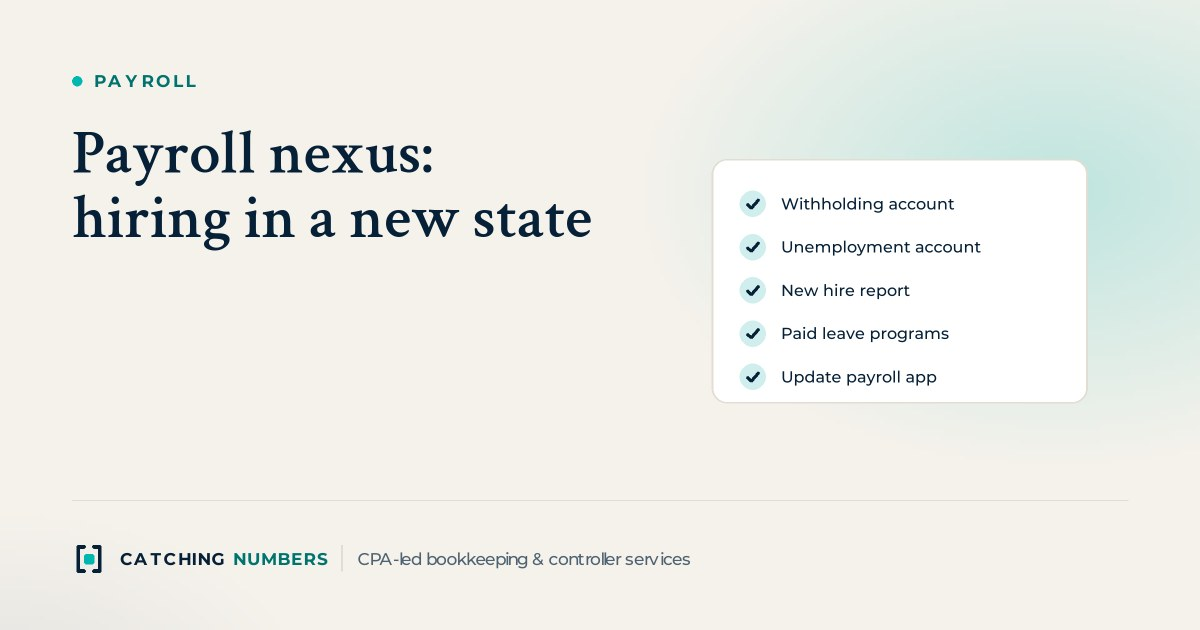
- Register for withholding with the state’s revenue department, before the first payday if you can.
- Register for unemployment insurance with the state’s labor or workforce agency, if the employee’s work is localized there.
- Check state programs and local taxes, such as disability or paid family leave programs and city or county payroll taxes.
- File the new hire report with that state’s new hire registry.
- Add the state in your payroll app, such as Gusto, QuickBooks Payroll or ADP, with the new account numbers, so it files and pays from the next pay run.
- Review the company’s income and sales tax position in that state.
Payroll apps file and pay once the state accounts exist, but registering is the employer’s responsibility. We handle these employer registrations as part of our payroll services, and our state pages cover local payroll rules for California, New York, New Jersey and Illinois.
Frequently asked questions
What if we already paid a remote employee without registering in their state?
Register now and fix it going forward, then deal with the past periods. Many states have voluntary disclosure programs that can limit penalties for employers who come forward before being contacted, so talk to your tax CPA about the earlier quarters.
Do contractors create payroll nexus?
No, there is no payroll withholding for genuine independent contractors. Their presence can still count for income tax or sales tax nexus, and a worker who is really an employee should be on payroll in their state.
Hiring in a new state? Book a free consultation and we’ll set up the registrations and payroll with you.
Sources: Illinois Department of Revenue, Publication 130; New York State, TSB-M-06(5)I; US Department of Labor, UIPL 20-04 (localization of work); California EDD, DE 231D. Checked November 25, 2026.