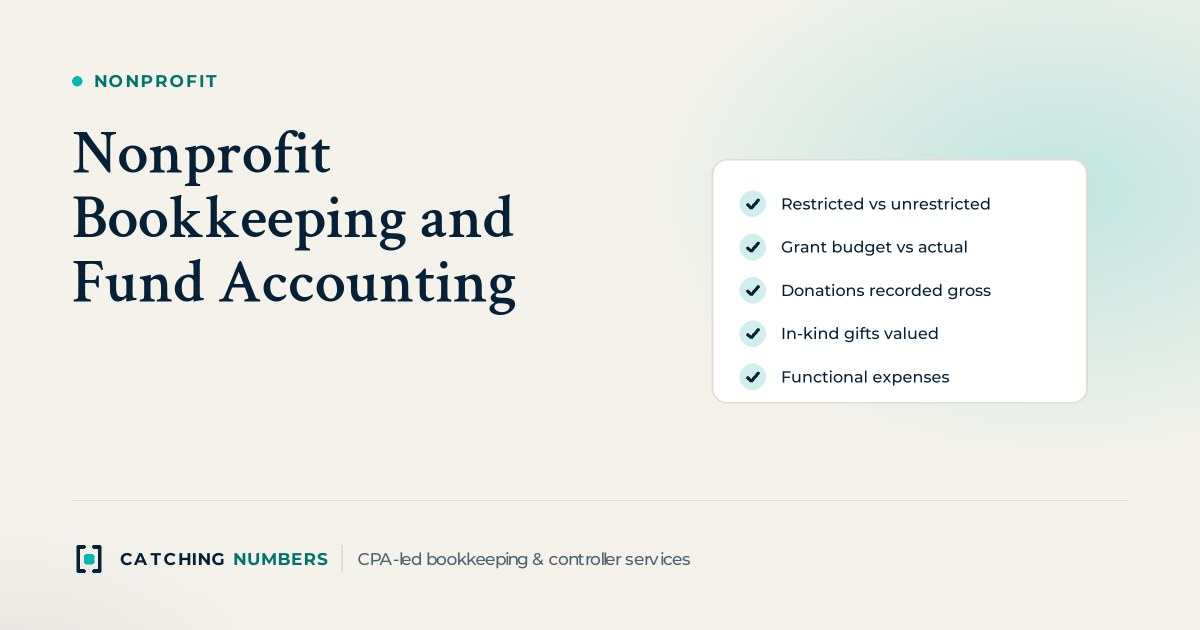
Nonprofit bookkeeping differs from business bookkeeping in one big way: you track money by its purpose, not just by its amount. Every gift and grant is either free to use for anything or restricted by the donor, and every expense has to be tied to a program, to management and general, or to fundraising. Set up fund accounting from the start, record donations at their full amount before platform fees, and close the books monthly, and your board reports, audit and Form 990 all get easier.
Key takeaways
- US nonprofits report net assets in two classes: with donor restrictions and without donor restrictions.
- Track programs, grants and restrictions with classes, tags or funds in your accounting software.
- Record online donations gross, with platform and processing fees as a separate expense.
- All nonprofits following US GAAP must analyze expenses by both nature and function.
What is fund accounting?
Fund accounting means tracking money by what it is for. A business mostly asks “how much did we earn and spend?” A nonprofit also has to answer “whose money was it, and did we use it the way they asked?” You don’t need special software for this. In QuickBooks Online, Xero and most other systems, you can use classes, tracking categories or tags for each program and grant, plus a way to mark whether a gift is restricted.
What is the difference between restricted and unrestricted funds?
Under FASB’s standard for not-for-profit financial statements (ASU 2016-14), nonprofits present two classes of net assets: net assets with donor restrictions and net assets without donor restrictions (Journal of Accountancy summary, checked October 24, 2026). A gift is restricted when the donor limits how or when it can be used, such as “for the after-school program” or “for next year.” When you spend the money as the donor specified, or the time passes, the restriction is met and the amount is released to net assets without donor restrictions.
Board-designated funds are different. If your board sets money aside for a reserve or a building, it is still unrestricted for accounting purposes, because the board can change its mind. Show it separately in your reports so the board knows it is earmarked.
How should grants be tracked?
- Give each grant its own class or tag, and load the approved budget so you can compare budget with actual spending.
- Note the grant period, reporting deadlines and any spending limits, such as caps on indirect costs.
- For reimbursable grants, prepare claims from reconciled books and keep the receipts behind each claim.
- Track federal awards separately; an organization that spends $1,000,000 or more in federal awards in a fiscal year beginning on or after October 1, 2024 generally needs a Single Audit (the threshold was $750,000 for earlier years, per the Federal Audit Clearinghouse, checked October 24, 2026).
How do you record online donations and platform fees?
Donation platforms pay you the gift minus fees, often days later and bundled with other gifts. If you record only the payout, your donation revenue is understated, your fundraising costs disappear and your totals won’t match donor receipts. Record the full gift as contribution revenue, the fees as an expense, and the payout as a transfer to your bank.
Givebutter is a good example of why this matters. According to Givebutter’s help center, when donor tips are turned on there are no platform or processing fees on online transactions; when tips are off, there is a 3% platform fee plus processing fees of 2.9% plus 30 cents for cards and 1.9% plus 30 cents for ACH for verified nonprofits (Givebutter pricing explained, checked October 24, 2026). Tips paid by donors go to the platform, not to you, so they are not your revenue.
How are in-kind donations recorded?
Donated goods, space and certain services are recorded at fair value with a documented method. Under ASU 2020-07, contributed nonfinancial assets are shown as their own line in the statement of activities, separate from cash and other financial gifts, with disclosures about how they were used and valued. Donated services are only recorded when they meet the accounting criteria, such as specialized skills you would otherwise pay for.
What is a statement of functional expenses?
It shows every expense two ways at once: by nature, such as salaries, rent and supplies, and by function, meaning each program, management and general, and fundraising. ASU 2016-14 requires all nonprofits following US GAAP to present this analysis, and Form 990 filers report functional expenses too. Shared costs such as rent and the executive director’s salary are allocated using a consistent basis, such as square footage or time records. Allocating monthly is far easier, and easier to defend, than reconstructing it once a year.
What should a nonprofit’s monthly close include?
- Reconcile bank, credit card and donation platform accounts.
- Match donations in the books to your donor database.
- Record new restricted gifts and release restrictions that were met.
- Compare each grant’s budget with actual spending.
- Allocate shared costs to programs, management and general, and fundraising.
- Send the board a statement of financial position, a statement of activities and a short cash summary.
We keep books like this for charities and foundations every month and prepare year-end schedules for their auditors and 990 preparers. See our nonprofit accounting services or pricing, and read which Form 990 your nonprofit files.
Frequently asked questions
Is nonprofit accounting different from business accounting?
Yes. The bookkeeping mechanics are the same, but nonprofits track money by purpose and restriction, report net assets instead of owner’s equity, and must analyze expenses by function. Their reports are also built for donors, funders and the board rather than owners.
Can a nonprofit use QuickBooks Online or Xero?
Yes. Both can handle fund accounting for most small and mid-sized nonprofits by using classes or tracking categories for programs and grants. Larger organizations with many restricted funds sometimes move to dedicated nonprofit or mid-market systems.
What is a restricted donation?
A gift the donor limits to a specific purpose or time period, such as a program, a project or a future year. It is reported as a net asset with donor restrictions until the restriction is met, then released to net assets without donor restrictions.
Are board-designated funds restricted?
No. Money the board sets aside for a reserve or project is still without donor restrictions, because the board can reverse its decision. Show it as board-designated in your reports so it is clearly earmarked.
Should donations be recorded net of platform fees?
No. Record the full gift as revenue and the fees as an expense. Recording only the net payout understates donations, hides fundraising costs and makes it hard to match your books to donor receipts.
Are donor tips on Givebutter our revenue?
No. Optional tips that donors add on Givebutter go to the platform to support its free model, not to your organization, so they are not part of your contribution revenue.
How do we value in-kind donations?
At fair value on the date received, using a documented method such as comparable retail prices for goods or market rent for donated space. Keep the support with the entry, because auditors will ask for it.
What are the three functional expense categories?
Program services, management and general, and fundraising. Program services are the work your mission exists for; management and general covers administration and oversight; fundraising covers the cost of raising contributions.
How should shared costs be allocated between programs?
Use a reasonable, consistent basis and document it: time records for salaries, square footage for rent and utilities, or direct usage where you can measure it. Apply it monthly so grant reports and the functional expense statement always agree.
When does a nonprofit need an audit?
A Single Audit is generally required when an organization spends $1,000,000 or more in federal awards in a fiscal year beginning on or after October 1, 2024. Separately, some states, funders and lenders require audited or reviewed financial statements at lower thresholds, so check your state’s charity registration rules and your grant agreements.
How often should a nonprofit’s board see financial statements?
Monthly or at least at every board meeting. A short package with the statement of financial position, the statement of activities, budget versus actual and a cash summary is usually enough for good oversight.
Want books your board and auditor can trust? Book a free consultation or call +1 (646) 450-8036.