A fractional CFO is a senior finance leader who works with your company part-time for a monthly fee. They look ahead: cash forecasts and runway, budgets, board and investor reporting, pricing and margin analysis, and fundraising support. They don’t keep the books or run the month-end close, but they depend on both, so the best results come when a bookkeeper and controller sit underneath the CFO.
Key takeaways
- A fractional CFO owns the forward-looking work: cash, budgets, forecasts, board reporting, fundraising and major decisions.
- A controller makes sure the numbers are right and a bookkeeper keeps them current. A forecast built on unreliable books is unreliable too.
- Our fractional CFO support runs $6,350 to $8,840 a month, including the bookkeeping, month-end close and controller review underneath it.
- Most companies bring one in before a raise, when cash is hard to predict, or when a board or lender starts asking for budgets and variance reports.
What does a fractional CFO do?
The work changes with your stage, but most of it falls into six areas:
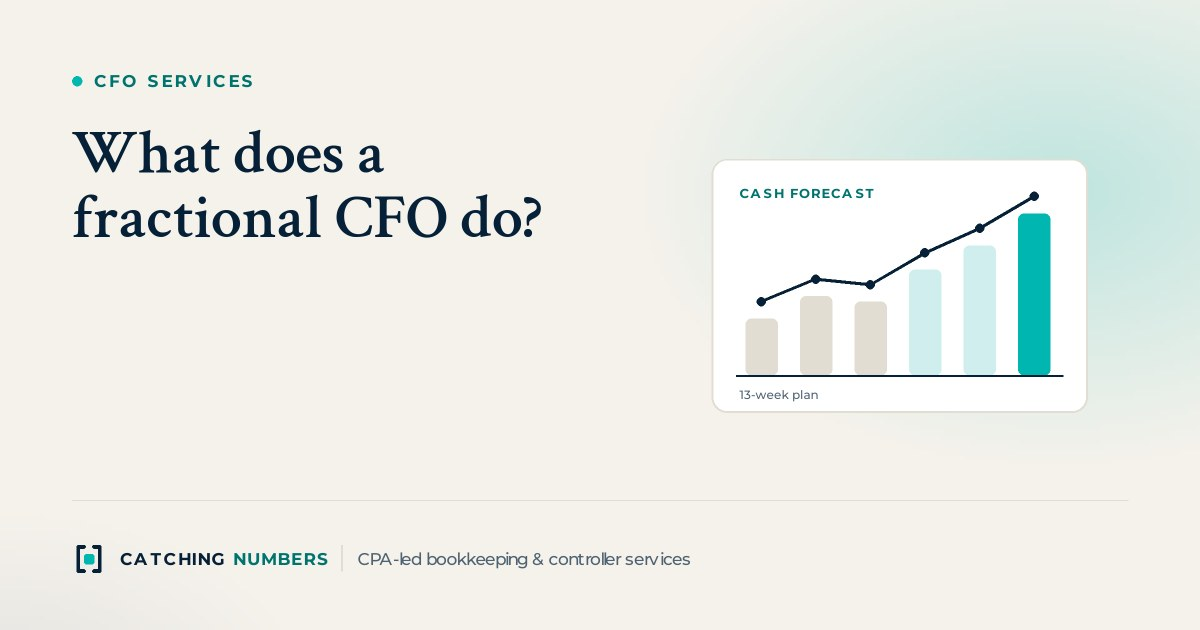
- Cash and runway. A rolling 13-week cash plan and a monthly forecast, so you know when cash gets tight before it happens.
- Budgets and models. An annual budget and a financial model you can use to test hiring plans, pricing changes and new markets.
- Board and investor reporting. A monthly or quarterly pack with KPIs, budget against actual, and plain commentary on what changed and why.
- Unit economics and margins. Gross margin, contribution margin, customer acquisition cost payback and lifetime value, by product or channel.
- Fundraising and lenders. The model, the data room and answers to investors’ diligence questions, or the reporting a bank needs for a credit line.
- Decisions. A finance view in leadership meetings on hires, pricing, spend and timing.
What doesn’t a fractional CFO do?
A CFO is not a bookkeeper. Categorizing transactions, reconciling bank and card accounts, paying bills and running payroll are bookkeeping tasks. Closing the month, booking accruals and signing off the financial statements is the controller’s job. Income tax returns are prepared by your tax CPA. If a CFO spends their hours fixing the books, you are paying senior rates for junior work, and the forecasts wait.
How is a fractional CFO different from a controller or bookkeeper?
| Role | Main question | Typical work |
|---|---|---|
| Bookkeeper | Are the books current? | Transactions, reconciliations, bills, invoices |
| Controller | Are the numbers right? | Month-end close, accruals, review, financial statements |
| Fractional CFO | What should we do next? | Cash forecasts, budgets, board reporting, fundraising |
For a fuller comparison with signs that you need each role, see bookkeeper vs controller vs fractional CFO, and for the controller role on its own, what a fractional controller does.
How much does a fractional CFO cost?
Our fractional CFO support is part of our Scale stage, which typically runs $6,350 to $8,840 a month. That includes roughly 30 to 40 hours of CFO time a month plus the bookkeeping, month-end close and controller review underneath it, so you are not paying three providers. We quote a fixed monthly fee after a free call. See pricing for all our plans.
For comparison, the US Bureau of Labor Statistics puts the median annual wage for financial managers at $166,570 in May 2025, and CFOs sit at the top of that group. A full-time CFO also brings benefits, a bonus and usually equity, for a role many growing companies only need part of the time.
When should you hire a fractional CFO?
- You are planning a raise and need a model investors will take seriously.
- Cash is tight or hard to predict, and you want your runway month by month. Our cash runway calculator gives a first estimate.
- A board, investor or lender now expects a budget and variance reporting.
- Revenue is growing but profit isn’t, and you need to know where margin is going.
- You are weighing a big decision: a senior hire, a new location, a new market or an acquisition.
If your monthly numbers are late or often wrong, start with a controller instead. Once the close is reliable, CFO work has something solid to build on.
What happens in the first month?
- Get the books current and closed. We connect to your systems and close the most recent month, because every forecast starts there.
- Agree the KPIs. We pick the handful of numbers that matter for your business and your board.
- Build a baseline cash forecast. By the end of the first month you have a cash forecast and a list of the decisions and reports we will tackle next.
Frequently asked questions
Is a fractional CFO worth it for a small business?
It is worth it when a decision or a deadline depends on forward-looking numbers: a raise, a loan, a major hire or a cash squeeze. If you mainly need accurate monthly statements, a bookkeeper and controller will do more for you at a lower cost.
What is the difference between a fractional CFO and a part-time CFO?
The terms are used interchangeably. Both mean senior finance leadership on a part-time basis; “fractional” usually means the CFO works with several companies on an ongoing share of their time.
Does a fractional CFO attend board meetings?
Usually, yes. Preparing the board pack and joining board or investor calls is a normal part of the role and comes out of the monthly CFO hours.
Want to see whether you need a CFO yet? See our fractional CFO services or book a free consultation.
Sources: US Bureau of Labor Statistics, Occupational Outlook Handbook: Financial Managers (median pay, May 2025). Checked November 25, 2026.