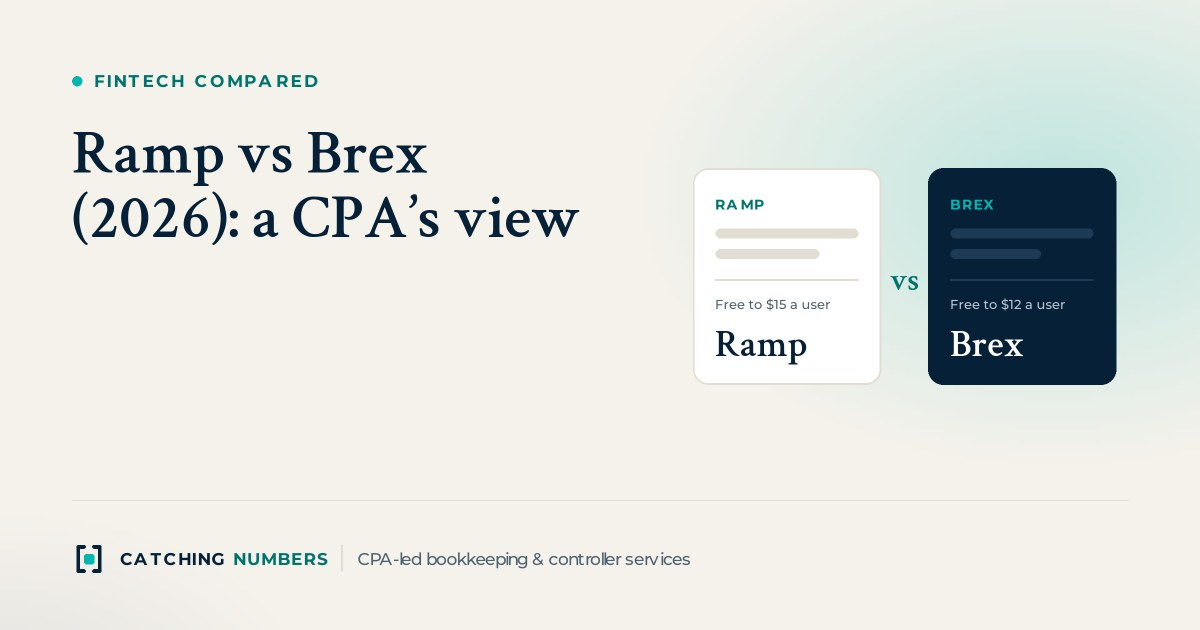
Ramp is usually the better fit for a US company that wants spend control and bill pay tightly synced to QuickBooks Online or Xero, and that keeps at least $25,000 in a business bank account. Brex is usually the better fit for a venture-backed startup that wants its card, business account and treasury in one place, needs NetSuite on a free plan, or operates in several countries. Since Capital One completed its $5.15 billion purchase of Brex on April 7, 2026, Brex also has a large bank behind it, though neither company has announced changes to existing customer accounts. Both offer a $0 plan, so the deciding factors are your accounting system, your entity setup and where you want your cash to sit.
Key takeaways
- Both have a free tier: Ramp Free at $0 per user and Brex Essentials at $0 per user. Paid tiers are Ramp Plus at $15 per user per month plus a platform fee, and Brex Premium at $12 per user per month.
- On the free tiers, Ramp connects to QuickBooks Online and Xero; Brex Essentials adds NetSuite and Sage Intacct as well.
- Ramp requires at least $25,000 in a US business bank account to apply. Neither company accepts sole proprietors.
- Brex is now owned by Capital One, with Brex CEO Pedro Franceschi staying on to run it. No changes to customer accounts have been announced.
- For your books, the bigger question is sync quality: how cleanly cards, receipts, bills and reimbursements land in your ledger before month-end close.
What changed at Brex after Capital One bought it?
Capital One completed its acquisition of Brex on April 7, 2026, in a stock and cash deal valued at $5.15 billion. Capital One says Pedro Franceschi continues as CEO of Brex, and its CEO Richard Fairbank pointed to Brex’s combination of corporate cards, spend management software and banking as the reason for the deal.
What has not changed, at least publicly: Brex’s own announcement does not describe any change to existing products, accounts, cards or integrations, and Brex’s pricing page still lists its Essentials, Premium, Enterprise and Smart Card plans. If you are on Brex today, we would keep using it, watch your email for any updated account agreements, and re-read the terms if your business account or card program moves to a new bank partner.
How do Ramp and Brex compare on price, features and integrations?
Here is how the two line up, based on each company’s own pricing, product and help pages, checked on October 7, 2026.
| Ramp | Brex | |
|---|---|---|
| Free plan | Ramp Free, $0 per user per month | Brex Essentials, $0 per user per month |
| Paid plan | Ramp Plus, $15 per user per month plus a platform fee based on team size (20% off with an annual commitment); Enterprise is custom | Brex Premium, $12 per user per month; Enterprise and Smart Card are custom |
| Bill pay | All plans; free wires and same-day ACH via Bill Pay; pay by ACH, card, check or wire | Available; Brex publishes a separate fee schedule for business account and bill pay |
| QuickBooks Online and Xero | Included on Free and Plus | Included on Essentials and above |
| NetSuite and Sage Intacct | Plus and Enterprise | Included on Essentials |
| Entities | Multi-entity setups supported through its ERP integrations | Essentials: up to two entities; Premium: multi-entity, US and international; Enterprise: unlimited |
| Business account and FDIC structure | Checking at First Internet Bank of Indiana (Member FDIC), with coverage extended through IntraFi’s ICS network; separate investment account is not FDIC insured (SIPC through Apex Clearing) | Checking at Column N.A. (Member FDIC); up to $6 million FDIC coverage by spreading deposits across program banks; Treasury option invests in a government money market fund through Brex Treasury LLC (not FDIC insured) |
| Posted yield (variable) | 2% APY on checking; investment account up to 4.61%, net of a 0.15% advisory fee, $5,000 minimum | Up to 4.36% APY, tiered by balance, no minimum |
| Who can apply | US-registered corporations, LLCs and LPs with an EIN and at least $25,000 in a US business bank account; no sole proprietors | US-registered C corps, S corps, LLCs and LLPs with an EIN; no sole proprietors |
| Ownership | Independent fintech; cards issued by partner banks | Owned by Capital One since April 7, 2026 |
| Best suited to | US companies on QuickBooks Online or Xero that want spend, AP and accounting sync in one tool | Startups wanting card, banking and treasury together, or companies needing NetSuite or several entities on a free plan |
Two cautions on the cash side. First, a money market fund or investment account is not a bank deposit: it is not FDIC insured, it can lose value, and SIPC coverage only protects you if the broker fails. Second, extended FDIC coverage through sweep networks depends on how the provider and its partner banks place your money, so read the account agreement rather than relying on the headline number. Before moving operating cash into a yield product, check how many months of spending you need on hand with our cash runway calculator.
What do Ramp and Brex mean for your books and month-end close?
As bookkeepers and controllers, we care less about card perks and more about whether the data arrives in the ledger complete, coded and easy to reconcile. Here is what each provider says its integration does.
Sync quality
Ramp says its QuickBooks Online integration syncs accounting fields, card transactions, reimbursements, payments, cashback, purchase orders, vendor bills, bill payments and credits, and that the sync runs in both directions. Brex’s QuickBooks Online integration sends expenses, receipts and memos, plus business account transactions, and Brex also documents bill syncing. Brex notes two limits worth knowing: one Brex account per QuickBooks Online company, and bank-feed transactions older than 90 days will not sync.
Both companies offer a direct integration and a simpler bank-feed style connection. We recommend the direct integration on either platform, because it lets you code transactions before they hit the ledger instead of categorizing them twice.
Receipts and categorization
Both platforms collect receipts and memos from cardholders and push them with the transaction, which is what an auditor or tax CPA will ask for later. Ramp says it suggests categories based on transaction details, history and your team’s feedback. Brex describes AI-powered rules on its Essentials plan. Either way, a human should review the coding rules at least quarterly, because a rule that maps every Amazon charge to office supplies will quietly misstate inventory or software costs.
Bill pay approvals
Ramp includes bill pay on all plans. On Brex, custom expense policies and dynamic approval chains sit on Premium. If you need multi-step approvals on vendor bills for internal control reasons, price out the plan that actually includes them, not just the free tier.
Reconciliation
- Treat the card as a liability account. Reconcile the Ramp or Brex card balance to the statement each month, the same way you would a bank account.
- Match repayments, not just purchases. Each payment from your bank account to Ramp or Brex should clear against the card liability, not land as an expense.
- Book cashback consistently. Pick one treatment (other income or a reduction of expense) and keep it.
- Separate deposits from investments. If you use a treasury or investment account, record it as its own asset account and book interest or fund income monthly from the statement.
These are the same checks we run in every client’s monthly close. If card, bill pay and bank data reach your ledger but nobody reconciles them by a fixed date each month, see what our month-end close services include.
When should you choose Ramp, and when Brex?
Choose Ramp if you run on QuickBooks Online or Xero, you have at least $25,000 in a US business bank account, and the main goal is controlling spend and automating accounts payable without paying per seat. Ramp’s free plan covers cards, bill pay and both of those accounting systems, which covers what many ecommerce brands and early SaaS companies need.
Choose Brex if you want one provider for your card, operating account and treasury, you are on NetSuite or Sage Intacct and want to stay on a free plan, or you have two or more entities, including international ones. The Capital One ownership may also appeal to founders who prefer a large bank parent, though it is too early to know how the products will evolve.
Use both if you have a reason to: some companies bank in one place and run cards and AP in another. That works fine for the books as long as each account has its own ledger account and is reconciled every month. If you are an early-stage SaaS company, the simplest setup is usually the best one.
How we compared
All pricing, features, eligibility rules, bank partners and yields in this article come from each provider’s own public pages, checked on October 7, 2026: Ramp pricing, Ramp Banking, Ramp integrations, Ramp eligibility, Brex pricing, Brex business account, Brex ERP integrations and Brex eligibility. Acquisition details come from Capital One’s newsroom. We did not rate either product, we have no affiliate relationship with either company, and prices and yields can change at any time, so confirm them before you sign up.
Frequently asked questions
Is Brex still safe to use after the Capital One acquisition?
Brex continues to operate under its own name with the same CEO, and neither Capital One nor Brex has announced changes to customer accounts. Deposit protection depends on the partner banks named in your account terms, so check those documents if Brex notifies you of any change.
Can a sole proprietor use Ramp or Brex?
No. Both require a US-registered entity, such as a corporation or LLC, with an EIN. Ramp also requires at least $25,000 in a US business bank account linked to the application.
Do Ramp and Brex work with Xero?
Yes. Ramp includes Xero on its Free and Plus plans, and Brex includes Xero on Essentials and above. Both also connect to QuickBooks Online on their free plans.
Is money in a Ramp or Brex treasury account FDIC insured?
Not the investment portion. Ramp’s investment account and Brex Treasury hold securities or money market fund shares, which are not FDIC insured and can lose value; SIPC covers you only if the broker fails. Their checking and business accounts are held at FDIC-member partner banks.
Whichever card you pick, the payoff only shows up if the books are set up to use it. Our outsourced bookkeeping team connects Ramp or Brex to QuickBooks Online or Xero, builds the coding rules, and reconciles every card and account each month, and our controller service adds approval workflows and a documented close.
Want Ramp or Brex set up right the first time?
Book a free consultation. We will look at your accounting system, entities and close process and tell you how either platform should plug in.