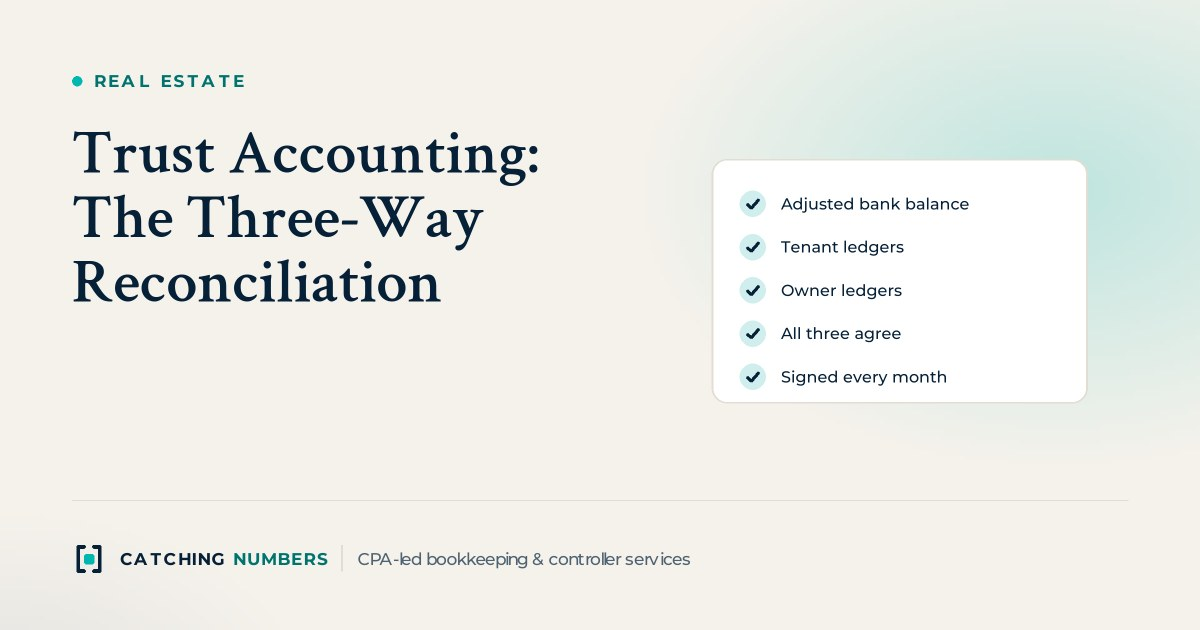
Trust accounting is how a property manager keeps money that belongs to owners and tenants, such as rent collected and security deposits, separate from the company’s own money, and proves it every month. The proof is the three-way reconciliation: the trust account’s adjusted bank balance must equal the total of your tenant ledgers and the total of your owner ledgers. If the three numbers agree, the money is where it should be. If they don’t, something was recorded wrong, mixed or used for the wrong client.
Key takeaways
- Owner and tenant funds belong in a trust account, never mixed with your management company’s operating money.
- A three-way reconciliation matches the adjusted bank balance, tenant ledgers and owner ledgers every month.
- An overfunded trust account can signal commingling; an underfunded one can signal that client money was used for something else.
- Rules differ by state, so check your state’s real estate regulator for deadlines, record keeping and how long to keep records.
What is trust accounting in property management?
When you manage property for owners, you collect money that isn’t yours: rent, security deposits, prepaid rent and reserves the owner leaves with you for repairs. Most states treat that money as held in trust. It has to sit in a separate trust (or escrow) account, it can only be paid out for the owner’s or tenant’s benefit, and your records have to show exactly whose money is in the account at any moment.
Your management company still has its own operating account for its fees, payroll and overhead. Your management fee moves from the trust account to the operating account only once it is earned and recorded on the owner’s ledger.
What is a three-way reconciliation?
A normal bank reconciliation compares two things: the bank statement and your books. A three-way reconciliation adds a third check, the individual ledgers that show whose money it is. Each month you prove that:
- Adjusted bank balance. Take the trust account’s ending bank statement balance, add deposits in transit and subtract outstanding checks and withdrawals.
- Trust ledger (book) balance. The trust account’s balance in your accounting or property management software for the same date.
- Sum of client ledgers. The total of every owner ledger plus every tenant ledger, including security deposits held, plus any funds the broker is allowed to keep in the account.
All three must agree. Arizona’s Department of Real Estate, for example, puts it as a formula: adjusted bank balance equals owner funds plus tenant funds plus broker funds, and it requires brokers to reconcile monthly (Arizona Department of Real Estate, Trust Funds Quick Guide, checked October 24, 2026). Other states have their own versions of the rule.
How do you do a three-way reconciliation, step by step?
- Download the trust account’s bank statement for the month and record every deposit and payment in your system first.
- Reconcile the bank account the normal way and list deposits in transit and outstanding checks.
- Run a report of every owner ledger balance and every tenant ledger balance, including security deposits, as of the same date.
- Add the owner and tenant totals, plus any broker funds the rules allow, and compare with the adjusted bank balance and the book balance.
- Investigate any difference before you pay owners, and clear old outstanding items rather than carrying them forward.
- Have the reconciliation reviewed and signed, and keep it with the bank statement and ledger reports.
Property management platforms such as Buildium and AppFolio keep owner and tenant ledgers and produce reconciliation reports, which makes the monthly check much faster. The software only helps if every transaction is recorded correctly, so the review still matters.
What do differences in a trust reconciliation mean?
Arizona’s guide gives a useful rule of thumb. If the bank holds more than the ledgers say (overfunding), it can mean the company’s own money has been mixed in, which is commingling. If the bank holds less than the ledgers say (underfunding), it can mean one client’s money was used for another client or for the company, which is conversion. A negative owner balance is a warning sign too: it means that owner’s bills were paid with someone else’s money.
Most differences are innocent: a deposit recorded to the wrong owner, a bank fee charged to the trust account, a check voided in the bank but not in the software. They still need fixing the same month, because small errors compound quickly across dozens of owners.
How should security deposits be handled?
Security deposits are money owed back to tenants, so in the books they are a liability, tracked tenant by tenant. Some states require deposits to be held in a separate account or to earn interest for the tenant, so check your state’s landlord-tenant law. For owners’ taxes, the IRS says a refundable security deposit isn’t income when it is received; any part the owner keeps, for example because a tenant breaks the lease, becomes income in the year it is kept (IRS Publication 527, checked October 24, 2026).
What are the most common trust accounting mistakes?
- Paying company expenses, or your management fee before it is earned, from the trust account.
- Letting an owner’s ledger go negative to cover a repair before the owner funds it.
- Recording security deposits as rent or as the owner’s income.
- Reconciling only the bank to the books and skipping the ledger totals.
- Carrying stale outstanding checks and unexplained differences month after month.
- Sending owner statements and distributions before the month is reconciled.
What should you do next?
Pick a fixed day each month to finish the three-way reconciliation, and don’t release owner distributions until it balances. If you are months behind or the numbers have never tied out, start with the most recent month that balances and work forward. Our real estate accounting team does monthly trust reconciliations in Buildium, AppFolio and other systems, and our cleanup and catch-up service can bring old months current for a fixed fee.
Frequently asked questions
What is a trust account in property management?
It is a bank account that holds money belonging to owners and tenants, such as rent collected and security deposits, separate from the management company’s own money. The company acts as a fiduciary: it can only use the funds for the owners’ and tenants’ benefit and must keep records showing whose money is in the account.
How often should a property manager reconcile the trust account?
At least monthly. Many state regulators require a monthly reconciliation, and Arizona’s rules are one example. Reconciling before owner statements go out each month catches errors before money leaves the account.
What is the difference between a two-way and a three-way reconciliation?
A two-way reconciliation matches the bank statement with your books. A three-way reconciliation also matches both to the total of the individual owner and tenant ledgers, which proves not just how much money is in the account but whose money it is.
What is commingling?
Commingling means mixing your company’s own money with client money in the trust account, or holding client money in your operating account. Regulators treat it as a serious violation even when no one loses money.
Can a property manager pay its management fee from the trust account?
Yes, once the fee is earned and charged to the owner’s ledger under the management agreement. The fee is then transferred to the company’s operating account. Paying it before it is earned, or paying other company costs from trust, is a common problem.
What does a negative owner ledger mean?
It means more was paid out for that owner than the owner has in the account, so the difference was covered by other clients’ money. Ask the owner to fund repairs in advance or hold a reserve so ledgers never go negative.
Are security deposits income for the property owner?
Not when they are received if the owner plans to return them, according to IRS Publication 527. Any part the owner keeps, for example for damage or a broken lease, becomes income in the year it is kept. Until then the deposit is a liability in the books.
Does Buildium or AppFolio do the three-way reconciliation for me?
Both keep owner and tenant ledgers and help you prepare the reconciliation, which saves a lot of time. They rely on every transaction being entered correctly, so someone still needs to review the result, investigate differences and sign off each month.
How long should trust account records be kept?
It depends on your state’s real estate rules, which set a minimum retention period for bank statements, ledgers and reconciliations. Check your state regulator’s guidance and keep the monthly reconciliation package together so it is easy to produce in a review.
What should I do if my trust account hasn’t balanced for months?
Find the last month that balanced, then reconcile forward one month at a time, correcting misposted deposits, voided checks and fees as you go. If the gap can’t be explained, talk to your broker of record and your attorney about your state’s reporting rules before you make adjustments.
Can you outsource trust accounting?
Yes. Many property managers outsource the monthly reconciliation and owner statement review to an accounting firm while keeping control of the bank accounts. The licensed broker generally stays responsible under state rules, so the outsourced work should come with clear monthly sign-offs.
Want your trust accounts to tie out every month? Book a free consultation or call +1 (646) 450-8036.