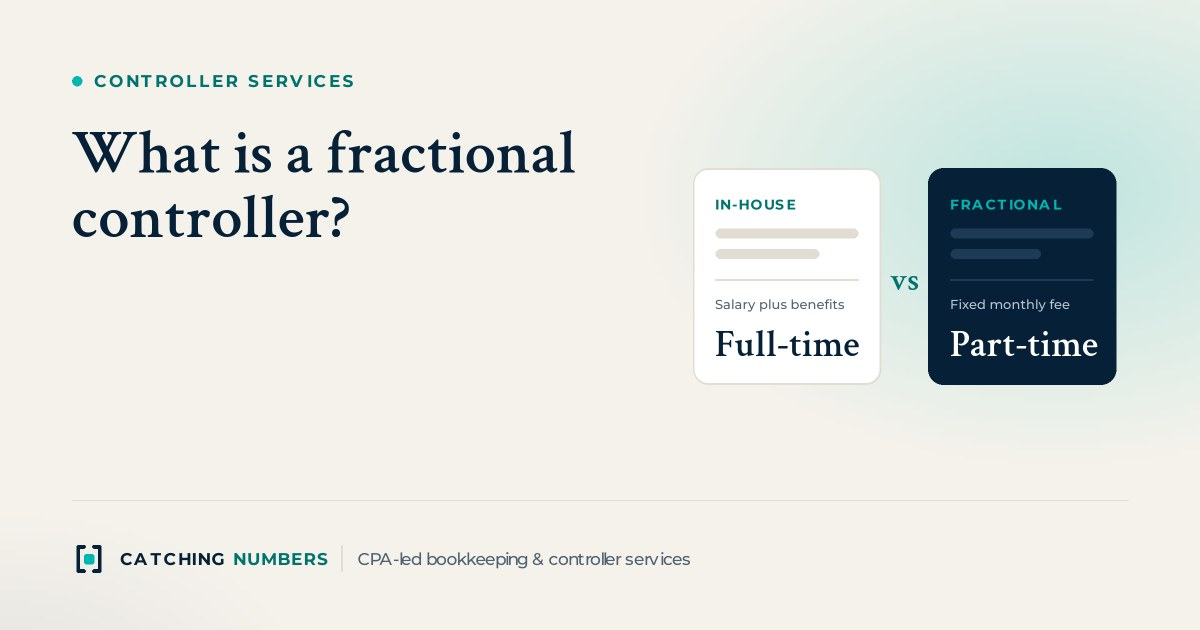
A fractional controller is an experienced accountant who oversees your company’s accounting part-time. They own the month-end close, review the books your bookkeeper produces, handle accruals and revenue recognition, and deliver financial statements you can rely on, without the cost of a full-time hire. Most growing companies bring one in when the books need to be accurate enough for investors, lenders or an audit, but there isn’t enough work for a full-time controller.
Key takeaways
- A fractional (or outsourced) controller does the same job as an in-house controller, for a set number of hours or a fixed monthly scope.
- The core of the role is a reliable monthly close: reconciliations, accruals, revenue recognition and a review before statements go out.
- A bookkeeper records transactions, a controller makes sure the numbers are right, and a CFO uses them to plan ahead.
- The usual triggers are fundraising, a lender or audit request, deferred revenue or inventory, and a founder who no longer trusts the monthly numbers.
What does a fractional controller do?
A controller is responsible for the accuracy of your financial statements. The U.S. Bureau of Labor Statistics describes controllers as the people who direct the preparation of financial reports that summarize and forecast an organization’s financial position. A fractional controller brings that responsibility to a smaller company. In practice the work usually covers:
- Running the month-end close on a set calendar, and signing off before reports are released
- Balance sheet reconciliations for cash, receivables, payables, prepaids, accruals and debt, with supporting schedules
- Accruals and cutoff so expenses and revenue land in the month they belong to
- Revenue recognition under ASC 606, including deferred and unbilled revenue schedules for subscription and contract businesses
- Inventory and cost of goods sold for product companies, so gross margin is real
- Monthly reporting: financial statements, a variance review and the key metrics your board or investors ask for
- Internal controls: approval rules for bills and payments, separation of duties, and a clean audit trail
- Audit, tax and due diligence support: preparing schedules for auditors, your tax CPA or an investor’s diligence team
Is a fractional controller the same as an outsourced controller?
The terms are used interchangeably. “Fractional” stresses that you buy a fraction of a controller’s time. “Outsourced” stresses that the controller works for a firm rather than on your payroll. Firms that offer outsourced controller services usually pair the controller with a bookkeeping team, so the person reviewing the books is not also the only person recording them.
Bookkeeper vs. controller vs. CFO: what’s the difference?
Each role builds on the one before it. A company can have all three, but most growing companies add them in this order.
| Bookkeeper | Controller | CFO | |
|---|---|---|---|
| Main question | Is every transaction recorded? | Are the numbers right? | What should we do next? |
| Typical work | Categorizing transactions, bank and card reconciliations, bills and invoices | Close review, accruals, revenue recognition, reconciliations, financial statements, controls | Budgets, cash forecasts, pricing, fundraising, board strategy |
| Looks at | The current month’s activity | The month just closed | The next 12 to 24 months |
| Our monthly fee (fixed) | From $199 | $2,440 to $3,750, including bookkeeping | $6,350 to $8,840, including the close |
How much does a fractional controller cost?
Fractional controllers are usually billed either by the hour or as a fixed monthly fee for a defined scope. At Catching Numbers, controller packages are fixed at $2,440 to $3,750 a month, and that includes the bookkeeping underneath. That is about $29,000 to $45,000 a year.
For comparison, the Bureau of Labor Statistics reports that the median annual wage for financial managers, the occupation that includes controllers, was $166,570 in May 2025. That figure is salary alone, before payroll taxes, benefits, recruiting and the bookkeeping staff a controller would still need to supervise.
What drives the price of a fractional controller:
- Transaction volume and the number of bank accounts, cards, entities and sales channels
- Revenue model: annual contracts, usage-based billing or inventory add schedules to every close
- Reporting needs: a board pack, lender covenants or GAAP statements for an audit take more review
- Close speed: closing in five business days takes more resources than closing in fifteen
- Starting point: books that are behind or messy need a one-time cleanup before the monthly work begins
When should you hire a fractional controller?
These are the situations where we most often see companies move from bookkeeping alone to controller-level support:
- You’re raising money or borrowing. Investors and lenders expect accrual-basis statements that tie out, and they will ask for supporting schedules.
- An audit or review is coming. An auditor will test your cutoff, accruals and revenue recognition. Fixing them during the audit costs far more than getting them right monthly.
- You have deferred revenue or inventory. SaaS contracts billed annually and ecommerce inventory both need monthly schedules that a bookkeeper alone usually doesn’t maintain.
- The close takes weeks, or never really ends. If numbers keep changing after you’ve looked at them, nobody owns the close.
- The founder is still the final reviewer. When the CEO is the one spotting errors in the P&L, it is time to hand that review to an accountant.
- You’re expanding into new states or entities. Multi-state sales tax, payroll and intercompany activity add reconciliation work every month. Our sales tax nexus checker shows where your sales may already require registration.
How does working with a fractional controller work?
A good engagement starts with a review of your current books and a cleanup of anything that is off, then moves to a monthly rhythm: the bookkeeping team records and reconciles, the controller reviews and posts adjusting entries, and you receive financial statements with commentary on a fixed date each month. Most of the work happens in your QuickBooks Online or Xero file, with a regular call to walk through the results. You can see how this looks with us on how we work.
A fractional controller doesn’t replace your tax CPA. The controller keeps the books tax-ready and hands your tax preparer clean, reconciled numbers at year end.
Frequently asked questions
Do small businesses need a fractional controller?
Not always. A small business with simple cash-basis books may only need a good bookkeeper. A controller becomes worth it when you need accrual-basis statements that outsiders will rely on, or when revenue recognition, inventory or multiple entities make the close too complex for bookkeeping alone.
How many hours does a fractional controller work?
It depends on your volume and how fast you need the close. Many firms, including ours, price by monthly scope rather than hours, so you know the cost in advance and aren’t billed more when a month is busy.
Can a fractional controller work with our in-house bookkeeper?
Yes. A controller can review and coach an in-house bookkeeper, own the adjusting entries and the close checklist, and leave day-to-day transaction work with your team.
When should we move from a fractional controller to a full-time one?
Usually when the work fills most of a full-time week every month: several entities, a large finance team to manage, or public-company style reporting. Until then, a fractional controller typically costs a fraction of a full-time salary.
Get controller-level numbers every month
Our CPA-led team runs your close and reviews every set of statements, for a fixed monthly fee. Book a free consultation to see whether it fits.
Source: U.S. Bureau of Labor Statistics, Occupational Outlook Handbook: Financial Managers (checked October 14, 2026).