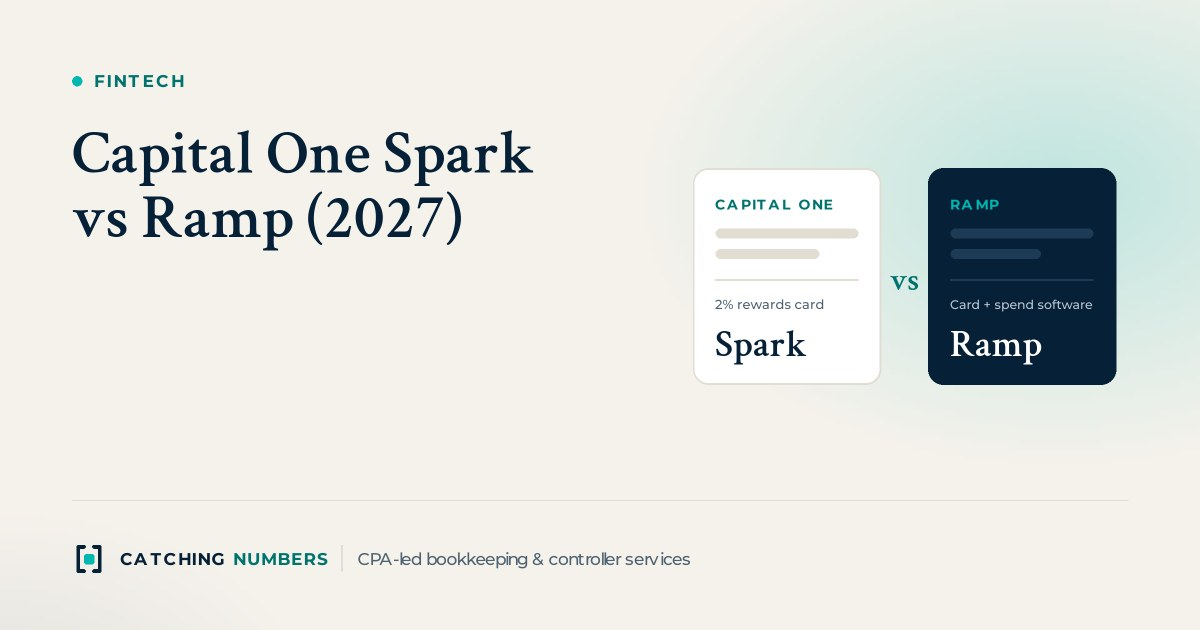
Capital One’s Spark cards are rewards cards from a bank: Spark Cash Plus pays 2% cash back on every purchase for a $150 annual fee, and Spark Cash Select pays 1.5% with no annual fee. Ramp is a free corporate card bundled with spend management software: unlimited employee cards, bill pay, approval rules and a direct sync with QuickBooks Online and Xero, but it requires at least $25,000 in a US business bank account and does not publish a cashback rate on its pricing page. Choose Spark if rewards and simplicity matter most and only a few people spend; choose Ramp if you want spending coded and synced to your books before month-end close. Capital One does not sell accounting software, though it now owns Brex and plans to bring Brex’s spend management tools to its small business card customers over time.
Key takeaways
- Spark Cash Plus: $150 a year, refunded in any year you spend $150,000 by your account anniversary, 2% cash back and no preset spending limit.
- Spark Cash Select: no annual fee and 1.5% cash back, on a revolving credit card with a variable APR.
- Ramp Free: $0 per user, unlimited cards, bill pay and a direct QuickBooks Online and Xero sync. NetSuite, Sage Intacct and Acumatica need Ramp Plus.
- Capital One card transactions reach QuickBooks through an online banking link or a download, and you categorize them in QuickBooks. Ramp codes them before they reach the ledger.
- Capital One completed its purchase of Brex on April 7, 2026, but has not yet announced changes for Spark cardholders.
Does Capital One have accounting software for small businesses?
No. Capital One does not sell a general ledger or bookkeeping software. What its small business cards come with is a set of tools around the card:
- Accounts payable: pay vendors by card, ACH or check from your Capital One account. Capital One notes that certain payment types carry a fee.
- Expense Management: add receipts and notes and monitor spending. Capital One lists it for Venture X Business, Spark Cash Plus, Spark 2% Cash and Venture Business.
- Spend controls: free employee cards, custom limits for authorized users and account managers, card lock and virtual card numbers.
- Accounting connections: download purchase records in QuickBooks, Quicken or Excel formats, or link the card to QuickBooks through online banking.
Your books still live in QuickBooks Online, Xero or another ledger. Capital One’s own QuickBooks guide has you review the imported card transactions and assign each one to an account in QuickBooks, so categorization happens at the ledger, after the spending.
What does Capital One owning Brex mean for Spark customers?
Nothing yet, but probably more software over time. Capital One completed its $5.15 billion purchase of Brex on April 7, 2026. On Capital One’s October 20, 2026 earnings call, CEO Richard Fairbank said Capital One can, over time, use Brex’s spend management tools to broaden what it offers small business card customers, and that this will need more technology and data integration. He also said Capital One will connect Brex’s spend management platform to its travel portal, probably next year, and integrate Brex’s banking services with its own.
No product changes for Spark cardholders or Brex customers have been announced. If you are choosing a card today, compare the products as they exist now, not a roadmap. Our Ramp vs Brex comparison covers Brex itself, plan by plan.
How do Capital One Spark cards compare with the Ramp card?
Here is how the three Capital One business cards people most often compare with Ramp line up, based on each provider’s own pages, checked on November 9, 2026.
| Spark Cash Plus | Spark Cash Select | Venture X Business | Ramp (Free plan) | |
|---|---|---|---|---|
| Fee | $150 a year, refunded as a statement credit if you spend $150,000 in net purchases by your anniversary | $0 | $395 a year | $0 per user per month; Ramp Plus is $15 per user per month plus a platform fee |
| Rewards | 2% cash back on every purchase; 5% on hotels, vacation rentals and rental cars booked through Capital One Business Travel | 1.5% cash back on every purchase; 5% on hotels and rental cars booked through Capital One Business Travel | 2X miles on every purchase; 10X on hotels and rental cars and 5X on flights and vacation rentals booked through Capital One Business Travel; $300 yearly credit for that portal; 10,000 anniversary miles | Cashback on card spend; no rate published on Ramp’s pricing page |
| Credit and limits | No preset spending limit; designed to be paid in full | Credit card; 0% intro APR for 9 months, then 16.99% to 26.99% variable | No preset spending limit; designed to be paid in full | Limit set as a percentage of cash in your linked bank accounts, or on revenue |
| Employee cards | Free | Free | Free | Unlimited virtual and physical cards at no extra cost |
| Bill pay and expenses | Capital One accounts payable; Expense Management for receipts and notes | Capital One accounts payable | Capital One accounts payable; Expense Management for receipts and notes | Bill pay by ACH, card, check or wire on the free plan |
| Accounting | Online banking link to QuickBooks, or downloads in QuickBooks, Quicken or Excel formats | Same as Spark Cash Plus | Same as Spark Cash Plus | Direct sync with QuickBooks Online and Xero; NetSuite, Sage Intacct, Acumatica and Business Central on Ramp Plus |
Is Spark Cash Plus or the Ramp card better for a growing company?
It depends on whether you are optimizing for rewards or for controls. Spark Cash Plus pays a flat 2% on everything, and the $150 fee comes back in any year you spend at least $150,000. A company spending $40,000 a month earns $9,600 a year in cash back at 2%, and gets the fee refunded. Ramp’s help center illustrates its cashback with a $1,000 purchase earning $15, which is 1.5%, but Ramp does not publish a rate on its pricing page, so confirm the rate in your own agreement before you compare totals.
What Ramp adds is the software around the card: a card for each employee with its own limit, approval rules, bill pay and coding that syncs to QuickBooks Online or Xero before the close. Spark cards come with free employee cards, custom limits and Expense Management, but categorization for the books still happens in QuickBooks after the transactions import. For a founder-led company with a few cardholders, a flat 2% card is hard to beat on simplicity. Once more than a handful of people are spending, we would weigh the hours saved at month-end ahead of half a point of rewards.
Which card fits a company with about 60 employees?
At that size, controls and close time matter more than the rewards rate. Ask three questions of any card:
- Can every spender have their own card, limit and policy? All three providers offer employee cards; check how limits and approvals are set and who can change them.
- Do receipts and coding arrive with the transaction? If they do, your bookkeeper reviews instead of chasing.
- Does the card reconcile to the ledger without re-coding? Hundreds of transactions a month categorized by hand in QuickBooks is where a close slows down.
Ramp is built around cards, policies and a two-way ledger sync. Spark gives you free employee cards and custom limits, with coding done in QuickBooks. Brex is the third option, for companies that want a card, business account and treasury in one place.
How does each card land in QuickBooks or Xero?
Capital One. Capital One’s QuickBooks guide links the card through online banking, so cleared transactions arrive in the For Review list, where you assign each one to an account. You can also download records in QuickBooks, Quicken or Excel formats. Capital One’s card pages do not mention Xero.
Ramp. The free plan connects directly to QuickBooks Online and Xero, and Ramp Plus adds NetSuite, Sage Intacct, Acumatica and Microsoft Dynamics 365 Business Central. Ramp says its QuickBooks Online integration syncs in both directions, including card transactions, reimbursements, bills, payments and cashback.
Whichever you choose, the month-end checks are the same: treat the card as a liability account and reconcile it to the statement, match each repayment against the card balance rather than booking it as an expense, and book cash back or miles the same way every month. If nobody owns those steps by a fixed date, see what our month-end close services include.
Which should you choose?
- Spark Cash Plus if a few people spend, you pay in full every month and you want a flat 2% with little setup.
- Spark Cash Select if you want no annual fee and accept a lower rate, keeping in mind that any balance you carry costs interest.
- Venture X Business if much of your spending is travel booked through Capital One Business Travel and you will use the $300 credit.
- Ramp if you have a team of spenders, pay vendors by ACH or check, and want transactions coded and synced before the close.
- Both if you have a reason to, such as a travel rewards card for the founders and Ramp for team spend and bills. That works as long as each card has its own liability account and is reconciled every month.
Comparing more providers? Our guide to the best corporate cards covers Amex, Brex, BILL Divvy, Mercury and others.
How we compared
Card fees, rewards, limits and tools come from Capital One’s pages for Spark Cash Plus, Spark Cash Select and Venture X Business, and its small business cards page. Ramp details come from Ramp pricing and the Ramp Help Center articles on eligibility and cashback. All were checked on November 9, 2026. Brex details come from Capital One’s newsroom and its October 20, 2026 earnings call. We did not rate either provider, and we have no affiliate relationship with Capital One, Ramp or Brex.
Frequently asked questions
Is Spark Cash Plus a charge card?
Yes. Capital One describes it as a charge card designed to be paid in full each month, with no preset spending limit. That does not mean unlimited spending: the limit adjusts with your spending, payment history and credit profile.
Do Capital One business cards affect your personal credit?
It depends on the card. Capital One says that for Spark Cash Plus, Venture X Business and Venture Business, only the hard inquiry from your application may appear on your personal credit report while the account is in good standing. Spark Cash, Spark Cash Select, VentureOne Business and Spark Classic report the primary cardholder’s activity to the personal credit bureaus.
Does the Ramp card require a personal guarantee?
No. Ramp says it does not require a personal guarantee from founders. It sets the limit from your business’s cash balance, cash flow and revenue instead.
Can a sole proprietor get the Ramp card?
No. Ramp accepts US-registered corporations, LLCs and LPs, including nonprofits, and requires an EIN. It does not accept individuals, sole proprietors or unregistered businesses.
Is the Venture X Business card worth the annual fee?
Only if you book travel through Capital One Business Travel. The $300 yearly credit and the 10,000 anniversary miles, which Capital One values at $100, add up to more than the $395 fee, but the credit and the 10X and 5X rates apply only to bookings made through that portal.
Whichever card you pick, it only pays off if the books are set up to use it. Our outsourced bookkeeping team connects your cards to QuickBooks Online or Xero, builds the coding rules and reconciles every card each month, and our accounting for startups adds the reporting investors ask for.
Want your cards set up right the first time?
Book a free consultation. We will look at your accounting system, your spenders and your close, and tell you how each card should plug in.