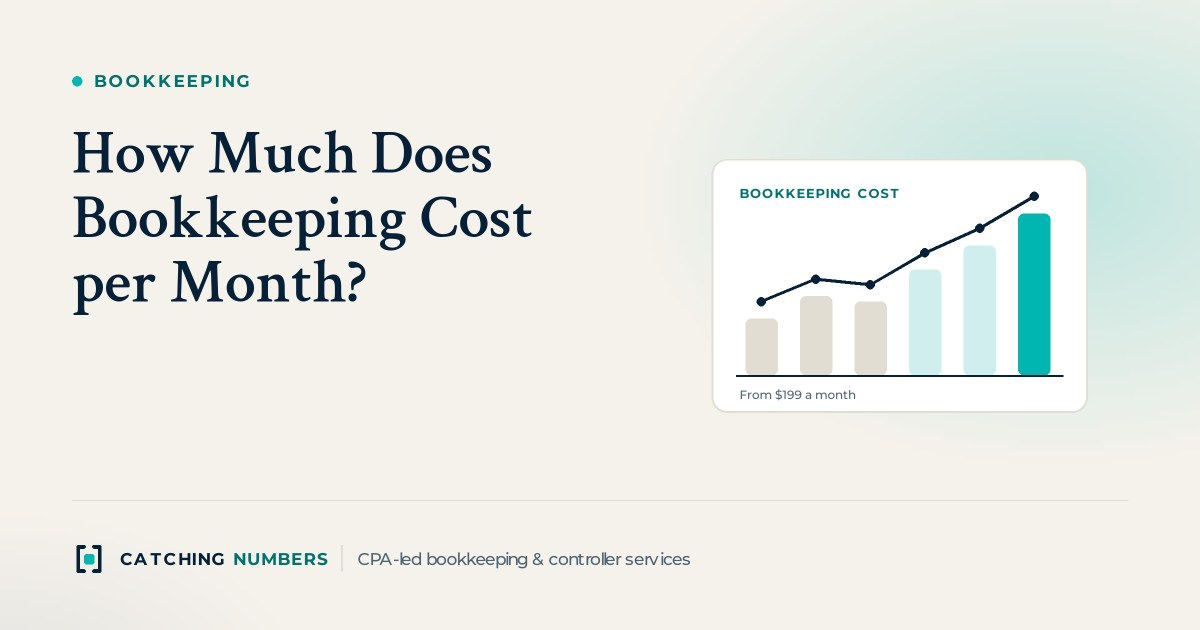
How much does a bookkeeper cost in 2027? For an outsourced, CPA-led service, monthly bookkeeping cost usually comes down to five things: how many bank and card accounts need reconciling, how many transactions you have each month, whether payroll and payment processors are involved, how many entities you run, and whether you need cash-basis books or accrual books with a real month-end close. At Catching Numbers, bookkeeping pricing starts at $199 a month for up to 2 accounts and 100 transactions, and our published plans run up to $6,350 to $8,840 a month for companies that need controller and fractional CFO support. You can see every plan on our bookkeeping pricing page.
Key takeaways
- Revenue is a weak guide to bookkeeping cost; accounts, transaction volume and complexity drive the quote.
- Our plans: Basic from $199 a month, Launch $599 to $699, Growth $2,440 to $3,750, and Scale $6,350 to $8,840 (checked November 9, 2026).
- Payroll, multiple payment processors, extra entities and accrual-basis books are the most common reasons a quote moves up a tier.
- Books that are months behind are quoted separately as a one-time catch-up project, then the monthly fee starts.
How much does a bookkeeper cost per month?
The honest answer is a range, because two businesses with the same revenue can have very different books. A consultant who invoices five clients a month and pays everything from one bank account needs far less work than a Shopify brand with the same sales running through Shopify Payments, PayPal, Amazon, two credit cards and a payroll provider.
Here is how our own monthly plans are priced. These are the ranges published on our pricing page when we checked it on November 9, 2026. Your exact fee is set after a free call and a look at your books, and you get it in writing before any work starts.
| Plan | Monthly fee | Typical fit |
|---|---|---|
| Basic | From $199 | Up to 2 bank or card accounts and 100 transactions a month. Solo owners, side businesses, a single rental property or a small nonprofit. |
| Launch | $599 to $699 | Early-stage companies with more accounts and transaction volume, often with payroll and several payment processors. |
| Growth | $2,440 to $3,750 | Companies that need accrual-basis books and a month-end close with controller review. |
| Scale | $6,350 to $8,840 | GAAP-basis reporting for a board, lender or investors, plus fractional CFO support, with the bookkeeping and close underneath. |
Even the Basic plan includes monthly categorization and reconciliation, a monthly profit and loss and balance sheet, and a year-end package for your tax CPA. We do not prepare tax returns; we keep your books tax-ready so your tax preparer’s work goes faster.
What moves bookkeeping pricing up or down?
When we quote monthly bookkeeping, these are the questions we ask first. Each one changes how many hours the work takes every month and how much review it needs.
- Number of accounts. Every bank account, credit card, loan and line of credit is reconciled to its statement each month. Two accounts and eight accounts are different jobs.
- Transaction volume. 100 transactions a month can be reviewed line by line quickly. 1,500 a month needs bank rules, summarized payout entries and tighter review.
- Payroll. Payroll runs from Gusto, Rippling, ADP or QuickBooks Payroll have to be booked to wages, employer taxes, benefits and liabilities, and those liability accounts need reconciling too.
- Payment processors and sales channels. Stripe, Shopify Payments, PayPal, Square and Amazon pay out net of fees, refunds, chargebacks and reserves. Each one has to be broken back out into gross sales, fees and timing differences.
- Entities. Each LLC or corporation has its own books, bank accounts and statements. A holding company with three property LLCs is close to four sets of books, plus intercompany entries.
- Cash vs accrual basis. Cash-basis books record money when it moves. Accrual books add accounts receivable, accounts payable, prepaid expenses, accruals and, for SaaS companies, deferred revenue. That is a month-end close, not just bookkeeping.
- Inventory and revenue recognition. Ecommerce brands need cost of goods sold tied to inventory. Subscription, contract and usage-based revenue needs a recognition schedule.
- How far behind the books are. If the last reconciled month was a year ago, that backlog is a separate, one-time catch-up project.
The accounting software matters less than people expect. We work in QuickBooks Online, Xero, NetSuite, Sage Intacct and AI-native platforms such as Rillet and Digits, and alongside Buildium and AppFolio for property managers and Givebutter for nonprofits. What drives the fee is the volume and complexity running through the system, not its logo.
What does a real quote look like? A worked example
Here is the kind of question we hear on discovery calls, with clearly illustrative round numbers rather than a real client:
“We sell on Shopify and Amazon. We have one checking account, one savings account and two credit cards, about 400 transactions a month, and we just started payroll in Gusto for three people. Our books are current through last quarter. Do we fit the $199 plan?”
Walking through the drivers:
| Driver | This business | Basic plan limit |
|---|---|---|
| Bank and card accounts | 4 | Up to 2 |
| Transactions a month | About 400 | Up to 100 |
| Payroll | Yes, 3 employees | Adding payroll usually means moving to Launch |
| Payment processors and channels | Shopify Payments, Amazon | Each one adds payout reconciliation |
| Books current? | Through last quarter | Recent months need catching up first |
This business has outgrown Basic on accounts, volume and payroll, so it would be quoted in our Launch range of $599 to $699 a month. The missing months since last quarter would be scoped as a short catch-up project before the monthly fee starts. If the same brand later raised money and its investors asked for accrual-basis statements with inventory, cost of goods sold and a monthly close, it would move into Growth. Nothing about its revenue appears in that reasoning, which is the point.
Is an outsourced bookkeeper cheaper than hiring in-house or doing it yourself?
It depends on what you are comparing against. There are four common options, and each has a different kind of cost:
- Doing it yourself. You pay only for software, but you pay in hours, and the usual failure is that reconciliations slip until tax season. Many of the catch-up projects we take on start this way.
- A freelance bookkeeper. Often billed hourly. It can work well, but coverage depends on one person, and there is usually no second-level review.
- An in-house bookkeeper. A salary plus payroll taxes, benefits, software seats and management time. It makes sense once there is a full-time workload, which most small businesses do not have.
- An outsourced firm. A fixed monthly fee, a team instead of one person, and review built in. With a CPA-led firm, the same team can step up to a month-end close and controller review as you grow.
For a company that needs a few hours to a few days of bookkeeping work a month, a fixed outsourced fee is usually the most predictable option. Once a company needs controller-level review and GAAP reporting, it is also usually far less than hiring a full-time controller. Our guide to what a fractional controller does covers that step in more detail.
What should be included in a monthly bookkeeping fee?
Comparing quotes only works if you compare the same scope. Before you sign with anyone, check whether the fee covers:
- Reconciliation of every bank, card and loan account to its statement, every month
- Payment processor payouts broken out into gross sales, fees and refunds, not booked as one net deposit
- Payroll journal entries and reconciled payroll liability accounts
- A monthly profit and loss and balance sheet, delivered on a set date
- Review by someone other than the person who did the work
- A year-end package for your tax CPA, with 1099 vendor information
A low quote that leaves out reconciliations or review often costs more later, when your tax CPA has to fix the books before preparing the return.
How do cash and accrual books change the monthly cost?
This is the single biggest jump in most quotes. Cash-basis books are mainly categorization and reconciliation. Accrual books need a month-end close: recording revenue when it is earned and expenses when they are incurred, booking accruals and prepaid expenses, tracking receivables and payables, and reviewing the balance sheet every month. The IRS explains the methods and who can use the cash method in Publication 538.
Many small businesses can use the cash method for tax purposes. Companies move to accrual books when lenders, investors or a board want statements that show real margins, when SaaS revenue has to be recognized over a contract, or when inventory makes cash-basis profit misleading. That is the line between our Launch and Growth plans.
What if my books are behind?
Then there are two prices, not one. The backlog is quoted once as a fixed-fee catch-up and cleanup project, based on how many months are missing, how many accounts are involved and whether statements are available. The monthly fee starts once the books are current. Our step-by-step guide to catch-up bookkeeping explains what we need from you to get there quickly.
Frequently asked questions
Do bookkeepers charge hourly or a flat monthly fee?
Both models exist, but most outsourced firms, including us, charge a flat monthly fee. A fixed fee makes your cost predictable and means a slow month or a tricky reconciliation does not change your bill. Hourly billing is more common with freelance bookkeepers and for one-off projects.
Is it cheaper to use QuickBooks myself than to hire a bookkeeper?
In cash out of pocket, yes; in total cost, often not. The software automates bank feeds and rules, but someone still has to review categories, reconcile accounts and fix sync errors from apps like Shopify or Stripe. Owners who do this themselves tend to fall behind, and catching up later costs more than staying current.
Does a bookkeeper do my taxes?
Not usually, and we do not prepare or file tax returns. A bookkeeper keeps accurate, reconciled books all year. At year end we hand your tax CPA a complete package so they can prepare the return without first cleaning up the books.
Are bookkeeping fees tax deductible?
Generally yes: bookkeeping and accounting fees paid for a business are an ordinary and necessary business expense. Record them in a professional fees or accounting fees account, and confirm the treatment for your situation with your tax CPA.
Should I hire a bookkeeper or an accountant?
Most small businesses need a bookkeeper every month and a tax CPA once a year. A bookkeeper records and reconciles transactions; a CPA-led firm adds review, the month-end close and controller oversight as you grow, while your tax CPA prepares the returns.
Can my bookkeeping fee change after I sign up?
It can, but only with your agreement. If you add accounts, payroll, an entity or a lot more transactions, we suggest the plan that fits and confirm the new fee in writing before anything changes on your bill.
Get a fixed monthly bookkeeping quote
Tell us how many accounts, entities and transactions you have, and we will recommend the right plan and confirm your fee in writing. See all plans on our pricing page or book a call.