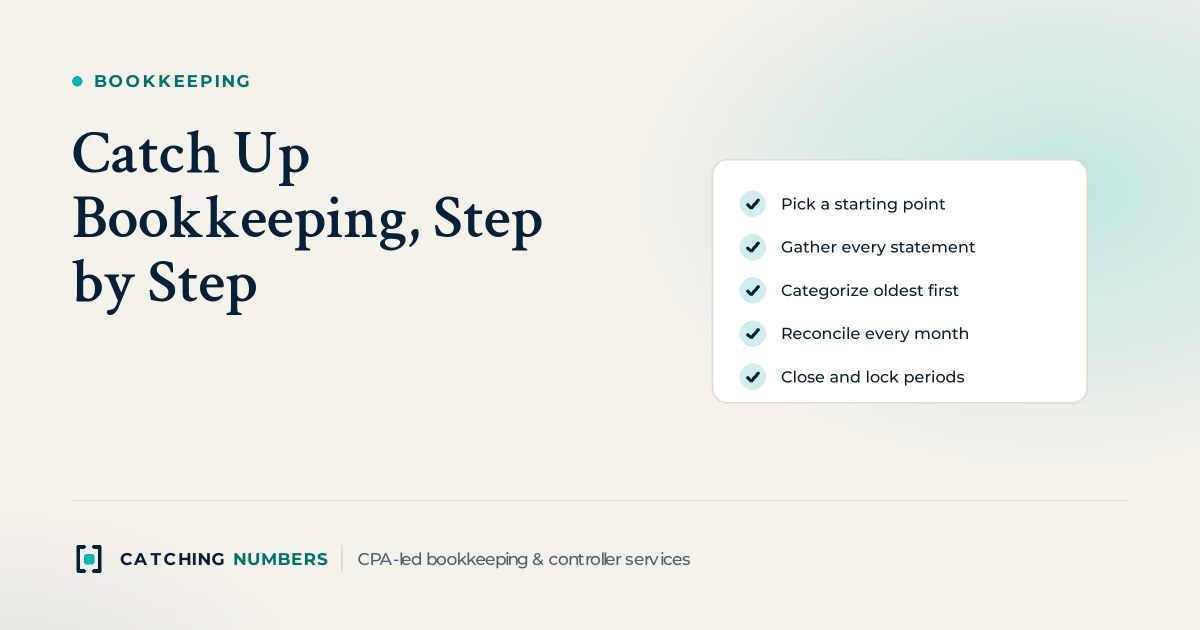
Catch up bookkeeping means recording and reconciling every month you are behind, in order, until your books match your bank, card and loan statements through the current month. The step-by-step version: decide the start date, gather every statement and payroll report for the gap, fix the chart of accounts, import and categorize transactions, reconcile each account month by month, tie out payroll and sales tax, then close and lock each period. Whether you are three months or three years behind, the order is the same; only the volume changes. If you would rather hand it off, our catch-up bookkeeping and cleanup service does exactly this.
Key takeaways
- Start from the last period you know is right, usually the last tax return filed or the last month that was reconciled.
- Work oldest month first and reconcile every bank, card and loan account before moving on, so errors do not roll forward.
- Bank statements are the backbone; receipts, invoices and payroll reports explain what each transaction was.
- Behind books can mean late returns: the IRS failure-to-file penalty is 5% of unpaid tax per month, up to 25%.
- Lock each finished period so nothing changes after your tax CPA starts.
What is catch up bookkeeping?
Catch-up bookkeeping is the work of bringing books current when months (or years) of transactions were never recorded or never reconciled. It is different from a cleanup, which fixes books that were kept but kept wrong: miscategorized expenses, duplicate entries, broken reconciliations. In practice most behind-on-books projects need a bit of both, because the months before the gap often have errors too.
The goal is not just “everything categorized.” It is a set of books where every bank, credit card, loan and merchant account reconciles to its statement for every month, and where the balance sheet makes sense. That is what your tax CPA, your lender and any buyer or investor will rely on.
Why does getting behind on books cost money?
The obvious cost is time: the longer you wait, the harder it is to remember what a $1,400 payment in March was for. The less obvious costs are real money:
- Late filing penalties. If behind books delay a return, the IRS failure-to-file penalty is 5% of the unpaid tax for each month or part of a month the return is late, up to 25%. For returns due after December 31, 2025 that are more than 60 days late, the minimum penalty for most returns is $525 or 100% of the tax owed, whichever is less. Partnership and S corporation returns have their own penalty of $255 per partner or shareholder per month, for up to 12 months.
- Late payment penalties. The failure-to-pay penalty is 0.5% of unpaid tax per month, also up to 25%, plus interest.
- Missed deductions. Expenses you cannot identify or support often end up left off the return.
- Bad decisions. Without current numbers you are pricing, hiring and borrowing blind, and lenders will usually ask for current financial statements anyway.
How do you catch up on bookkeeping, step by step?
This is the process we follow on catch-up projects, whether the books live in QuickBooks Online, Xero, NetSuite, Sage Intacct or an AI-native ledger such as Rillet or Digits.
- Pick a reliable starting point. Find the last date you can trust. Usually that is the end of the last year a tax return was filed, or the last month every account was reconciled. Compare the ending balances in your books to the balance sheet on that return. If they do not match, fix that first or nothing after it will tie out.
- Gather every statement for the gap. Download monthly statements for every business bank account, credit card, loan, line of credit, PayPal, Stripe, Square, Shopify or Amazon account, plus payroll provider reports and sales tax filings. Check how far back each provider’s online statements go and request older ones early, because some take days to arrive.
- Set up or clean the chart of accounts. Make sure every account you will need exists before you categorize anything: separate accounts for each bank and card, loan principal, owner draws or distributions, payroll taxes, sales tax payable and merchant fees. Merge or deactivate duplicates.
- Bring in the transactions. Use bank feeds where they reach back far enough, and import statement files (CSV, QBO or OFX) for older months. Watch for duplicates where a bank feed and a manual import overlap.
- Categorize, oldest month first. Set bank rules for recurring vendors, then work through the rest. Record transfers between your own accounts as transfers, loan payments as principal and interest, and owner money as equity, not income or expense. Match deposits to invoices and payouts so revenue is not double counted.
- Reconcile every account, every month. Reconcile each bank, card and loan account to its statement before you move to the next month. A difference you leave in January will show up in every month after it.
- Tie out payroll and sales tax. Agree wages, employer taxes and benefits to payroll reports and quarterly Forms 941. Agree sales tax collected to the returns filed with each state, and note any state where you may owe but have not registered.
- Record what the bank does not show. If you keep books on the accrual basis, add unpaid bills, unbilled revenue, accrued payroll, prepaid expenses and depreciation. Even on a cash basis, record fixed asset purchases and loans correctly.
- Review and close each period. Read the balance sheet and profit and loss for each month and each year. Look for negative balances, odd swings and large “uncategorized” or “ask my accountant” totals. Then set a closing date or lock date so finished months cannot change.
- Hand off and stay current. Send the year-end reports and supporting schedules to your tax CPA, then move to a monthly close so you never fall behind again. Our year-end close checklist covers what your CPA will ask for.
What records do you need to catch up?
The IRS says you need records such as receipts, canceled checks and other documents that support each item of income, deduction or credit. For a catch-up, that usually means:
- Bank, credit card and loan statements for every month in the gap
- Payment processor and marketplace payout reports (Stripe, PayPal, Square, Shopify, Amazon)
- Payroll registers and quarterly and annual payroll filings
- Sales invoices and customer contracts
- Receipts and bills for larger expenses and all equipment purchases
- Loan agreements and amortization schedules
- The last filed tax return and any IRS or state notices
How far back to go depends on what is missing. The IRS generally expects you to keep records for 3 years, 6 years if income was underreported by more than 25%, at least 4 years for employment tax records, and indefinitely if a return was never filed. If years of returns are unfiled, your tax CPA will tell you which years they need books for.
Should you do catch-up bookkeeping yourself or hire help?
A few months of a simple business with one bank account and one card is often manageable on your own if you follow the steps above. Hire help when the gap is a year or more, when there are several accounts, payroll, inventory or sales tax in multiple states, when a tax deadline or loan is waiting on the numbers, or when the books before the gap are also wrong.
Catching Numbers, a CPA-led firm in Secaucus, New Jersey, handles catch-up bookkeeping and cleanups for businesses that are months or years behind. Catch-up projects are usually priced once, based on how many months and accounts are involved and how many transactions there are, and then ongoing monthly bookkeeping takes over. Our basic monthly bookkeeping starts at $199 a month; see pricing for details. We keep books tax-ready and work alongside your tax CPA; we do not prepare returns. If catching up shows you underpaid estimated taxes for the current year, our estimated tax calculator can help you size the next payment before you talk to your CPA.
Frequently asked questions
How long does catch-up bookkeeping take?
It depends mostly on transaction volume and how quickly you can gather statements, not on the number of months alone. A low-volume business can catch up a year faster than a busy ecommerce brand can catch up a quarter, so get your statements together first and the timeline becomes clear.
Can I file my taxes if my books are behind?
You can request an extension (Form 4868 for individuals, Form 7004 for most businesses) to buy time to file, but an extension does not extend the time to pay. Estimate what you owe and pay it by the original due date to limit penalties and interest.
What if I am missing receipts?
Start with what you can rebuild: vendor portals, email confirmations, card statements and contracts often replace lost receipts. Bank statements show that you paid, but not always what for, so note the business purpose of larger expenses as you categorize them.
Do I need to catch up every year, or just the current one?
You need complete books for every year that still needs a return, plus a correct opening balance for the current year. If earlier returns were filed, start from their balance sheet and catch up from there.
Should I switch accounting software while I catch up?
Usually not in the middle of the project. Catch up in the system you have, close the year, and then migrate at a clean year-end if you have outgrown it, so the conversion starts from reconciled balances.
How much does catch-up bookkeeping cost?
It depends on how many months you are behind, how many accounts you have and how many transactions each month holds. Most firms quote a one-time project fee after reviewing your statements, then move you to a monthly fee once you are current.
Do you do catch-up bookkeeping in QuickBooks Online, Xero and other software?
Yes. Catching Numbers catches up books in QuickBooks Online, Xero, NetSuite, Sage Intacct and AI-native ledgers such as Rillet and Digits, as well as Buildium and AppFolio for property managers. We work in the software you already use.
Behind on your books? We will get you current.
Our CPA-led team catches up months or years of books, reconciles every account and hands your tax CPA a clean set of numbers. Book a free consultation and we will scope your catch-up.