Probably not a classic bank run, but a real shift in how cash moves. On September 27, 2026, Apollo’s chief economist Torsten Slok warned that AI agents could soon sweep household cash out of checking accounts paying about 0.1% into fintech accounts paying 3.3% to 5.0%, draining the cheap deposits banks lend from. For a business, the lesson is the same whether or not the “agentic bank run” arrives: idle cash has a real cost, and moving it faster needs better controls, not fewer.
Key takeaways
- The gap is wide: the FDIC’s national average savings rate was 0.38% in October 2026, while leading high-yield savings accounts advertised up to about 5%.
- Apollo’s worry is scale and speed: if agents move everyone’s spare cash automatically, banks lose the “sticky” deposits that fund loans.
- Today’s agents mostly browse, fill out forms, book and negotiate; fully automatic money movement between banks is still early.
- Businesses should size their operating cash, check FDIC coverage, earn a return on the rest, and put approval rules around any automation.
What did Apollo actually say?
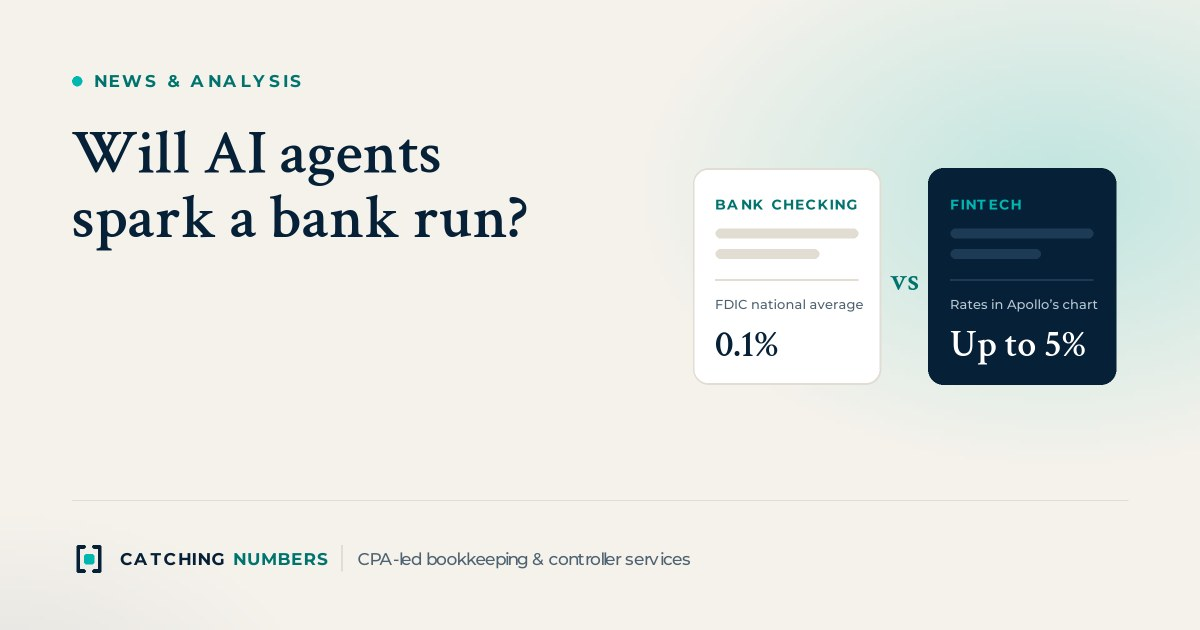
In a short Daily Spark note titled “Is an Agentic Bank Run Coming?”, Slok pointed to Muse, the personal AI agent Meta launched on September 8, 2026, and similar assistants. His argument: these agents could “sweep household cash automatically” into accounts paying 3.3% to 5.0%, instead of the 0.1% national average on checking. If every household did that, “banks could lose a large share of the cheap deposits they rely on to make loans.”
His chart compared deposit rates at ten fintech providers with the FDIC’s national averages. These are the rates shown in the chart, as reported when the note was published. They change often and many come with conditions, such as balance caps, direct deposit or membership requirements.
| Provider or benchmark | Rate shown (September 27, 2026) |
|---|---|
| Adelfi | 5.0% |
| SoFi | 4.5% |
| LendingClub (LevelUp) | 4.2% |
| Pibank | 4.1% |
| Revolut Metal, Current | 4.0% |
| Fitness Bank, Varo | 3.8% |
| Wealthfront | 3.6% |
| Revolut Standard | 3.5% |
| AlumniFi | 3.3% |
| National average, savings (FDIC) | 0.4% |
| National average, checking (FDIC) | 0.1% |
More recent data tells the same story. The FDIC’s national savings rate was 0.37% in September 2026 and 0.38% in October 2026, while lists of the best high-yield savings accounts in October 2026 were led by accounts advertising up to 5% APY. The spread got wider after the Federal Reserve raised its target range by a quarter point to 3.75% to 4.00% on September 16, 2026.
Is an agentic bank run coming?
Not in the panic sense, at least not yet. A traditional bank run is a panic: depositors fear a bank will fail and pull their money at once. What Apollo describes is different. It is a steady, rational move toward higher yields, done by software instead of people. That is less dramatic in calm times, but it can hurt banks in two ways.
- Cheap funding disappears. Banks earn much of their profit on deposits they pay almost nothing for. Consulting firm Curinos estimated in July 2026 that just under $2 trillion of savings balances were earning less than 1%, and that among customers actively switching banks, the share with four or more checking relationships jumped from 7% in 2019 to 50% in 2024. Customers are already less loyal; agents remove the last bit of effort.
- Money moves faster in a scare. In March 2023, Silicon Valley Bank customers tried to withdraw $42 billion in a single day, driven largely by group chats and social media. Software that watches news and moves balances automatically could compress that into minutes.
Regulators are studying the same risk. A Dallas Fed analysis from August 25, 2026 found that if tokenized deposits and AI agents made deposits 10 percentage points more rate sensitive, banks’ appetite for long-term assets could shrink by about $700 billion in 10-year equivalents. In plain terms: fewer long-term loans and more money parked in short-term government bonds. The views are the authors’, not an official Federal Reserve position.
There are brakes, too. Transfers between banks still take time through ACH, banks can set limits, and FDIC insurance removes much of the panic motive for smaller balances. Today’s consumer agents, including Muse, mainly browse, fill out forms, book and negotiate on a person’s behalf; automatic sweeping between banks is still early. So the more likely near-term outcome is higher deposit rates and thinner bank margins, not a sudden collapse.
What could agents do with business cash next?
For companies, the same tools will arrive through banking and spend platforms rather than consumer apps. Expect features that:
- Watch rates continuously and suggest, or execute, moves between operating, reserve and treasury accounts
- Time bill payments to the due date so cash earns interest for longer
- Spread balances across banks to stay within FDIC limits
- Move money instantly on tokenized or real-time payment rails, which removes the “it takes two days” buffer
That is useful, and it also means cash can leave your accounts faster than your books, your approvals or your bookkeeper can keep up. The companies that benefit will be the ones with a clear cash policy and a clean month-end close. Spend platforms are already moving this way; our Ramp vs Brex comparison covers how their treasury and bill pay features fit into the close.
What should your business do about it now?
- Know how much cash you actually need. Keep one to three months of operating costs in your main account, based on a real forecast rather than a guess. Our cash runway calculator is a quick starting point.
- Check your FDIC coverage. Deposits are insured up to $250,000 per depositor, per insured bank, per ownership category. Above that, consider a second bank or a sweep network that spreads balances across banks.
- Put the rest to work, deliberately. Business high-yield savings, money market funds and Treasury bills all pay far more than checking. Many business platforms now offer treasury accounts that invest in money market funds or T-bills; remember these are investments, not FDIC-insured deposits.
- Write a one-page cash policy. Set who can move money, how much, where, and with what approval. Board-backed companies should have it approved, especially if investors’ money is involved.
- Set guardrails before you automate. If you let software or an agent move money, use limits, allowed destination accounts, two-person approval above a threshold and alerts for every transfer.
- Keep the books in step. Every account and sweep needs to be reconciled monthly, interest recorded, and money market funds or T-bills classified correctly. Investments with an original maturity over three months are not cash equivalents on the balance sheet.
For SaaS and AI companies holding a large raise, this is where a controller earns their keep. We set up the cash policy, reconcile every treasury and sweep account in the monthly close, and report yield and runway to founders and boards. See our outsourced controller services, our fractional CFO services for cash forecasting, and how we work with SaaS companies.
Frequently asked questions
What is an agentic bank run?
It is a term for large amounts of money leaving banks because AI agents automatically move customers’ cash to wherever it earns the most, or out of a bank at the first sign of trouble. Apollo’s chief economist used it on September 27, 2026 to describe the risk that agents erode the cheap, stable deposits banks lend from.
Is my business money safe in a fintech account?
It depends on how the account is structured. Many fintechs hold deposits at partner banks with FDIC insurance, sometimes spread across several banks for higher coverage, while treasury products invest in money market funds or Treasury bills that are not FDIC insured. Read the account terms to see which you have, and see our note on what happens to your account when a fintech is sold.
How should interest on business cash be recorded?
Record it as interest income in the month it is earned, reconciled to each account statement, and keep money market funds and T-bills in the right balance sheet line. Your tax CPA will need these totals at year end, so clean monthly records save time later.
Who is Torsten Slok?
Torsten Slok is the chief economist at Apollo, the asset manager. He publishes The Daily Spark, a short daily note with one chart, and it was in that series that he asked whether an agentic bank run is coming.
What is Meta Muse?
Muse is a personal AI agent Meta launched in the US on September 8, 2026 for adults 18 and over. Meta says it can open a browser, fill out forms, book travel and negotiate on a user’s behalf. Apollo cited it as an example of the kind of assistant that could one day move cash automatically.
How much FDIC insurance does a business bank account have?
Deposits are insured up to $250,000 per depositor, per insured bank, per ownership category. A corporation’s or LLC’s accounts are insured separately from its owners’ personal accounts, but all of the company’s accounts at the same bank share one $250,000 limit.
What is a deposit sweep network?
A sweep network spreads a large balance across many FDIC-insured banks, keeping the amount at each bank under the insurance limit, while you see one account. Many banks and business fintechs offer one. Each bank in the network should appear in the program documents, and the account still needs to be reconciled every month.
Are money market funds FDIC insured?
No. Money market funds are investments, not bank deposits, so they are not covered by FDIC insurance and can, rarely, lose value. Treasury bills are backed by the US government rather than the FDIC. Both belong on your balance sheet as investments or cash equivalents, depending on the maturity when you bought them.
How much cash should a business keep in its checking account?
We usually suggest one to three months of operating costs in the main account, set from a forecast rather than a rule of thumb. Seasonal businesses and companies with lumpy payroll or inventory buys may need more. Cash beyond that can earn a return in savings, money market funds or T-bills under a written cash policy.
Can an AI agent move money out of my business bank account?
Only if you or your bank give it access. Most business banking and spend platforms already offer rule-based sweeps and scheduled bill pay, and agent features are being added on top. Before turning any of them on, set transfer limits, approved destination accounts and two-person approval for large amounts.
Want your cash working harder, with the controls to match?
We keep your books closed monthly and help you set a cash policy that earns more without adding risk.