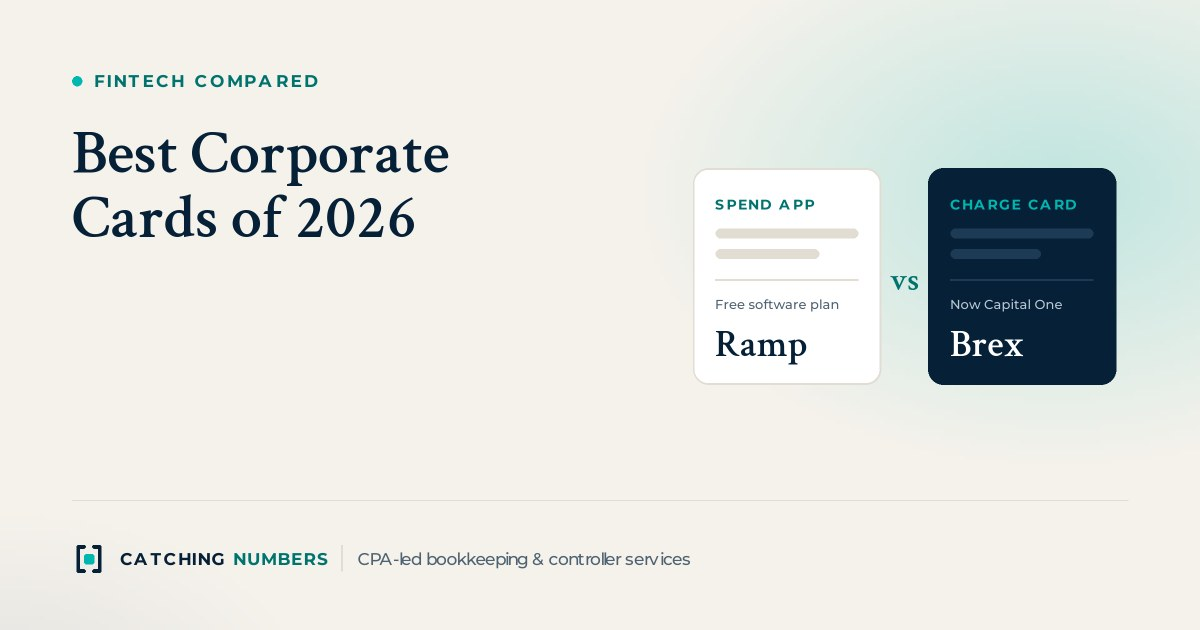
The best corporate card for most US startups and small businesses in 2026 is one that pairs a no-personal-guarantee card with free expense software and a clean sync to your accounting system, which is why Ramp, Brex and BILL Spend & Expense (formerly Divvy) top most shortlists. Ramp is the best all-round pick if you want strong automation at $0 per user, Brex (now owned by Capital One) suits venture-backed and travel-heavy teams, BILL Spend & Expense fits companies already paying bills in BILL, and American Express or Capital One Spark Cash Plus make sense when an owner wants simple, high rewards. Expensify, Mercury, Rho and Navan each win in narrower cases we explain below.
Key takeaways
- Ramp, Brex, BILL Spend & Expense, Mercury, Rho and Expensify all offer cards with no personal guarantee, with limits based on your cash, revenue or funding.
- Software can be free: Ramp Free, Brex Essentials, BILL Spend & Expense and Navan’s Business plan list $0, while Ramp Plus ($15) and Brex Premium ($12) charge per user per month.
- Rewards range from flat cash back (Mercury 1.5%, Capital One Spark Cash Plus 2%) to points with conditions (Brex, BILL Divvy, Amex), so read the fine print.
- For your books, the sync to QuickBooks Online, Xero, NetSuite or Sage Intacct and receipt capture matter more than an extra half point of rewards.
What are the best corporate cards for small businesses in 2026?
We compared the cards our clients ask about most: Ramp (Free and Plus), Brex, BILL Spend & Expense, American Express business cards, Expensify, Mercury IO, Rho, Navan and Capital One Spark Cash Plus. Every figure below comes from the provider’s own pricing, card terms or help pages, checked October 28, 2026.
| Card | Software price | Card type and limit | Rewards (as published) | Accounting integrations |
|---|---|---|---|---|
| Ramp | Free $0; Plus $15/user/mo plus a platform fee by team size; Enterprise custom | Charge card, 30-day payback; limit based on revenue or funds raised; no personal guarantee | Cash back; no fixed rate published on the pricing page | Free: QuickBooks Online, Xero. Plus adds NetSuite, Sage Intacct, Acumatica, Business Central |
| Brex (Capital One) | Essentials $0; Premium $12/user/mo; Enterprise custom | Paid daily or monthly by autopay; limit based on revenue, funds raised or cash; no personal guarantee | Points: up to 7x rideshare, 4x Brex Travel, 3x restaurants, 2x software, 1x other | QuickBooks Online, Xero, NetSuite, Sage Intacct, Business Central, Rillet and others on Essentials |
| BILL Spend & Expense (Divvy) | $0 per user | Charge card, $0 annual fee; lines from $1,000; soft credit pull; no personal guarantee | Points: weekly payment 7x restaurants, 5x hotels, 2x software, 1.5x other (lower if paid monthly), with conditions | QuickBooks, Xero, NetSuite, Sage Intacct, Acumatica |
| Amex Business Platinum | $895 annual card fee | Pay in full with Pay Over Time option; no preset spending limit | 5X on flights and prepaid hotels via AmexTravel; 2X on key categories and purchases of $5,000+ (up to $2M a year) | Connects to QuickBooks |
| Amex Blue Business Cash / Plus | No annual fee listed for Blue Business Plus | Credit card | Cash: 2% on first $50,000 a year, then 1%. Plus: 2X points on first $50,000, then 1X | Not described on the card pages |
| Expensify Card | Collect $5/member/mo; Control $18 annual or $36 pay-per-use, up to 50% less when you use the card | Settles daily or monthly; Expensify says it is “not a credit card”; no personal guarantee or credit check | 1% cash back, 2% when company spend exceeds $250,000 a month (US cards, USD purchases) | Collect: QuickBooks, Xero. Control adds NetSuite, Sage Intacct |
| Mercury IO | Mercury $0; paid plans available | Charge card; limit based on Mercury balances; no personal guarantee | 1.5% cash back, no cap | QuickBooks, Xero free; NetSuite on paid plans |
| Rho | No subscription or per-user fees | Credit card; daily or monthly terms; no personal guarantee | Up to 1.25% (daily) or 1% (monthly); up to 2% / 1.75% with Rho Platinum on up to $1M a year | QuickBooks Online, NetSuite, Sage Intacct; Xero via bank feed |
| Navan | Business plan free; first 5 expense filers free each month, then $15/user/mo | Navan card or connect existing Visa, Mastercard or Amex cards | Up to 1.5% back | NetSuite, QuickBooks Online, Xero, Sage |
| Capital One Spark Cash Plus | $150 annual fee, refunded in years you spend $150,000+ | Pay-in-full charge card; no preset spending limit | Unlimited 2% cash back; 5% on Capital One Business Travel | Exports to QuickBooks |
Ramp Free vs Ramp Plus: is the paid plan worth it?
Ramp Free already covers cards, receipt matching, bill pay and syncs with QuickBooks Online and Xero, which is enough for most companies under a few dozen employees. Ramp Plus ($15 per user per month plus a platform fee that Ramp sets by team size, 20% off with annual billing) is worth it when you need NetSuite, Sage Intacct, Acumatica or Business Central, reimbursement controls, or AI features such as AI coding of every field and the Policy Agent, which Ramp made generally available on January 13, 2026 to recommend approve, reject or review on each transaction. Ramp also says it raised $750 million at a $44 billion valuation in June 2026.
What changed at Brex after Capital One bought it?
Capital One completed its acquisition of Brex on April 7, 2026, and Pedro Franceschi remains CEO. Brex says it “will remain Brex,” that Essentials stays free and that startup rewards are unchanged. For customers, the practical differences so far are a bank-owned parent and continued product updates, including an AI-native accounting API launched in January 2026. We cover the head-to-head in detail in Ramp vs Brex (2026).
Is BILL Spend & Expense (Divvy) still a good corporate card?
Yes, especially if you already run accounts payable in BILL, because cards, reimbursements and bills share one vendor and one sync. The software is free and credit lines start at $1,000. The rewards come with conditions to know before you count on them: category multipliers apply only to the first $5,000 of spend each month, you lose a month’s points if you spend less than 30% of your line, points cannot be redeemed during the first 12 months, and paying weekly earns more than paying monthly. BILL has also been adding AI agents, including a Transaction Agent made generally available in April 2026 and a new risk and controls suite announced October 19, 2026.
Should you use an Amex or Capital One card instead of a spend management card?
Traditional issuer cards win on simple, high rewards and travel perks. Amex Blue Business Cash pays 2% on the first $50,000 a year, Capital One Spark Cash Plus pays an unlimited 2%, and the Business Platinum earns 5X on flights and prepaid hotels booked through AmexTravel for an $895 annual fee. What they lack is the built-in spend controls, per-employee virtual cards, receipt chasing and approval workflows that Ramp, Brex and BILL include for free. American Express is closing that gap: it bought expense software company Center in 2025 and agreed to acquire AI expense tool Hyper in April 2026. Many of our clients run both: a spend management card for the team and an issuer card for the owner’s travel.
Where do Expensify, Mercury, Rho and Navan fit?
- Expensify is strongest when out-of-pocket reimbursements are the main problem. Its card cuts the Control plan price by up to half, and its Concierge AI handles expenses through chat.
- Mercury IO suits startups that bank at Mercury and want a flat 1.5% with no cap, with the limit tied to Mercury balances.
- Rho combines banking, a credit card, bill pay and treasury with no software fees; its highest rates need Rho Platinum and balances held at Rho.
- Navan is built around travel booking, with expense management and an AI agent for out-of-pocket expenses launched in March 2026.
What does a corporate card mean for your books and month-end close?
A card program is only as good as the data it hands your bookkeeper. Before you switch, check these five things:
- Sync quality: transactions should post to QuickBooks Online, Xero, NetSuite or Sage Intacct with category, class or department, vendor and receipt attached, without duplicating the bank feed.
- Receipts: automatic receipt matching and reminders decide whether you close with 5 missing receipts or 50.
- Categorization: AI coding is helpful, but map it to your chart of accounts and review it each month.
- Reconciliation: daily-pay cards create many small payments; monthly-pay cards create one large one. Both reconcile cleanly if the card is set up as its own liability account.
- Rewards: book cash back consistently (usually as a reduction of expense or other income) and agree the treatment with your tax CPA.
Our outsourced bookkeeping team sets up and reconciles all of these programs every month, and our controllers design the approval rules and policies behind them.
Which corporate card should you choose?
- Ramp Free if you want the most automation at $0 and use QuickBooks Online or Xero.
- Ramp Plus or Brex Premium if you run NetSuite or Sage Intacct and need deeper policy controls.
- Brex if you are venture-backed, spend heavily on travel and software, or want a bank-owned provider.
- BILL Spend & Expense if your AP already lives in BILL.
- Amex or Capital One Spark Cash Plus if simple, high rewards for a few cardholders matter more than controls.
- Expensify, Mercury, Rho or Navan for reimbursements, Mercury banking, an all-in-one bank, or travel, respectively.
How we compared
We used only each provider’s own pricing, card terms, help center and press pages, checked October 28, 2026. We did not run hands-on tests for this article, we do not publish ratings, and we have no affiliate relationship with any company listed. Rewards, fees and eligibility change often and depend on approval, so confirm current terms with each provider before you apply.
Frequently asked questions
Which corporate cards do not require a personal guarantee?
Ramp, Brex, BILL Spend & Expense, Mercury IO, Rho and the Expensify Card all state that no personal guarantee is required. They set limits from your company’s cash balance, revenue or funding instead of the owner’s personal credit.
Is Ramp really free?
Ramp’s Free plan costs $0 per user and includes cards, expense management, bill pay and QuickBooks Online and Xero syncs. Ramp charges for Ramp Plus and Enterprise, which add ERP integrations, reimbursement controls and advanced AI features, and some bill pay fees apply when you pay from an outside bank.
What is the difference between a corporate charge card and a business credit card?
A charge card must be paid in full each cycle, often daily or monthly by autopay, so it never carries a balance. A business credit card, such as Amex Blue Business Cash, can carry a balance with interest, which adds flexibility but also a debt to track and manage.
Which corporate card has the best cash back?
Among flat rates we verified, Capital One Spark Cash Plus pays an unlimited 2%, Amex Blue Business Cash pays 2% on the first $50,000 a year, and Mercury IO pays 1.5% with no cap. Rho reaches up to 2% with Rho Platinum, and Expensify pays 2% only above $250,000 of monthly spend.
Did anything change for Brex customers after the Capital One deal?
Brex says it will keep operating as Brex, Essentials remains free and startup rewards are unchanged. The deal closed on April 7, 2026, so watch for future changes to rewards, banking partners or pricing in your account notices.
Is Divvy the same as BILL?
Yes. Divvy is now part of BILL and is sold as BILL Spend & Expense, with the BILL Divvy Card. It is free and separate from BILL’s paid accounts payable plans, but connects to them.
Which corporate cards integrate with NetSuite?
Brex includes NetSuite on its free Essentials plan, and BILL Spend & Expense, Rho and Navan list NetSuite as well. Ramp requires Ramp Plus, Expensify requires its Control plan and Mercury requires a paid plan.
How are corporate card limits set without a personal guarantee?
Providers look at company data such as bank balances, revenue and equity raised, often through a linked bank account. Mercury bases its IO limit on balances held at Mercury, and BILL uses a soft credit pull with lines from $1,000.
How should cash back from a business card be recorded in the books?
Most companies record cash back as a reduction of the related expense or as other income, applied the same way every month. Ask your tax CPA which treatment to use, then set a rule in your accounting system so it posts consistently.
Can I use more than one corporate card program?
Yes, and many companies do, such as a spend management card for employees and an Amex or Capital One card for the owner. Each program should have its own liability account and be reconciled monthly so nothing is double counted.
Do AI features in expense apps replace receipt review?
They reduce it. Tools like Ramp’s Policy Agent, Brex’s AI expense assistant and Expensify’s Concierge flag out-of-policy spend and draft coding, but someone still needs to approve exceptions and review coding before the books close.
Want your card spend to close itself?
Book a free consultation. We’ll help you pick a card program, set up the sync and policies, and reconcile it every month. Basic monthly bookkeeping starts at $199 a month; see pricing.