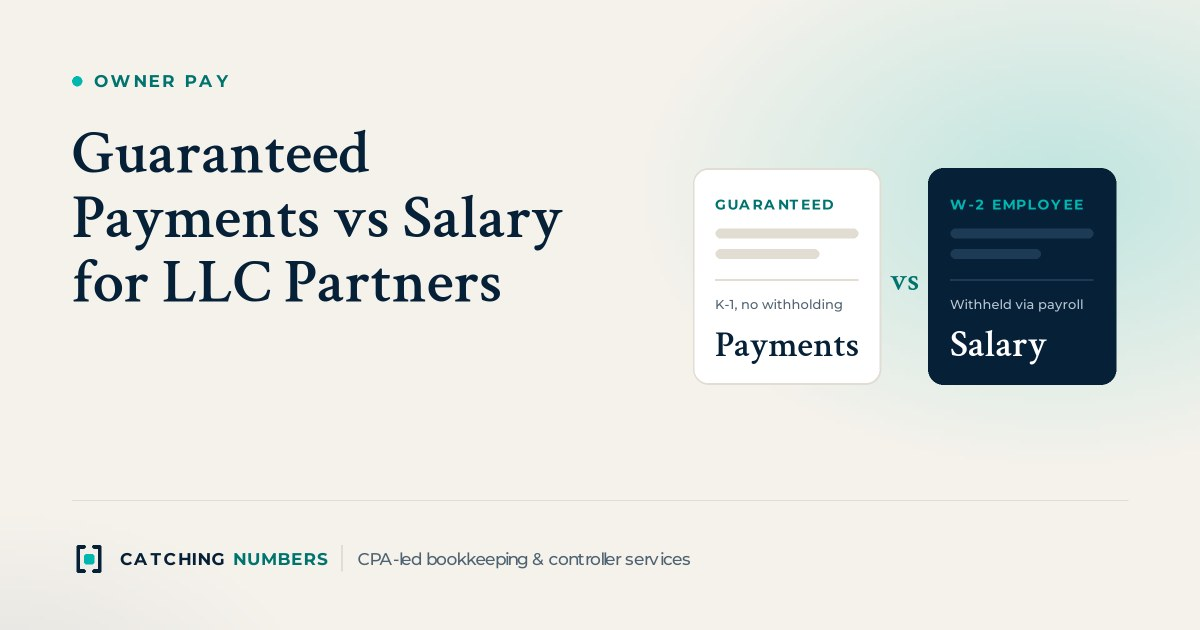
Guaranteed payments vs salary comes down to one rule: a partner in an LLC taxed as a partnership cannot be a W-2 employee of that LLC, so there is no salary. A partner who is paid a fixed amount for work, regardless of profit, receives a guaranteed payment instead. The LLC deducts it, the partner reports it as ordinary income from Schedule K-1, nothing is withheld, and a guaranteed payment for services is generally subject to self-employment tax.
Key takeaways
- Partners are not employees of their partnership, so they get guaranteed payments and distributions, not W-2 wages.
- A guaranteed payment is a fixed amount set without regard to partnership income; the LLC deducts it on Form 1065, line 10.
- The partner reports it as ordinary income from Schedule K-1, boxes 4a to 4c, with no withholding, so quarterly estimated taxes matter.
- Guaranteed payments are not qualified business income, so they do not earn the 20% QBI deduction.
- In your books, guaranteed payments are an expense; distributions and draws are equity. Mixing them up is the most common error we fix.
Can an LLC partner be paid a salary?
No, not if the LLC is taxed as a partnership. Since Rev. Rul. 69-184, the IRS position has been that bona fide members of a partnership are not employees of the partnership for FICA, FUTA and income tax withholding purposes, and a partner who works in the business is a self-employed individual. Treasury left that holding in place in T.D. 9766 (2016) and, in T.D. 9869 (2019), closed the workaround of employing partners through a disregarded subsidiary: that entity “is not the employer of any partner of the partnership that owns the entity.”
So if your multi-member LLC is running a partner through payroll and issuing a W-2, that is a problem to fix with your tax CPA, not a tax strategy. Partners get paid two ways: guaranteed payments and distributions (often called draws). If you want owner-employee wages, the LLC would need to elect S corporation or C corporation treatment, which changes the rules entirely. Our guide to owner’s draw vs salary covers how each entity type pays its owners.
What is a guaranteed payment to a partner?
IRS Publication 541 (Rev. December 2025) defines guaranteed payments as payments a partnership makes to a partner “that are determined without regard to the partnership’s income.” The classic example is a managing partner who receives $8,000 a month for running the business, whether the year is good or bad.
There are two kinds, reported separately on the partner’s Schedule K-1 (Form 1065):
- Box 4a, guaranteed payments for services. Payment for work the partner does for the business.
- Box 4b, guaranteed payments for capital. Payments “other than for services, such as for the use of capital,” for example a fixed annual return on money a partner contributed.
- Box 4c, total guaranteed payments. The sum of both.
A guaranteed minimum can also create a guaranteed payment. In the Publication 541 example, a partner is guaranteed at least $8,000 and is entitled to 30% of profit. If profit is $20,000, her 30% share is $6,000, so the guaranteed payment is the $2,000 difference. If profit had been $30,000, her share would cover the minimum and there would be no guaranteed payment at all.
Guaranteed payments vs salary: what is the difference?
Economically they look alike: a regular, fixed amount for work. For tax and bookkeeping they are very different. Here is how a partner’s guaranteed payment compares with W-2 salary paid to an S corporation owner-employee, and with a partner distribution.
| Partner guaranteed payment | S corp owner W-2 salary | Partner distribution (draw) | |
|---|---|---|---|
| Who gets it | LLC members and partners taxed as a partnership | S corp shareholders who work in the business | Any partner, usually in line with the operating agreement |
| Deductible by the business? | Generally yes, Form 1065 line 10 | Yes, as wages | No, it reduces the partner’s capital account |
| Tax document | Schedule K-1, boxes 4a to 4c | Form W-2 | Schedule K-1 (distributions), plus the partner’s share of profit |
| Withholding | None | Income tax and FICA withheld through payroll | None |
| Social Security and Medicare | Self-employment tax on payments for services | FICA, split between company and employee | Not taxed on the cash itself; SE tax depends on the partner’s share of profit |
| Counts as QBI? | No | No (reasonable compensation is excluded) | The partner’s share of profit generally can |
| Taxed when? | In the partner’s tax year in which the partnership’s year ends | When paid | Profit is taxed when earned, whether or not distributed |
How are guaranteed payments taxed?
Income tax
The partnership generally deducts guaranteed payments as a business expense, and the partner reports them on Schedule E (Form 1040) as ordinary income. Publication 541 adds a timing rule that catches fiscal-year partnerships: guaranteed payments are included “in the partner’s tax year in which the partnership’s tax year ends,” not necessarily the year the cash arrived.
Guaranteed payments also stay taxable when the business loses money. If the partnership has a loss after the guaranteed payment, the partner still reports the full guaranteed payment as ordinary income and deducts their share of the loss separately, only to the extent of their basis in the partnership.
Self-employment tax
The Schedule SE instructions say partners “must also pay SE tax on your share of certain partnership income and your guaranteed payments.” The self-employment tax rate is 15.3% (12.4% Social Security and 2.9% Medicare), and the Social Security part stops at the wage base, which the Social Security Administration set at $184,500 for 2026 ($176,100 for 2025). An additional 0.9% Medicare tax applies to self-employment income above $200,000 for single filers or $250,000 for joint filers, per the IRS self-employment tax page.
Limited partners are treated differently: they “should include only guaranteed payments for services actually rendered to or on behalf of the partnership.” Whether an active LLC member counts as a limited partner for this purpose has been litigated recently, including a 2026 federal appeals court decision, and is still unsettled, so this is a question for your tax CPA, not something to assume in your books.
No QBI deduction on guaranteed payments
The Form 8995 instructions list “amounts received as guaranteed payments” among items that are not qualified business income. The 2025 tax law made the 20% QBI deduction permanent, so this trade-off continues: a larger guaranteed payment shifts income out of the partners’ QBI. That is a reason to set guaranteed payments deliberately with your tax CPA rather than by habit.
What does it look like with real numbers?
Here is an illustrative example. Two partners split an LLC 50/50. Partner A runs the business day to day and the operating agreement gives her a $90,000 guaranteed payment for services. Profit before the guaranteed payment is $300,000.
| Partner A | Partner B | |
|---|---|---|
| Guaranteed payment (box 4a) | $90,000 | $0 |
| Share of ordinary income: ($300,000 minus $90,000) x 50% (box 1) | $105,000 | $105,000 |
| Total ordinary income reported | $195,000 | $105,000 |
| QBI from this business (before limits) | $105,000 | $105,000 |
Without the guaranteed payment, each partner would report $150,000. The guaranteed payment moves $45,000 of income from B to A, compensates A for her work, and keeps it out of QBI. Notice that how much cash either partner actually withdrew changes none of these numbers.
How do you record guaranteed payments in your books?
Whether the books are in QuickBooks Online, Xero, NetSuite, Sage Intacct or an AI-native ledger such as Rillet or Digits, the setup we use is the same:
- Create an expense account called “Guaranteed payments to partners,” with a sub-account, class or dimension for each partner, and separate services from capital if you have both.
- Pay it outside payroll. A transfer or bill payment to the partner, coded to that expense account. No W-2 and no withholding.
- Record draws in equity. Use a “Partner distributions” equity account for each partner, never an expense account.
- Code partner health insurance correctly. Publication 541 treats premiums the partnership pays for a partner as guaranteed payments, which affects the partner’s self-employed health insurance deduction.
- Tie out at year end. The expense account by partner should match what your tax CPA reports in each K-1, box 4, and each capital account should roll forward cleanly.
Because nothing is withheld, partners who receive guaranteed payments usually need quarterly estimated taxes. Our free estimated tax calculator works out safe harbor amounts and due dates. If draws and guaranteed payments have been coded inconsistently for a few years, our cleanup and catch-up bookkeeping service fixes the history before your CPA files.
Should your LLC use guaranteed payments or elect S corp status?
Guaranteed payments fit when partners contribute unequal work or capital and you want the profit split to reflect it. An S corporation election replaces guaranteed payments with W-2 salary and distributions, which can reduce self-employment tax on profit above a reasonable salary, but adds payroll, the reasonable compensation requirement and rules that distributions follow ownership. It is a decision to model with your tax CPA using clean, current numbers. See S corporation vs C corporation for the entity basics.
Frequently asked questions
Are guaranteed payments the same as a salary?
No. Salary is W-2 wages paid to an employee through payroll with withholding. A guaranteed payment goes to a partner, who by IRS rules is not an employee, is reported on Schedule K-1, and has no withholding. Both are deductible to the business, but the partner pays self-employment tax instead of FICA.
Can a single-member LLC make guaranteed payments?
No. A single-member LLC is disregarded for income tax unless it elects corporate treatment, so there is no partnership and no K-1. The owner takes draws and reports profit on Schedule C. Guaranteed payments only exist in entities taxed as partnerships.
Do guaranteed payments reduce my share of partnership profit?
Yes. The partnership deducts them before it allocates ordinary income, so every partner’s share of box 1 income falls. The partner who receives the guaranteed payment reports it in addition to their own reduced share.
Are guaranteed payments subject to self-employment tax?
Guaranteed payments for services generally are. The IRS Schedule SE instructions say limited partners include only guaranteed payments for services actually rendered to the partnership. Guaranteed payments for capital and the limited partner rules raise technical questions, so confirm the treatment with your tax CPA.
Is tax withheld from guaranteed payments?
No. Publication 541 states that guaranteed payments are not subject to income tax withholding. Partners cover income tax and self-employment tax with quarterly estimated payments, or extra withholding from a spouse’s or other job.
Where do guaranteed payments show up on the tax forms?
The partnership deducts them on Form 1065, line 10, and reports each partner’s amounts on Schedule K-1 in box 4a (services), 4b (capital) and 4c (total). The partner then reports them as nonpassive ordinary income on Schedule E of Form 1040.
Can a guaranteed payment create a loss for the partnership?
Yes. Because it is deductible and set without regard to income, a guaranteed payment can push the partnership into a loss. The receiving partner still reports the full payment as income and can deduct their share of the loss only up to their basis.
Do guaranteed payments qualify for the QBI deduction?
No. The Form 8995 instructions exclude amounts received as guaranteed payments from qualified business income. The partner’s share of ordinary business income can still qualify, subject to the usual limits.
Is health insurance paid for a partner a guaranteed payment?
Yes, when the partnership pays premiums for a partner’s services as a partner. The partnership deducts them and the partner includes them in income, then may claim the self-employed health insurance deduction if eligible. If the partnership treats premiums as a reduction of distributions instead, it cannot deduct them.
Where should guaranteed payments be documented?
In the LLC operating agreement or partnership agreement, or a written amendment approved by the partners. It should state the amount or formula, what it pays for and how often. Clear terms make the bookkeeping and the K-1s much easier to support.
Is a partner draw taxable?
Generally not by itself. Partners are taxed on their share of profit whether or not they take cash out. A cash distribution creates gain only to the extent it exceeds the partner’s adjusted basis in the partnership interest.
What if our LLC has been issuing a W-2 to a partner?
Raise it with your tax CPA soon. Under long-standing IRS rules, bona fide partners are not employees, so wages reported on a W-2 to a partner usually need to be reclassified as guaranteed payments, which can affect payroll filings, benefits and the partner’s estimated taxes. We can help correct the books once the treatment is settled.
Want partner pay that is clean on the books and ready for your CPA?
We set up guaranteed payments, draws and capital accounts correctly, close your books every month and hand your tax CPA a K-1-ready ledger. See our outsourced bookkeeping service or book a free consultation.