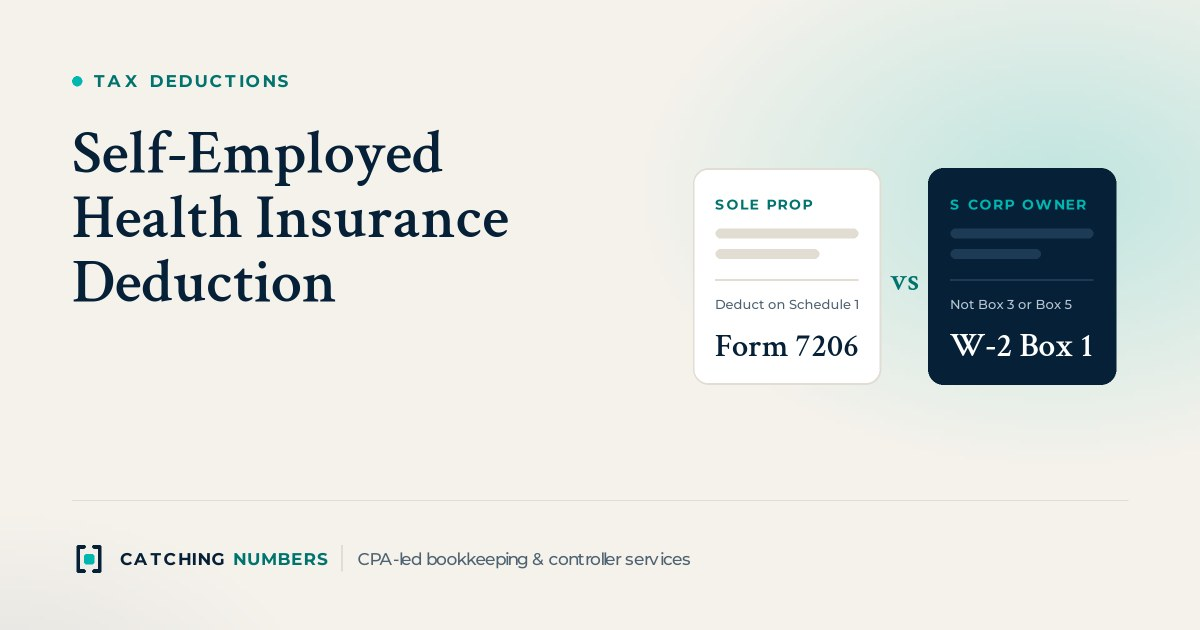
The self-employed health insurance deduction lets sole proprietors, partners and more-than-2% S corp shareholders deduct medical, dental and qualified long-term care premiums for themselves, their spouse and dependents above the line on Form 1040, under Internal Revenue Code section 162(l). It is capped at the earned income from the business that sponsors the plan, and it is not available for any month you could join a subsidized employer plan. For S corp health insurance, the deduction only works if the S corporation pays or reimburses the premiums and puts them on the owner’s W-2.
Key takeaways
- Sole proprietors, partners and more-than-2% S corp shareholders deduct health premiums on Schedule 1 (Form 1040), not as a business expense on their own return.
- The deduction can’t exceed the earned income from the business that established the plan, and it is lost for any month you or your spouse were eligible for a subsidized employer plan.
- S corp owners: the company must pay or reimburse the premiums and report them in Box 1 of the owner’s W-2 (not Boxes 3 and 5), or the deduction is lost.
- Qualified long-term care premiums count only up to age-based limits ($6,020 maximum for 2025 and $6,200 for 2026, at age 71 or older).
- HSA limits are $4,400 self-only and $8,750 family for 2026, rising to $4,500 and $9,000 for 2027.
Who qualifies for the self-employed health insurance deduction?
According to the IRS Instructions for Form 7206 (2025), three groups can take the deduction:
- Sole proprietors and single-member LLCs with a net profit on Schedule C or Schedule F (or who used an optional method on Schedule SE).
- Partners and LLC members taxed as a partnership with net earnings from self-employment on Schedule K-1 (Form 1065), box 14, code A.
- More-than-2% S corporation shareholders who received wages from the S corporation, with the premiums it paid or reimbursed shown as wages on Form W-2.
Two limits apply to everyone. First, the deduction can’t exceed your earned income from the business under which the plan is established, per IRC section 162(l)(2)(A). For an S corp shareholder, earned income means your wages from that S corporation as defined in section 3121, which is why a reasonable salary matters.
Second, the test runs month by month. You can’t count premiums for any month in which you were eligible to join a subsidized health plan offered by your employer, your spouse’s employer, or the employer of a dependent or a child under 27, even if nobody enrolled.
The deduction lowers income tax but not self-employment tax. The Form 7206 instructions say you can’t subtract it when figuring net earnings for self-employment tax from the business that sponsors the plan.
What premiums and family members are covered?
Eligible premiums include medical and dental coverage for you, your spouse and your dependents. A child who was under age 27 at the end of the year also counts, even if the child isn’t your dependent. Medicare premiums you voluntarily pay for coverage in your own name can be included too.
Qualified long-term care insurance counts, but only up to an age-based limit per person. The table shows the limits from the 2025 Form 7206 instructions and Rev. Proc. 2025-32 for 2026. The IRS publishes the 2027 limits with its annual inflation adjustments. Age is measured at the end of the year.
| Age at year end | 2025 limit per person | 2026 limit per person |
|---|---|---|
| 40 or under | $480 | $500 |
| 41 to 50 | $900 | $930 |
| 51 to 60 | $1,800 | $1,860 |
| 61 to 70 | $4,810 | $4,960 |
| 71 and older | $6,020 | $6,200 |
How does S corp health insurance work for owners?
Under the fringe benefit rules in section 1372, a shareholder who owns more than 2% of an S corporation (counting stock owned by family members under the section 318 attribution rules) is treated like a partner, not an employee. That means the owner can’t receive tax-free health coverage the way a regular employee can. IRS Notice 2008-1 sets out how the deduction still works:
- The S corporation establishes the plan. It either pays the premiums directly or reimburses the shareholder in the same tax year after the shareholder gives proof of payment. The policy can be in the shareholder’s own name.
- The S corporation deducts the premiums. They are treated as compensation to the shareholder.
- The premiums go on the W-2 in Box 1 only. Per the IRS page on S corporation compensation and medical insurance issues, they are included in Box 1 wages but not Boxes 3 and 5, so no Social Security, Medicare or FUTA tax applies, provided the premiums are paid under a plan for employees generally or a class of employees.
- The shareholder deducts the premiums on Form 1040. The deduction goes on Schedule 1, line 17, using Form 7206 or the worksheet in the Form 1040 instructions.
If the shareholder pays personally and the S corporation never reimburses, Notice 2008-1 says no plan is established by the company and the 162(l) deduction is not allowed.
How is health insurance handled by entity type?
Partners follow a parallel path. If the policy is in your name and you pay it, the partnership must reimburse you and report the amount on your K-1 as a guaranteed payment, or the plan isn’t considered established under the business. C corporation owners who work in the business are employees, and Pub. 15-B says employer-provided accident and health benefits are generally excluded from an employee’s wages.
| Entity type | Who pays the premiums | How it is reported | Where the deduction happens |
|---|---|---|---|
| Sole proprietor or single-member LLC | Owner or business; policy can be in either name | Not a Schedule C expense for the owner’s own coverage | Schedule 1 (Form 1040), line 17, via Form 7206 or the 1040 worksheet |
| Partnership or multi-member LLC | Partnership pays, or reimburses the partner | Guaranteed payment on Schedule K-1 | Partnership deducts the guaranteed payment; partner deducts on Schedule 1 |
| S corporation (more-than-2% shareholder) | S corp pays, or reimburses in the same year | W-2 Box 1 wages, not Boxes 3 and 5 | S corp deducts as compensation; shareholder deducts on Schedule 1 |
| C corporation (owner-employee) | Corporation through an employer plan | Generally excluded from the employee’s wages | Corporation deducts; no separate personal deduction needed |
Choosing between these structures involves much more than health insurance. Our guides to S corporation vs. C corporation and owner’s draw vs. salary cover the bigger picture.
Can S corp owners and self-employed people use an HSA?
Yes, if you are covered by a high deductible health plan (HDHP) and meet the other eligibility rules. Rev. Proc. 2025-19 sets the 2026 contribution limits at $4,400 for self-only coverage and $8,750 for family coverage, with a minimum HDHP deductible of $1,700 self-only or $3,400 family. Rev. Proc. 2026-24 raises them to $4,500 and $9,000 for 2027, with a minimum HDHP deductible of $1,750 self-only or $3,500 family. If you are 55 or older at year end, you can add $1,000. For 2025, the limits in Pub. 969 were $4,300 and $8,550.
The One Big Beautiful Bill Act (P.L. 119-21) widened HSA eligibility. Per IRS Notice 2026-5, bronze and catastrophic plans that are available as individual coverage through an Exchange are treated as HDHPs for months beginning after December 31, 2025, including the same plan bought directly from the insurer. Qualifying direct primary care arrangements (up to $150 a month for one person or $300 for more than one) no longer block HSA contributions from 2026, and the telehealth safe harbor is now permanent for plan years beginning after 2024.
The 2% shareholder wrinkle: partners and more-than-2% S corp shareholders can’t make pre-tax salary reduction contributions to an HSA. If the S corporation contributes to the owner’s HSA, Pub. 969 treats it as a guaranteed payment that the company deducts and the shareholder includes in gross income. The shareholder then deducts the contribution on Form 8889.
What about a QSEHRA? For 2026, Rev. Proc. 2025-32 caps QSEHRA reimbursements at $6,450 for self-only and $13,100 for family coverage. But the IRS says a more-than-2% S corp shareholder can’t participate in a QSEHRA, an HRA or a section 125 FSA, so these plans help your employees, not you.
What goes wrong most often with S corp health insurance?
The most common mistake we see is simple: the S corporation pays the owner’s premiums all year, books them as an ordinary health insurance expense, and nobody adds them to the owner’s W-2. Without the W-2 inclusion, the shareholder doesn’t meet the Notice 2008-1 conditions for the deduction.
- The owner pays premiums from a personal account and the S corp never reimburses them in the same year.
- The premiums are put into Boxes 3 and 5 as well, so the company and owner pay Social Security and Medicare tax they didn’t owe.
- The owner takes little or no salary, which leaves no wages to support the deduction.
- A spouse’s subsidized employer coverage is overlooked for some months.
- A sole proprietor deducts the owner’s own premiums on Schedule C instead of Schedule 1.
How should you record health insurance premiums in the books and payroll?
The setup is the same in QuickBooks Online, Xero, NetSuite, Sage Intacct or an AI-native platform such as Rillet or Digits.
- Separate the owner’s premiums. Use a dedicated account or class, such as “Officer health insurance,” apart from employee group health costs.
- Pay or reimburse from the business. If the owner pays personally, reimburse through the company in the same year, ideally under an accountable plan with proof of payment attached.
- Set up the payroll item early. In Gusto, ADP or your payroll provider, add a 2% shareholder health insurance item that flows to Box 1 only, and enter premiums each payroll or at least before the final payroll of the year.
- Reconcile before year end. Tie the premiums on the general ledger to the payroll total so the W-2 matches the books.
- Handle HSA contributions the same way. Run owner HSA contributions through payroll as Box 1 wages.
Keep the insurance policy and premium statements, proof of payment, reimbursement records, payroll reports showing the Box 1 inclusion, and a note of any months anyone in the family was eligible for a subsidized employer plan. Partnerships should keep the guaranteed payment schedule that ties to the K-1s.
We don’t prepare tax returns. Our outsourced bookkeeping team makes sure premiums are booked and run through payroll correctly, so your tax CPA gets clean numbers. Confirm your own situation with your tax CPA, and use our estimated tax calculator to see how the deduction changes your quarterly payments. If you are reviewing other owner deductions, see our guides to the home office deduction and hiring your children.
Frequently asked questions
Is the self-employed health insurance deduction an itemized deduction?
No. It is an above-the-line adjustment on Schedule 1 (Form 1040), line 17, so you can claim it whether or not you itemize. Any amount you deduct there can’t also be included in medical expenses on Schedule A.
Do I have to file Form 7206?
Not always. The worksheet in the Form 1040 instructions works for simple cases, but Form 7206 is required if you have more than one source of self-employment income, file Form 2555, or include qualified long-term care premiums.
Can I deduct health insurance if my business had a loss?
Generally no. The deduction can’t exceed your earned income from the business that established the plan, so a loss leaves nothing to deduct under section 162(l). The premiums may still count as medical expenses if you itemize on Schedule A, subject to its limits.
Can I take the deduction if my spouse’s employer offers health insurance?
Not for any month you were eligible to join your spouse’s subsidized employer plan, even if you declined it. The test is applied month by month, so months before or after that eligibility can still qualify.
Can my S corp pay my health insurance tax-free?
Not tax-free in the way it is for regular employees. For a more-than-2% shareholder, the premiums are added to Box 1 wages and subject to income tax, but they are exempt from Social Security and Medicare tax if paid under a plan for employees. You then deduct them on Schedule 1, which usually offsets the income inclusion.
Does the health insurance policy have to be in the S corporation’s name?
No. Notice 2008-1 allows a policy in the shareholder’s own name, as long as the S corporation pays the premiums directly or reimburses the shareholder in the same tax year and reports the amount as W-2 wages.
Does the self-employed health insurance deduction reduce self-employment tax?
No. The Form 7206 instructions say you can’t subtract it when figuring net earnings for self-employment tax. It reduces income tax only.
Can I deduct Medicare premiums as self-employed?
Yes. The Form 7206 instructions allow Medicare premiums you voluntarily pay for coverage in your own name. The other rules still apply, including the earned income limit and, for S corp owners, the requirement that the company pay or reimburse the premiums.
Can I cover my adult child under 27?
Yes. Premiums for a child who was under age 27 at the end of the year count even if the child isn’t your dependent. A child includes a son, daughter, stepchild, adopted child or eligible foster child.
What are the HSA contribution limits for 2026 and 2027?
For 2026, the limits are $4,400 for self-only HDHP coverage and $8,750 for family coverage under Rev. Proc. 2025-19. For 2027, Rev. Proc. 2026-24 raises them to $4,500 and $9,000. People 55 or older can add $1,000 in either year.
Can a bronze Marketplace plan make me HSA eligible?
Starting with months after December 31, 2025, yes. Under the One Big Beautiful Bill Act and IRS Notice 2026-5, bronze and catastrophic plans offered as individual coverage through an Exchange are treated as HDHPs, even if they don’t meet the usual deductible and out-of-pocket rules.
Can an S corp owner use a QSEHRA?
No. The IRS says a more-than-2% S corp shareholder can’t participate in a QSEHRA, citing Notice 2017-67 and section 1372. A QSEHRA can still reimburse your regular employees, up to $6,450 self-only or $13,100 family for 2026.
Does my spouse who works in my S corp count as a 2% shareholder?
Often, yes. Section 1372 counts stock treated as owned under the section 318 attribution rules, which generally attribute stock between spouses and between parents and children. A family member treated as a 2% shareholder gets the same W-2 treatment for health premiums as the owner.
Want your owner premiums booked right the first time?
Book a free consultation. We’ll check how your health premiums and HSA contributions run through the books and payroll, and hand your tax CPA clean, tax-ready numbers.