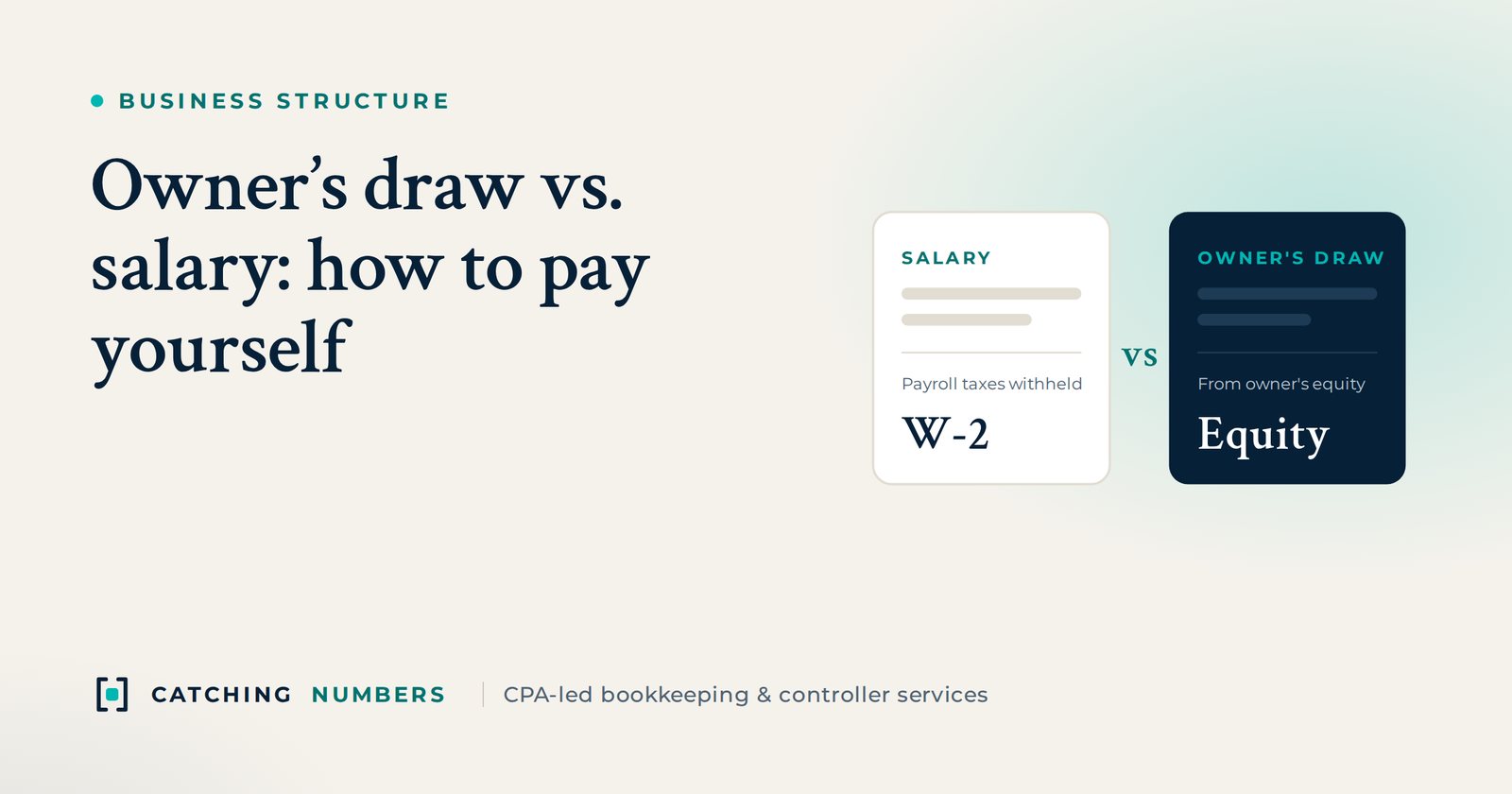
“How should I pay myself?” is one of the first questions every business owner asks, and the answer depends almost entirely on how your business is taxed. An owner’s draw and a salary both move money from the business to you, but they’re taxed differently, recorded differently, and in some entities one of them isn’t even allowed.
Key takeaways
- You’re taxed on your business’s profit, not on what you withdraw.
- Sole proprietors and partners take draws; they can’t pay themselves W-2 wages.
- S corporation owners who work in the business must take a reasonable salary before distributions.
- Record draws and distributions in equity accounts, never as expenses.
The most common misconception is that a draw is “tax-free money.” It isn’t. Here’s how it actually works.
What is an owner’s draw?
An owner’s draw is a transfer of money out of the business to the owner. It’s recorded as a reduction of the owner’s equity, not as an expense, so it doesn’t reduce the business’s profit.
The key point: you aren’t taxed on the draw. You’re taxed on the profit. In a sole proprietorship, single-member LLC or partnership, the business’s net income flows onto your personal return whether you draw all of it, some of it, or none of it. Taking a draw doesn’t create extra tax, and skipping one doesn’t save any.
What is a salary?
A salary is wages paid through payroll to someone who is an employee of the business. The business withholds federal and state income tax plus Social Security and Medicare, pays the employer’s share of payroll taxes, and reports the wages on Form W-2. For the business, salary is a deductible expense.
How it works for each type of business
Sole proprietorships and single-member LLCs
You can’t pay yourself a W-2 salary. You pay yourself with draws. Your business’s net profit is reported on Schedule C of your personal return and is generally subject to both income tax and self-employment tax (15.3% for Social Security and Medicare, with the Social Security portion capped at the annual wage base). Because nothing is withheld from draws, you’ll typically need to make quarterly estimated tax payments. Our free estimated tax calculator works out the safe harbor amount and due dates.
Partnerships and multi-member LLCs
Partners aren’t employees either, so they don’t receive W-2 wages. Partners take distributions, and may receive guaranteed payments for services. Each partner pays tax on their share of the partnership’s income as reported on their Schedule K-1, again regardless of what they actually withdraw. Guaranteed payments, and generally an active partner’s share of business income, are subject to self-employment tax. For more on how those work, see guaranteed payments vs. salary.
S corporations: salary first, then distributions
This is where the choice really matters. If you own an S corporation and work in the business, you must pay yourself a reasonable salary through payroll before taking distributions. Distributions beyond that salary aren’t subject to Social Security and Medicare taxes, which is a big reason owners elect S corp status. To estimate the savings for your own numbers, try our S corp tax savings calculator.
That savings is exactly why the IRS scrutinizes owners who pay themselves little or no salary and take everything as distributions. If the IRS decides your salary is unreasonably low, it can reclassify distributions as wages and assess back payroll taxes, penalties and interest. “Reasonable” means roughly what you’d have to pay someone else to do your job, based on your role, hours, experience and what comparable businesses pay.
Two other S corp rules to know: distributions generally must be made in proportion to ownership, and distributions in excess of your stock basis can be taxable.
C corporations
Owners who work in a C corporation are paid a salary, which the corporation can deduct. Profits paid out beyond that are dividends, which aren’t deductible and are taxed again on your personal return. There’s no “owner’s draw” in a C corporation. Money taken out without payroll or a formal dividend can create problems.
At a glance
| Business type | How owners get paid | What you’re taxed on |
|---|---|---|
| Sole prop / single-member LLC | Owner’s draw | All net profit (income + self-employment tax) |
| Partnership / multi-member LLC | Distributions and guaranteed payments | Your share of income per K-1, plus self-employment tax |
| S corporation | Reasonable W-2 salary, then distributions | Salary (with payroll taxes) plus your share of profit per K-1 |
| C corporation | W-2 salary and dividends | Salary, plus dividends when paid |
Recording it correctly in QuickBooks or Xero
- Draws go to an equity account such as “Owner’s Draw,” never to an expense account.
- S corp distributions go to an equity account such as “Shareholder Distributions,” tracked by shareholder.
- Salary runs through your payroll provider, so wages and taxes post to expense and liability accounts automatically.
- Personal expenses paid from the business account should be recorded as draws or distributions, not business expenses.
How do you record an owner’s draw? The journal entry
Say you move $5,000 from your single-member LLC’s bank account to your personal account. The entry is a debit to Owner’s Draw (an equity account) for $5,000 and a credit to the business bank account for $5,000. Nothing touches the profit and loss statement. At year end, the draw account is closed into owner’s equity (or capital), so the balance sheet shows what you put in, plus profits, minus what you took out.
How much should you take as an owner’s draw?
There’s no legal limit for a sole proprietor or single-member LLC, but a few habits keep the business healthy:
- Set aside tax first. You owe tax on the profit whether you draw it or not, so keep enough cash for your quarterly estimates.
- Keep an operating cushion. Leave enough in the account to cover a few months of fixed costs.
- Don’t draw money that isn’t yours. Customer deposits and sales tax you’ve collected belong to someone else.
- Draw on a schedule. A regular draw after the books close each month is easier to plan around than ad hoc transfers.
Owner’s draw FAQs
Is an owner’s draw an expense?
No. A draw is a withdrawal of equity, not a cost of running the business. It reduces the owner’s equity account on the balance sheet, it doesn’t appear on the profit and loss statement, and it isn’t tax deductible. Your business profit is the same whether you take a draw or not.
What is the difference between an owner’s draw and a distribution?
Both move profit from the business to the owner outside payroll. “Draw” is the term used for sole proprietors, single-member LLCs and partners. “Distribution” is the term used for S corporation shareholders, whose distributions must be made in proportion to ownership and should follow a reasonable salary paid through payroll.
Is an owner’s draw taxable?
Not by itself. Owners of sole proprietorships, LLCs and partnerships are taxed on the business’s profit, whether or not they draw it out, so taking a draw doesn’t create extra tax. What it does affect is how much cash you have left to pay that tax.
What type of account is an owner’s draw?
An equity account. In QuickBooks Online or Xero it’s usually set up as an “Owner’s draw” or “Drawings” equity account that reduces owner’s equity, and it is closed into equity at year end. It never appears on the profit and loss statement.
How are owner draws taxed in an LLC?
The draw itself isn’t taxed. A single-member LLC’s net profit is reported on Schedule C and is subject to income tax and self-employment tax whether you withdraw the money or leave it in the business. Multi-member LLC partners pay tax on their share of profit from their Schedule K-1. Most owners cover this with quarterly estimated payments, which our estimated tax calculator can help you plan.
How are distributions taxed in an S corp?
Your salary is taxed through payroll like any employee’s wages. Your share of the company’s profit flows to your personal return on Schedule K-1 and is subject to income tax whether or not it’s distributed, but distributions aren’t subject to Social Security and Medicare tax. That is why the IRS expects a reasonable salary before any distributions.
Can an S corp owner take an owner’s draw?
Not under that name. An S corporation owner who works in the business is paid a reasonable salary through payroll, and money taken out beyond that is a shareholder distribution, made in proportion to ownership. Record each withdrawal in your books as salary or a distribution, never as an owner’s draw or an expense, so payroll, distributions and your stock basis stay easy to track.
Is an owner’s draw considered income?
Not separately. For a sole proprietor, single-member LLC or partner, the business’s profit is your income for tax purposes, and the draw is just you moving some of that money to your personal account. You don’t add your draws to your profit, and you don’t subtract them from it.
Where do owner draws go on Schedule C?
Nowhere. Schedule C reports the business’s income and expenses, and a draw is neither. Only your net profit carries to your personal return. Keep the draws in an equity account so they don’t end up in an expense line by mistake.
What is the difference between owner’s draw and owner’s equity?
Owner’s equity is your total stake in the business: what you’ve put in plus the profits you’ve left in. Owner’s draw is a separate equity account that tracks what you’ve taken out, and it reduces owner’s equity. At year end the draw balance is closed into equity.
Can I take an owner’s draw if the business isn’t profitable?
A sole proprietor or single-member LLC owner can, as long as there’s cash, because you’re withdrawing your own money, but you’re shrinking the cushion the business runs on. For partners and S corp shareholders, taking out more than your basis can create taxable gain, so check with your tax CPA before drawing more than you’ve put in plus your share of profits.
How do I take an owner’s draw from a single-member LLC?
Transfer the money from the LLC’s bank account to your personal account, then record it in your books as a debit to Owner’s Draw and a credit to the bank account. Avoid paying personal bills straight from the business account; if it happens, record those payments as draws too.
How are guaranteed payments different from owner’s draws?
A guaranteed payment is a fixed amount a partnership pays a partner for services or capital, whatever the profit. It’s deductible by the partnership and taxable to the partner. A draw is simply a withdrawal of profit. See guaranteed payments vs. salary for the details.
So which should you choose?
Often, your entity type chooses for you. Sole proprietors and partners take draws; S corporation owners need a reasonable salary plus distributions; C corporation owners take a salary and, sometimes, dividends. The real questions are how much to take, when, and whether your current entity is still the right one, for example whether a growing LLC would save money by electing S corp status. For more on that choice, see S corporation vs. C corporation.
Whatever you choose, document every withdrawal and plan for the tax. If you’d like help setting a reasonable salary, running payroll or keeping distributions clean in your books, talk to us.
Further reading: the IRS guidance on S corporation compensation.