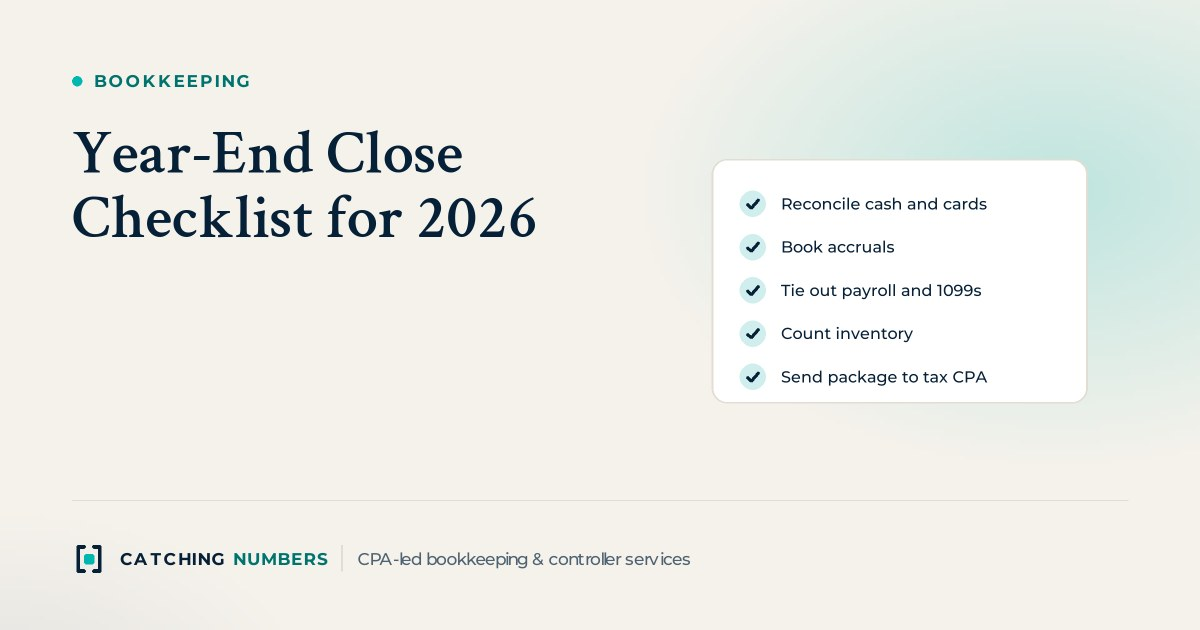
A year-end close is the work that turns twelve months of transactions into a trial balance your tax CPA can use without sending it back. For a calendar-year company, that means reconciling every bank, card and loan account through December 31, confirming payroll and contractor totals, tying out receivables, payables, inventory and fixed assets, booking accruals, and handing over a clean package in January. We start the checklist in the fall, because the 2026 information return deadline lands on February 1, 2027, and S corporation and partnership returns are due March 15, 2027.
Key takeaways
- Your tax CPA can only work from what the books say, so the close has to be finished before tax prep starts, not alongside it.
- Forms W-2 and 1099-NEC for 2026 are due February 1, 2027, because January 31 falls on a Sunday.
- For payments made in 2026, the 1099-NEC and 1099-MISC reporting threshold rose from $600 to $2,000, so collect W-9s now and track totals by vendor.
- Reconciliations, accruals and a short list of open questions are what make the handoff fast and the tax bill accurate.
What is a year-end close, and why does it come before tax prep?
A year-end close is a month-end close with extra steps. Every balance sheet account gets checked against an outside source, the income statement gets reviewed for misclassified items, and anything earned or owed but not yet recorded gets booked. The result is a final trial balance for the year.
Your tax CPA builds the return from that trial balance. If the books are still moving when they start, they either wait, make their own adjusting entries that never make it back into your ledger, or file on numbers that change later. Each of those costs time or money. A finished close means one set of numbers that everyone agrees on.
When should you start the year-end close?
Earlier than most owners expect. The steps that depend on outside people, such as collecting W-9s from contractors or confirming loan balances with a lender, take weeks. We like to clean up the first eleven months during October and November, with catch up bookkeeping for any months that were never reconciled, so December is the only month left to close in January. Here are the dates that drive the timeline for a calendar-year company closing 2026, checked on irs.gov on October 2, 2026.
| Filing | Who it applies to | 2027 due date |
|---|---|---|
| Form W-2 to employees and SSA, Form 940, Q4 Form 941 | Employers | February 1, 2027 (January 31 is a Sunday) |
| Form 1099-NEC to recipients and IRS | Businesses paying contractors $2,000 or more in 2026 | February 1, 2027 |
| Form 1099-MISC to recipients | Businesses paying rent and other reportable amounts | February 1, 2027 for most boxes |
| Form 1099-MISC to IRS | Same | March 1, 2027 on paper; March 31, 2027 electronically |
| Form 1065 and Form 1120-S | Partnerships, multi-member LLCs and S corporations | March 15, 2027 |
| Form 1120 | C corporations | April 15, 2027 |
Your tax CPA files the returns. Our job, and the job of this checklist, is to get them the numbers early enough that those dates are comfortable.
What should be on a year-end close checklist?
This is the order we work in. Cash comes first because almost everything else depends on it.
1. Cash, cards and loans
- Reconcile every bank account, credit card, PayPal, Stripe and other payment balance to the December 31 statement.
- Clear or explain old uncleared checks and deposits.
- Tie each loan and line of credit to the lender’s year-end statement, and split payments between principal and interest.
- Empty the “uncategorized” and “ask my accountant” accounts.
2. Revenue and receivables
- Match the accounts receivable aging to the balance sheet and write off invoices you will not collect.
- For SaaS companies, check that annual and multi-year contracts sit in deferred revenue and are recognized month by month.
- For ecommerce sellers, reconcile Shopify, Amazon and marketplace payouts to gross sales, fees, refunds and reserves, so revenue is recorded gross rather than as net deposits.
- Reconcile sales tax payable to the returns you filed in each state.
3. Expenses, payables and accruals
- Record December bills that arrive in January, and book accruals for services you received but have not been billed for.
- Match the accounts payable aging to the balance sheet.
- Move prepaid annual software, insurance and retainers to prepaid expenses and amortize them.
- Reclassify owner personal expenses out of operating expenses.
4. Payroll and contractors
- Tie annual wages and payroll taxes in the books to the payroll provider’s year-end reports.
- Confirm taxable fringe benefits and owner benefits that belong on Forms W-2 are recorded before the final 2026 payroll.
- Run a payments-by-vendor report, flag contractors at or above $2,000, and request missing Forms W-9.
5. Inventory and fixed assets
- Count inventory at or near December 31, including stock at 3PLs and Amazon FBA, and adjust the books to the count.
- Update the fixed asset list with the year’s purchases and disposals, attaching invoices.
- Apply your capitalization policy consistently and leave depreciation method choices to your tax CPA.
6. Equity and the handoff
- Record owner contributions, distributions and draws, and roll prior-year net income into retained earnings.
- Agree opening balances to the prior-year return your tax CPA filed.
- Lock the period in QuickBooks Online or Xero so nobody changes 2026 by accident.
What changed for the 2026 close?
Three changes from the 2025 tax law, which the IRS now calls the Working Families Tax Cuts, affect what we prepare for the tax CPA this year.
Higher 1099 threshold. According to the 2026 Instructions for Forms 1099-MISC and 1099-NEC, the minimum reporting threshold for these payments rose to $2,000 for payments made after 2025, and may be adjusted for inflation starting in 2027. Fewer small contractors will need a form, but you still need accurate totals by vendor to know who crosses the line. Payments made by credit card or through a payment network such as PayPal fall under Form 1099-K reporting by the payment processor instead, so your books should show how each contractor was paid.
Form 1099-K back to $20,000 and 200 transactions. The IRS Form 1099-K FAQs confirm the law retroactively reinstated the old threshold. Many smaller sellers will not receive a 1099-K at all, which makes reconciling platform reports to your books even more important, since there may be no IRS form to compare against.
Domestic research costs. New section 174A lets businesses deduct domestic research or experimental expenditures for tax years beginning after December 31, 2024, while foreign research is still amortized over 15 years, per the IRS summary of the law’s business provisions. For SaaS and AI companies, the bookkeeping job is to tag developer salaries, contractors and cloud costs as domestic or foreign so your tax CPA can apply the rules.
What should you send your tax CPA?
A good year-end package answers questions before they are asked. Ours usually includes:
- Financial statements. A balance sheet, profit and loss statement, and final trial balance as of December 31.
- Reconciliations. Year-end reconciliations for every bank, card and loan account, with statements attached.
- Supporting schedules. Fixed asset additions with invoices, the inventory count, accruals and prepaids, and deferred revenue if you have it.
- Payroll and 1099 reports. Year-end payroll summaries and the list of contractors and amounts reported.
- A short memo. Unusual items from the year, such as a loan, an asset sale, a new state or a research project, with our open questions.
One small item your tax CPA may ask about is the de minimis safe harbor. The IRS tangible property regulations let businesses without an audited financial statement expense items up to $2,500 per invoice or item, through an annual election attached to the return. A written capitalization policy in your books makes that election easy to support.
If your books need more than a review to get here, our outsourced bookkeeping team can catch up the year, and our outsourced controller service owns the close and the handoff every year after that. Ecommerce sellers can see how we handle payouts and inventory on our ecommerce accounting page.
Frequently asked questions
How long does a year-end close take?
If the books have been closed monthly, December usually takes a few weeks once statements and payroll reports arrive in early January. If several months were never reconciled, plan for catch-up work first, which is why we suggest starting in the fall.
Do I need to file a 1099-NEC for a contractor I paid $1,500 in 2026?
Generally no. For payments made in 2026, the IRS threshold for Form 1099-NEC is $2,000. Still collect a W-9 from every contractor before you pay them, because you need it the moment a vendor crosses the threshold.
Can my tax CPA just fix the books while doing the return?
They can make adjusting entries, but those entries often stay in their workpapers and never reach your QuickBooks or Xero file, so next year starts from the wrong balances. It also tends to cost more, since tax season hours are the most expensive of the year.
Want 2026 closed before your tax CPA asks?
Book a free consultation. We will review where your books stand and quote a fee for the year-end close based on what you actually need.