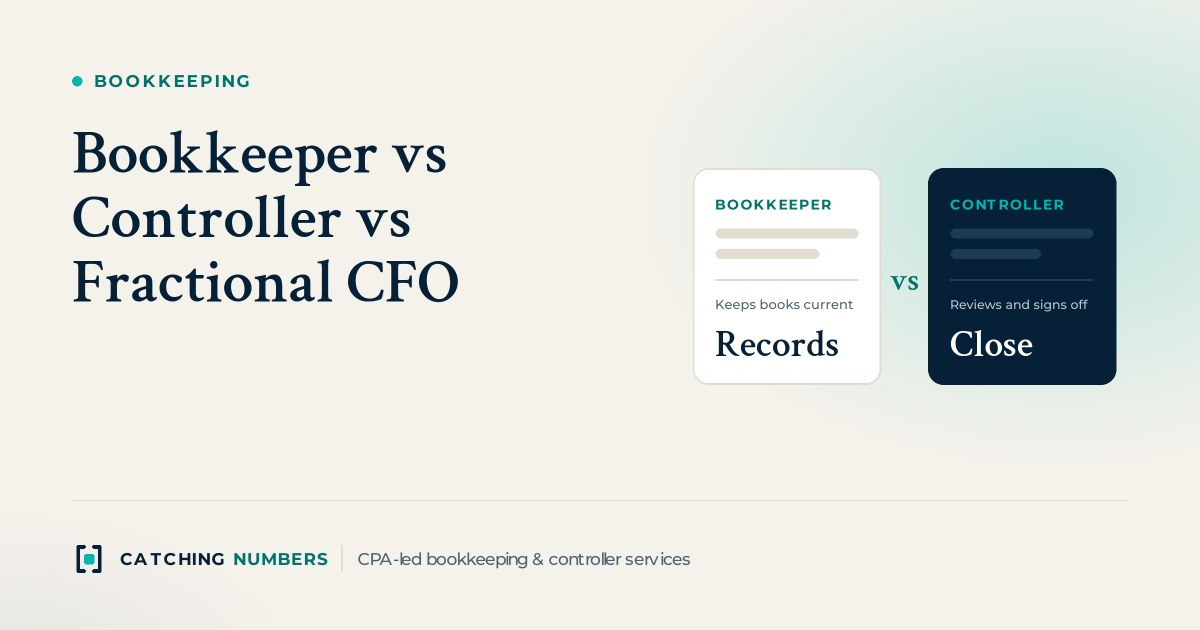
Bookkeeper vs controller vs fractional CFO comes down to three different jobs: a bookkeeper records and reconciles what happened, a controller makes sure the monthly numbers are complete and correct and closes the books, and a fractional CFO uses those numbers to plan cash, budgets and fundraising. Most companies need a bookkeeper first, add a controller once they need accrual books, investors or lenders, and add CFO time when big decisions depend on a forecast. Below we explain what each role does, the signs you need the next one, and a worked example of a company moving up.
Key takeaways
- A bookkeeper keeps the books current, a controller makes them right and closes the month, and a CFO looks ahead.
- The roles stack: a forecast is only as good as the close under it, and the close is only as good as the bookkeeping under that.
- You usually need a controller when you switch to accrual accounting, report to investors, a board or a lender, or your monthly numbers keep arriving late.
- Few growing companies need any of these full-time at first, which is why outsourced and fractional versions exist.
Bookkeeper vs controller: what is the difference?
The short version of bookkeeper vs controller: the bookkeeper does the recording, the controller owns the result. The U.S. Bureau of Labor Statistics describes bookkeeping, accounting and auditing clerks as the people who compute, classify and record financial data so a business has complete records. It lists controllers as a type of financial manager who directs the preparation of financial reports and oversees the accounting function (BLS, bookkeeping clerks; BLS, financial managers).
In day-to-day terms, a bookkeeper categorizes transactions, reconciles bank and card accounts, enters bills and invoices, and keeps payroll and payment processor activity posted correctly. A controller reviews that work, books the adjustments a bookkeeper usually does not (accruals, prepaid expenses, deferred revenue, depreciation, inventory and cost of goods sold), reconciles every balance sheet account, and signs off on the financial statements. A controller also owns internal controls: who can approve a bill, who can add a vendor, who can move money.
A fractional CFO works on what comes next: a cash forecast, the annual budget, pricing and margin analysis, the model for a fundraise and the board pack. The CFO does not usually close the books; they rely on the controller to hand them numbers they can trust.
What does each role do? A side-by-side comparison
| Bookkeeper | Controller | Fractional CFO | |
|---|---|---|---|
| Main question answered | What happened? | Are the numbers complete and right? | What should we do next? |
| Typical work | Categorizing, bank and card reconciliations, bills, invoices, payroll entries | Month-end close, accruals and deferrals, balance sheet reconciliations, financial statements, internal controls | Cash forecasts, budgets, financial models, KPIs, board and investor reporting, fundraising |
| Time frame | Daily to weekly | Monthly, quarterly and year-end | Next 13 weeks to next 3 years |
| Basis of accounting | Often cash basis | Usually accrual basis (GAAP) | Builds on accrual numbers |
| Main output | Up-to-date, reconciled ledger | Closed month and reviewed financial statements | Forecast, budget, board pack |
| Usually needed when | From the first sale | Investors, lenders, a board, inventory or deferred revenue | Raising money, tight cash, big hiring or market decisions |
When do you need a controller instead of just a bookkeeper?
You need controller-level work when the books have to be right on an accrual basis, on a deadline, for someone outside the company. In our experience these are the signs:
- You are switching from cash to accrual books, or an investor or lender has asked for accrual financials.
- You sell annual subscriptions or prepaid packages and need deferred revenue, or you hold inventory and need cost of goods sold that ties to a count.
- Monthly statements arrive late, change after you have seen them, or nobody can explain a balance sheet account.
- You now have more than one entity, currency or location to consolidate.
- You are preparing for an audit, a review or due diligence.
- One person enters bills, approves them and pays them, with no second set of eyes.
That last point matters more than it looks. Separating who records, who approves and who pays is a basic control, and it is hard to set up when one bookkeeper does everything. A controller designs those approvals in whatever system you use, whether that is QuickBooks Online, Xero, NetSuite, Sage Intacct or an AI-native ledger such as Rillet or Digits, and in tools like Buildium, AppFolio or Givebutter for property managers and nonprofits.
If those signs sound familiar, our outsourced controller services add a CPA-led close and controller review on top of the bookkeeping, with monthly statements by the 7th to 10th business day.
When do you need a fractional CFO?
You need CFO time when a decision depends on what the numbers will look like, not just what they were. Common triggers are planning a raise, cash that is tight or hard to predict, a board or lender that expects a budget and variance reporting, or revenue that grows while profit does not. If runway is the worry, start with our free cash runway calculator to see how many months of cash you have at today’s burn.
The order matters. We often get this question from founders in roughly these words: “Can we skip the controller and just hire a CFO to build our model?” Our answer is usually no. A model built on books that have not been closed properly starts from the wrong cash balance, the wrong margin and the wrong burn. If the monthly numbers are late or keep changing, fix the close first and add CFO time once it is reliable.
How do the costs compare with full-time hires?
The gap between the roles is large. According to BLS, the median annual wage was $50,670 for bookkeeping, accounting and auditing clerks and $166,570 for financial managers, the group that includes controllers, both as of May 2025 (BLS, checked November 16, 2026). Those are salaries only, before benefits, payroll taxes, bonus, equity and recruiting costs, and many companies only need a controller or CFO for part of each month.
That is why outsourced and fractional models are common for growing companies: you pay for the share of each role you use. With us, basic monthly bookkeeping starts at $199 a month, and our pricing page shows the ranges for plans that add the month-end close, controller review and fractional CFO support. For a deeper look at controller fees, see our guide to outsourced controller cost.
A worked example: one company, three stages
Here is an illustrative SaaS company with round numbers, to show how the need changes. It is not a client.
- Year one: bookkeeper. Two founders, $20,000 a month of revenue on monthly plans through Stripe, one bank account and one card. A bookkeeper reconciles the accounts, posts Stripe payouts gross of fees, and sends a profit and loss and balance sheet each month. Cash basis is fine for now.
- Year two: add a controller. Revenue reaches $100,000 a month, half of new customers pay annually upfront, and the company raises a seed round. A $12,000 annual contract paid in January is not $12,000 of January revenue; under accrual accounting it is $1,000 a month for 12 months, with the rest held as deferred revenue. The controller sets up that schedule, accrues unpaid contractor invoices, reconciles every balance sheet account and closes the month on a fixed calendar so investor updates use final numbers.
- Year three: add CFO time. The team plans to double headcount and raise a Series A. With a reliable close, a fractional CFO builds a 13-week cash forecast and a three-year model, tests hiring plans against runway, and prepares the board pack and data room.
Notice that nothing was replaced. The bookkeeping kept running in year three; the controller and CFO work sat on top of it.
Which one does your company need right now?
- Bookkeeper: you need clean, reconciled books every month, a simple profit and loss, and a year-end package for your tax CPA.
- Bookkeeper plus controller: you need accrual books, a dependable close date, reviewed financial statements for investors, lenders or a board, or tighter controls.
- All three: you are raising money, managing tight cash, or making hiring and market decisions that need a forecast.
If your books are behind, start there. About 7 in 10 of our new clients arrive with at least one unreconciled bank or card account, and no controller or CFO can work around that. Get current first, then build up. Our outsourced bookkeeping covers the first layer, and we add the close, controller review and CFO support as one team when you are ready, so the forecast and the books always agree. We keep your books tax-ready and work alongside your tax CPA, who prepares and files your returns.
Frequently asked questions
Is a controller the same as an accountant?
No. “Accountant” is a broad term, while a controller is a specific management role that runs the accounting function and owns the financial statements. Many controllers are accountants, often CPAs, but most accountants are not controllers.
Does a controller need to be a CPA?
No, there is no legal requirement for a controller to hold a CPA license. Many employers and investors prefer one, because a CPA has been tested on accounting standards and is bound by professional ethics rules.
Can a bookkeeper do the month-end close?
A bookkeeper can handle the reconciliations that start a close, but the accruals, deferrals and final review are usually controller work. Having someone other than the person who recorded the entries review them also catches errors a single bookkeeper would miss.
Is a controller higher than a CFO?
No. In most companies the controller reports to the CFO. The controller looks after accuracy and the close, while the CFO leads finance strategy, cash, capital and investor relationships.
What is the difference between a controller and a fractional controller?
The work is the same; the difference is the arrangement. A fractional or outsourced controller does the job part-time for a monthly fee, while a full-time controller is an employee. See what a fractional controller does for more.
Can one firm provide the bookkeeper, controller and CFO?
Yes. Many outsourced accounting firms, including ours, offer all three layers as one team. The benefit is that the person building your forecast works from the same books the controller closed, so there is no reconciling between providers.
Not sure which level you need?
Book a free consultation. We will look at where your books stand and recommend bookkeeping, controller or CFO support, with a fixed monthly fee in writing.