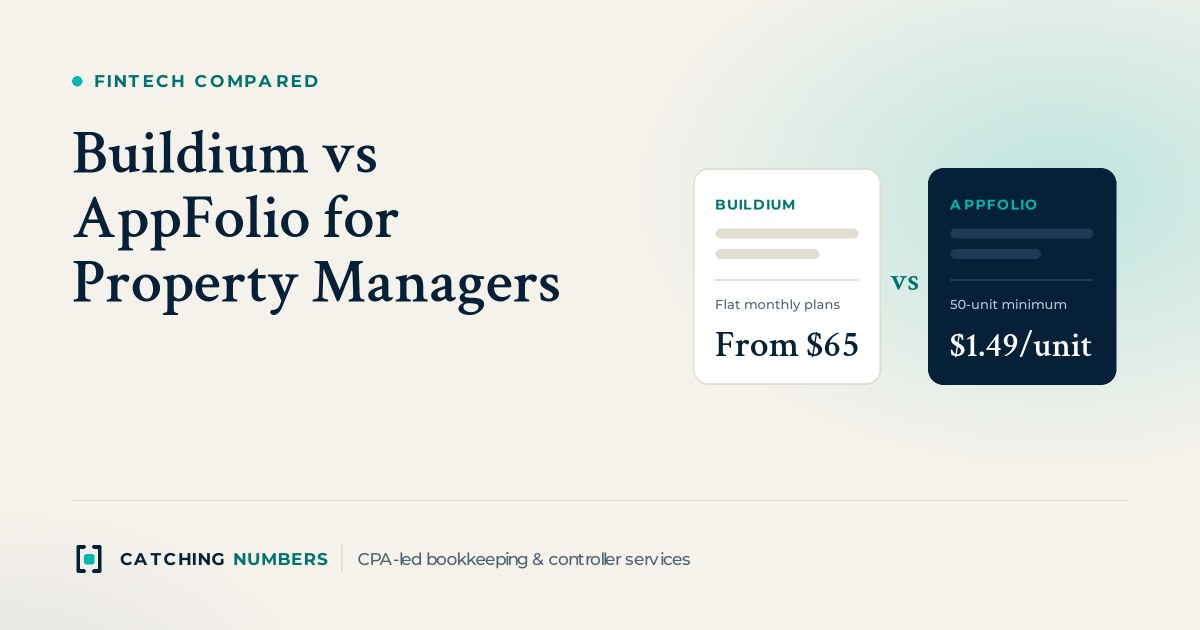
Buildium is usually the better fit for smaller and growing property managers who want published, flat monthly pricing (plans start at $65, $202 and $420 a month) and the option to start below 50 units. AppFolio is usually the better fit for larger portfolios of 50 units or more that want per-unit pricing (starting at $1.49 per unit a month on its Core plan), management-company books in the same system, and more built-in AI for the month-end close. Both run full property accounting with bank reconciliation, owner distributions and owner portals; the right choice depends on portfolio size, how you pay and collect money, and who closes your books each month.
Key takeaways
- Buildium publishes flat monthly starting prices and fixed ePay fees; AppFolio prices per unit with a 50-unit minimum and a minimum spend on Core.
- AppFolio keeps your management company’s own books in the same platform; Buildium focuses on the properties and connects to other tools through its marketplace and, on Premium, an open API.
- Neither tool removes the need for a monthly close: trust bank reconciliations, owner statement review and tax-ready books still take a person.
- Get payment fees, onboarding costs and minimums in writing before you sign, because neither vendor publishes every figure.
How do Buildium and AppFolio compare on price and features?
Here is the side-by-side, using only what each company publishes on its own pricing and feature pages, checked November 7, 2026.
| Buildium | AppFolio | |
|---|---|---|
| Plans and starting price | Essential from $65/month, Growth from $202/month, Premium from $420/month | Core from $1.49 per unit/month, Plus from $3.20, Max from $5.00 |
| Minimums | No unit minimum published; portfolios over 5,000 units are asked to call | Core: minimum spend and 50-unit minimum; Plus and Max: minimum spend and units apply |
| Onboarding | Required on Growth and Premium, with additional fees | No onboarding fee published |
| Online rent payments | Incoming EFT $2.35 (Essential), $1.35 (Growth), $0.60 after 12 free months (Premium); cards 2.99%; outgoing EFT $0.99 | Online payments and eCheck offered; fees not published on the pages we checked |
| Bank reconciliation | Automatic matching of bank statements, with reconciliation rules | Auto Bank Reconciliation through Plaid |
| Owner reporting | Owner portal and rental owner statements | Owner portal with statements, contributions, documents and 1099s |
| Management company books | Not described as a separate feature | Corporate Accounting in the same platform |
| AI for accounting | Not a headline feature on the pricing page | Realm-X on every plan; Accounting Performer for bill entry and close on Plus and Max |
| 1099s | E-filing add-on: $50 per batch plus $4.50 per form | 1099s can be shared in the owner portal; e-filing pricing not published |
| Integrations | Marketplace; open API on Premium | AppFolio Stack integrations; read-only API on Plus, read/write on Max |
| Free trial | 14 days, no credit card | Not published; pricing page directs you to contact sales |
Prices are starting prices. Your quote will depend on units, add-ons and contract terms, so treat the table as a starting point for the sales call, not the final number.
Which is cheaper, Buildium or AppFolio?
For small portfolios, Buildium is usually cheaper and always easier to estimate. Its plans are flat starting prices, and a landlord or new manager with a few dozen doors can sign up without meeting a unit minimum. AppFolio’s Core plan requires at least 50 units plus a minimum monthly spend that AppFolio does not publish, so below 50 units it is not an option.
As a portfolio grows, the math gets closer. At 300 units, AppFolio Core at its starting rate is about $447 a month in software (300 × $1.49), close to Buildium Premium’s $420 starting price. That simple comparison leaves out the costs that move the total most:
- Payment fees. Buildium’s incoming EFT fee drops from $2.35 to $1.35 to $0.60 as you move up plans. On a few hundred electronic rent payments a month, that difference can outweigh the plan price gap. Ask AppFolio for its fee schedule and who pays each fee.
- Onboarding. Buildium requires paid onboarding on Growth and Premium. Ask both vendors for the one-time cost in writing.
- Bank accounts. Buildium charges $99 per business bank account set up for ePay, with 10 free on Growth and 100 free on Premium. Managers who keep a separate trust account per owner should count accounts before choosing a plan.
- Add-ons. 1099 e-filing, screening, insurance and other services can be priced separately on either platform.
What does each mean for your books and month-end close?
This is where we spend most of our time with property management clients, and where the two products differ in practice.
Trust accounting and the three-way reconciliation
Both platforms reconcile bank accounts: Buildium through automatic matching of bank statements and reconciliation rules, AppFolio through a Plaid bank connection. Buildium also says it provides a suite of reports to help you follow trust accounting rules. Neither one replaces the monthly three-way reconciliation, where the bank balance, the trust account book balance and the total of every owner and tenant ledger must agree. Software makes the tie-out faster. A person still has to clear the reconciling items, chase uncleared deposits and sign off.
Owner statements and distributions
Both products produce owner statements and publish them to an owner portal. AppFolio’s owner portal shows statements, contributions, inspection reports, documents and 1099s, and lets owners contribute funds online by card or eCheck. AppFolio also advertises sending distributions without exporting to a spreadsheet and an automatic true-up on distributions. Whichever you use, review statements before they go out: a miscoded repair or an unapplied tenant payment shows up first as an owner phone call.
Your management company’s own books
This is the biggest structural difference. AppFolio’s Corporate Accounting puts the management company’s books (management fee income, payroll, overhead) in the same platform as the properties. With Buildium, many managers keep the operating company’s books in a separate general ledger such as QuickBooks Online or Xero. On the pages we checked, neither vendor names a direct QuickBooks Online sync, so plan how management fees and owner-paid expenses will reach your company books each month.
Payables, bill entry and automation
AppFolio’s Realm-X Accounting Performer, on the Plus and Max plans, codes bills and helps with reconciliation and month-end close steps. Treat vendor accuracy and time-saved figures as claims to test during a demo with your own invoices. Buildium does not headline AI for payables on its pricing page; it offers 1099 e-filing for owners and vendors as a paid add-on. In both, set approval rules so no one person can create a vendor, enter a bill and release payment.
When should you choose Buildium, and when AppFolio?
Choose Buildium if you manage fewer than 50 units or are growing toward a few hundred, you want published pricing you can budget around, you want to try the product before talking to sales, or you already keep your company books in QuickBooks Online, Xero or another ledger and want to keep it that way.
Choose AppFolio if you manage 50 units or more (often many more), you want the management company and the properties in one system, you value AI help with bill entry and the close, or you need deeper leasing and maintenance automation on the higher plans.
If you are switching from one to the other, plan the move at a month-end. Convert opening balances by owner and tenant ledger, carry over security deposit liabilities, and run one parallel three-way reconciliation in both systems before you shut the old one off. Our real estate accounting team works in Buildium and AppFolio alongside QuickBooks Online, Xero, NetSuite, Sage Intacct and AI-native ledgers such as Rillet and Digits, so we can help with the conversion and the first close.
How we compared
This comparison was prepared by Catching Numbers, a CPA-led accounting firm in Secaucus, New Jersey, that keeps books and runs the monthly close for property managers and real estate investors. All pricing and features come from each company’s own pages, checked November 7, 2026: Buildium pricing, Buildium accounting, Buildium 1099 e-filing, AppFolio pricing, AppFolio accounting and the AppFolio owner portal help page. Where a vendor does not publish a figure, we say so rather than estimate it. We did not run a hands-on test for this article, and neither company paid for or reviewed it. Pricing changes often, so confirm current terms with each vendor.
Frequently asked questions
Is AppFolio better than Buildium?
Neither is better for everyone. AppFolio generally suits portfolios of 50 units or more that want corporate accounting and AI tools in one platform, while Buildium generally suits smaller or growing managers who want published flat pricing and no unit minimum.
Who owns Buildium?
Buildium is owned by RealPage, and its site is branded “Buildium, A RealPage Company.” RealPage agreed to buy Buildium in November 2019 for $580 million in cash.
Does AppFolio or Buildium integrate with QuickBooks?
Neither names a direct QuickBooks Online sync on its pricing or accounting pages. Both are full accounting systems for the properties, so the usual setup is to keep property books in the platform and, if needed, post summary entries for the management company into QuickBooks Online or another ledger each month.
Can I use AppFolio with fewer than 50 units?
Not on the Core plan, which AppFolio says carries a 50-unit minimum and a minimum spend. Smaller landlords and managers usually look at Buildium or a landlord-focused tool instead; our rental property bookkeeping guide covers the setup either way.
Can I file owner and vendor 1099s from Buildium?
Yes, as a paid add-on: Buildium charges $50 per batch plus $4.50 per form, and digital copies to recipients are free when filed through Buildium. Check owner and vendor tax IDs well before the 1099 filing deadline.
Do I still need a bookkeeper if I use Buildium or AppFolio?
Usually, yes. The software records transactions, but someone still has to complete the three-way reconciliation, review owner statements, keep the management company’s books and hand tax-ready numbers to your tax CPA.
Do you work in Buildium and AppFolio?
Yes. Catching Numbers runs trust reconciliations, owner statements and month-end closes in Buildium and AppFolio, and keeps management company books in QuickBooks Online, Xero, NetSuite, Sage Intacct, Rillet or Digits. We can also help you switch platforms at a clean month-end.
Want a clean close in Buildium or AppFolio?
We run trust reconciliations, owner statements and the management company’s books every month, in whichever platform you use. Book a free consultation and we will look at your setup.