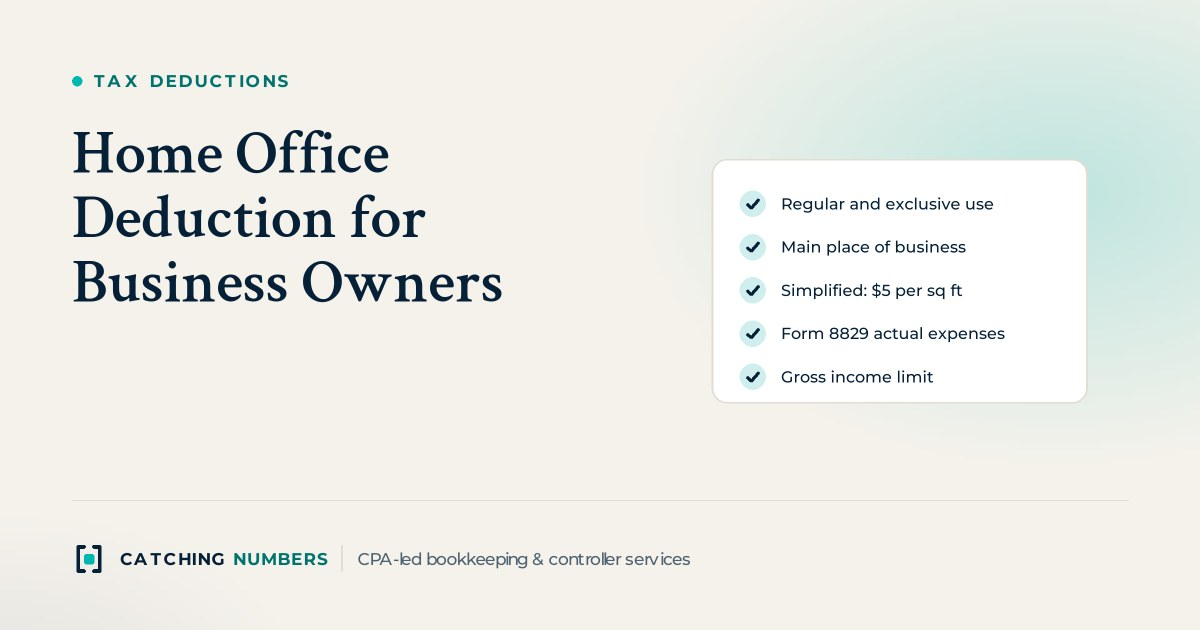
The home office deduction lets you deduct part of the cost of your home when you use a specific area of it regularly and exclusively for your business, and it is your principal place of business or a place where you meet clients. For 2025 returns, sole proprietors and single-member LLC owners can claim it on Schedule C using either the simplified method ($5 per square foot, up to 300 square feet) or actual expenses on Form 8829. Partners claim it as unreimbursed partnership expenses, and S corp and C corp owner-employees generally cannot claim it on their personal returns; instead, the corporation reimburses them under an accountable plan.
Key takeaways
- The space must be used regularly and exclusively for business, and be your principal place of business (or a client meeting place or separate structure).
- The simplified method is $5 per square foot up to 300 square feet, a maximum of $1,500, with no depreciation and no carryover.
- The regular method on Form 8829 can produce a larger deduction, but it includes depreciation you cannot exclude from gain when you sell.
- The deduction cannot exceed the gross income from the business use; under the regular method the excess carries forward.
- Employees, including S corp owner-employees, get no deduction for unreimbursed home office costs, now permanently. The fix is an accountable plan reimbursement.
Who qualifies for the home office deduction?
The rules come from Internal Revenue Code section 280A and are explained in IRS Publication 587 (2025). A part of your home has to pass these tests:
- Exclusive use. A specific, identifiable area is used only for your business. A den that doubles as the family TV room fails.
- Regular use. You use the area on a regular basis, not just now and then.
- Trade or business. The use is for an actual business, not for managing your own investments.
- Location. The space is your principal place of business, a place where you physically meet clients or customers in the normal course of business, or a separate structure used for the business.
What is the administrative or management activities test?
Many owners do the real work at client sites or on the road. Your home office can still be your principal place of business if you use it regularly and exclusively for administrative or management activities (billing, bookkeeping, ordering, scheduling) and there is no other fixed location where you do substantial administrative or management work.
Are there exceptions to the exclusive use rule?
Two, briefly. If you sell products at wholesale or retail and your home is the only fixed location of your business, space used regularly to store inventory or product samples can qualify without exclusive use. And licensed (or exempt) day care providers can deduct space used regularly for day care even when the family also uses it, prorated by hours of use.
Simplified method vs regular method: which one should you use?
You choose a method each year on a timely filed original return, and you can switch from year to year. The simplified method comes from Rev. Proc. 2013-13, summarized in IRS Topic 509.
| Tax year 2025 | Simplified method | Regular method (Form 8829) |
|---|---|---|
| How it is figured | $5 x business square feet | Direct expenses plus business share of indirect expenses |
| Maximum | 300 sq ft, so $1,500 | No fixed cap |
| Depreciation | None (treated as zero) | Yes, 39-year straight line on the business share |
| Gross income limit | Applies | Applies |
| Carryover of excess | No | Yes, to the next year you use actual expenses |
| Mortgage interest and property tax | Fully on Schedule A if you itemize | Business share on Form 8829, rest on Schedule A |
Under the regular method, you deduct direct expenses (such as painting the office) in full and indirect expenses (mortgage interest, real estate taxes, rent, utilities, insurance, general repairs) by the business percentage, usually office square feet divided by total home square feet. Owners also depreciate the business share of the home’s basis (the lesser of adjusted basis or fair market value when business use began, excluding land) over 39 years.
How does the gross income limitation work?
The deduction cannot create or increase a business loss. Under section 280A(c)(5), it is limited to the gross income from the business use of the home, minus your other business expenses. Under the regular method, anything disallowed carries forward to the next year you use actual expenses. Under the simplified method, the excess is lost.
How does it work for sole proprietors, partners and S corp owners?
Your entity type decides where, and whether, the deduction shows up. See our guide to owner’s draw vs salary for how each structure pays owners.
| Owner type (tax year 2025) | How home office costs are handled |
|---|---|
| Sole proprietor or single-member LLC | Deduct on Schedule C, with Form 8829 (regular) or the simplified worksheet. It reduces net profit, so it also reduces self-employment tax. |
| Partner or multi-member LLC member | Deduct as unreimbursed partnership expenses on Schedule E, line 28, labeled “UPE,” only if the partnership agreement requires you to pay them. |
| S corp owner-employee | No personal deduction. The S corp reimburses you under an accountable plan and deducts the reimbursement. |
| C corp owner-employee | Same as S corp: no personal deduction; use an accountable plan. |
Why the employee rule? Unreimbursed employee expenses are miscellaneous itemized deductions, which the 2017 tax law suspended for 2018 through 2025. The One Big Beautiful Bill Act (P.L. 119-21, section 70110) made that permanent: IRC 67(h) now disallows them for any tax year beginning after December 31, 2017. S corp and C corp owners who work in the business are employees, so the clean route is a company reimbursement under an accountable plan. Under Treasury Regulation 1.62-2, the expense needs a business connection, you must substantiate it within a reasonable time, and you must return any excess. Reimbursements that meet those rules are not wages. An employee’s exclusive use must also be for the employer’s convenience, so document why the company needs the space.
One trap: section 280A(c)(6) denies the deduction for a home office you rent to your own employer. Renting your home to your company for a few meetings a year is a separate rule; see our post on the Augusta rule 14-day rental.
Does it matter whether you rent or own your home?
Yes. Renters deduct the business percentage of rent, utilities and renter’s insurance, with no depreciation to worry about. Owners cannot deduct a “fair rental value” for their own home; they deduct the business share of mortgage interest, real estate taxes, insurance, utilities and repairs, plus depreciation.
Depreciation is where owners need to think ahead. Publication 587 says you cannot exclude the part of any gain equal to depreciation allowed or allowable after May 6, 1997, even if the rest qualifies for the home sale exclusion of up to $250,000 ($500,000 for certain joint filers). That amount is unrecaptured section 1250 gain, taxed at a maximum 25% rate per IRS Topic 409. If the office was inside the home rather than a separate structure, you generally do not need to split the gain.
What does a worked example look like?
Illustrative round numbers, not a real client: a sole proprietor owns a 2,000 square foot home and uses a 200 square foot room exclusively and regularly as the only office for her consulting business, so the business percentage is 10%. Her income easily covers the deduction.
| Illustrative example, tax year 2025 | Annual total | Business share (10%) |
|---|---|---|
| Mortgage interest | $12,000 | $1,200 |
| Real estate taxes | $8,000 | $800 |
| Homeowner’s insurance | $1,500 | $150 |
| Utilities | $3,500 | $350 |
| General repairs | $1,000 | $100 |
| Depreciation: $300,000 building basis (no land) x 10% / 39 years, full year | about $770 | |
| Regular method total | about $3,370 | |
| Simplified method: 200 sq ft x $5 | $1,000 |
The regular method gives her about $2,370 more in Schedule C deductions. The trade-offs: under the simplified method, all $20,000 of mortgage interest and taxes stays available on Schedule A if she itemizes, and she builds up no depreciation. Under the regular method, five full years would add about $3,850 of depreciation that becomes taxable when she sells. Run both with your tax CPA, and use our estimated tax calculator to see how a lower Schedule C profit changes your quarterly payments.
What does the IRS commonly disallow?
This is a legitimate deduction written into the tax code, not a loophole. Claims usually fail on the facts:
- Mixed use: a guest room, kitchen table or family den also used personally.
- An owner with a company office elsewhere who does substantial admin work there.
- W-2 employees, including S corp owners, claiming it on their personal return.
- Deductions larger than the business’s gross income allows.
- Mortgage interest or taxes counted on both Form 8829 and Schedule A.
- No measurements, photos or expense records to support the claim.
How do you record the home office deduction in your books?
In QuickBooks Online, Xero, NetSuite, Sage Intacct or AI-native platforms such as Rillet and Digits, the treatment depends on the entity:
- Sole proprietors and single-member LLCs. Home costs are usually paid personally, so they stay out of the business ledger. Keep a home office schedule (square footage, annual expenses, basis) for your tax CPA. If you pay a home bill from the business account, code the personal share to owner’s draw.
- Partnerships. Unreimbursed partnership expenses belong on the partner’s own return, so keep them out of the partnership’s books, and confirm the partnership agreement says partners bear them.
- S corps and C corps. The owner submits a monthly or quarterly expense report showing the business share of actual home costs. The company pays it and records it to an expense account such as “Home office reimbursement,” separate from payroll. Nothing goes on the W-2.
- Close the loop at year end. Tie the schedule or reimbursements to source documents before your tax CPA starts. Our outsourced bookkeeping team builds this into the monthly close.
What documentation should you keep?
- Measurements of the office and the whole home, plus dated photos
- Form 1098, property tax bills, insurance, utility bills or your lease
- Closing statement, improvement receipts and a depreciation schedule
- Notes showing the business work done in the office and that no other fixed location is used for admin
- For corporations, a written accountable plan and each signed expense report
Frequently asked questions
Can W-2 employees take the home office deduction?
No. Unreimbursed employee expenses are miscellaneous itemized deductions, which IRC 67(h) disallows for tax years beginning after December 31, 2017. The One Big Beautiful Bill Act removed the 2025 end date, so the disallowance is now permanent. Employees can only be reimbursed tax-free by their employer under an accountable plan.
Can an S corp owner take the home office deduction?
Not on their personal return, because an S corp owner who works in the business is an employee. Instead, the S corp can reimburse the business share of home expenses under an accountable plan. The company deducts the reimbursement and it is not wages to the owner, as long as the plan meets the Treasury Regulation 1.62-2 rules.
What is the simplified home office deduction for 2025?
It is $5 per square foot of the area used for business, up to 300 square feet, for a maximum of $1,500. There is no depreciation and no carryover of any amount limited by income. The rate has been $5 since Rev. Proc. 2013-13 created the method, and Publication 587 (2025) confirms it for 2025 returns.
Can I switch between the simplified and regular method?
Yes. You choose each year on a timely filed original return, and the choice cannot be changed for that year. If you go back to the regular method after using the simplified method, you figure depreciation using the optional MACRS tables in Publication 946.
Does my home office have to be a separate room?
No. Publication 587 says the area can be a room or other separately identifiable space, and it does not need to be marked off by a permanent partition. A corner of a room can qualify if nothing personal happens there.
Can I claim a home office if I also have an office elsewhere?
Sometimes. If you regularly meet clients at home, or the office is a separate structure, it can qualify. If you rely on the administrative or management test, you cannot have another fixed location where you do substantial admin or management work.
Can renters take the home office deduction?
Yes. Renters deduct the business percentage of rent, plus the same share of utilities, renter’s insurance and general repairs. Because there is no depreciation, renters have nothing to recapture later.
Do I pay tax on home office depreciation when I sell my house?
Generally yes. You cannot exclude gain equal to depreciation allowed or allowable after May 6, 1997, and that unrecaptured section 1250 gain is taxed at up to 25%. The rest of the gain may still qualify for the home sale exclusion if you meet the ownership and use tests.
Can I take the home office deduction if my business had a loss?
The deduction cannot exceed the gross income from the business use of your home minus other business expenses, so it cannot create or increase a loss. Under the regular method, the disallowed amount carries forward to the next year you use actual expenses. Under the simplified method, it does not carry forward.
Does the home office deduction reduce self-employment tax?
For sole proprietors and single-member LLCs, yes. The deduction is taken on Schedule C, so it lowers net profit, which is the base for self-employment tax as well as income tax.
How do partners deduct home office expenses?
Partners report them as unreimbursed partnership expenses on Schedule E, line 28, on a separate line marked “UPE.” This only works if the partnership agreement requires the partner to pay those expenses, and the amount is figured with the worksheet in Publication 587 rather than Form 8829.
Can I store inventory at home and deduct the space?
Yes, if you sell products at wholesale or retail, your home is the only fixed location of the business, and you regularly use a separately identifiable space to store inventory or product samples. That space does not have to be used exclusively for business.
Want home office costs tracked right all year?
We keep your books tax-ready, set up clean reimbursement tracking and hand your tax CPA a documented schedule. Book a free consultation and we will quote a fee based on what you actually need.