An accountable plan is a written reimbursement arrangement that lets a business pay back owners and employees for business expenses they cover personally, without those payments counting as wages. If the plan meets three IRS tests in Treas. Reg. 1.62-2 (a business connection, timely substantiation and the return of any excess), the reimbursement is tax-free to the employee, stays off the W-2 and is deductible by the company. For S corp and C corp owner-employees, it is often the only way to get a tax benefit for a home office, phone or mileage.
Key takeaways
- An accountable plan must require a business connection, substantiation within a reasonable period and the return of any excess. Miss one and every payment under the arrangement is treated as wages.
- The IRS safe harbor treats substantiation within 60 days and the return of excess within 120 days of the expense as reasonable.
- Employees, including S corp owner-employees, cannot deduct unreimbursed employee expenses. The One Big Beautiful Bill Act made that rule permanent, so reimbursement is the route.
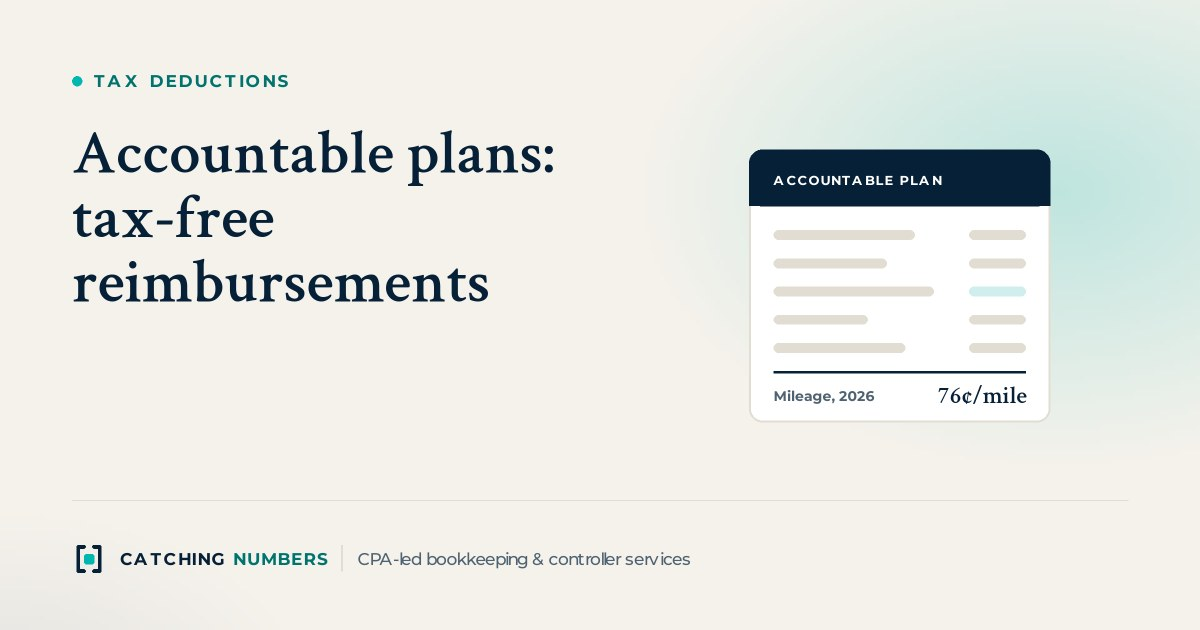
- The business standard mileage rate is 70 cents for 2025, 72.5 cents for January to June 2026 and 76 cents from July 1, 2026.
- Partners are not employees. Their expenses run through the partnership agreement instead.
What is an accountable plan?
An accountable plan is not a form you file. It is a company policy for paying people back. Under Treas. Reg. 1.62-2(c), it qualifies only if it meets all three requirements:
- Business connection. The plan covers only deductible business expenses the employee pays or incurs while working for the company (Reg. 1.62-2(d)). A plan that pays a set amount whether or not any expense happened fails this test entirely.
- Substantiation. The employee proves each expense to the company within a reasonable period (Reg. 1.62-2(e)). Lumping costs into broad categories is not enough; travel, gifts and vehicle costs also need the amount, time, place and business purpose required by section 274(d).
- Return of excess. The employee must give back any advance or allowance beyond the substantiated expenses within a reasonable period (Reg. 1.62-2(f)).
Reg. 1.62-2(g) gives two safe harbors for “reasonable period.” Under the fixed date method, an advance paid within 30 days of the expense, substantiation within 60 days after it and return of excess within 120 days after it are reasonable. Under the periodic statement method, the company sends at least quarterly statements of outstanding amounts, and the employee has 120 days to substantiate or repay.
Accountable plan vs nonaccountable plan: what’s the difference?
Accountable plan payments are excluded from the employee’s income and stay off Form W-2. Fail any test and it is a nonaccountable plan: under Reg. 1.62-2(c)(5), payments are reported as W-2 wages subject to income tax withholding and employment taxes. A flat monthly “expense allowance” with no receipts is the classic example.
Per diem and mileage allowances sit in between. If you pay at or below the federal rate and the employee substantiates time, place and business purpose, the allowance is treated as substantiated. Any amount above the federal rate that is not returned is wages, and the 2026 Form W-2 instructions say to report the substantiated, nontaxable portion in box 12 with code L.
Why does an accountable plan matter so much for S corp and C corp owners?
If you own an S corp or C corp and take a salary, you are an employee of your company. Employee business expenses were miscellaneous itemized deductions, and the 2017 tax law suspended those for 2018 through 2025. The One Big Beautiful Bill Act (P.L. 119-21) removed the end date, so IRC section 67(h) now denies miscellaneous itemized deductions for any tax year beginning after December 31, 2017, with no sunset. Starting in 2026 the law carves out certain educator expenses, but nothing for business owners.
So if you pay company costs on your personal card and never get paid back, the deduction is usually lost. Reimbursed under an accountable plan, the company deducts the cost (subject to normal limits, such as the 50% limit on most meals) and you receive the money tax-free, which beats covering the same costs with extra salary or a distribution (see owner’s draw vs salary). Because these reimbursements are not wages, they do not raise your taxable income; our estimated tax calculator can help you check quarterly payments.
What expenses can an accountable plan reimburse?
Any ordinary and necessary business expense the employee pays for the company can qualify. The most common ones for owner-employees are below. Rates are for tax year 2026, checked October 21, 2026.
| Expense type (2026) | How to substantiate | How the reimbursement is booked |
|---|---|---|
| Home office share | Office and total square footage, plus the month’s rent or mortgage interest, utilities, insurance and repairs | Rent or home office reimbursement expense, paid outside payroll |
| Cell phone | Monthly bill plus a stated business-use percentage tied to how the phone is actually used | Telephone expense |
| Home internet | Monthly bill plus business-use percentage | Internet or utilities expense |
| Business mileage in a personal car | Mileage log: date, destination, business purpose, miles; paid at 72.5 cents (Jan 1 to Jun 30) or 76 cents (Jul 1 to Dec 31) | Auto or mileage reimbursement expense |
| Travel (airfare, lodging, rideshare) | Receipts for all lodging and any expense of $75 or more, plus time, place and business purpose | Travel expense, by category |
| Meals and incidentals on travel (per diem) | Trip dates, location and business purpose; no meal receipts needed at or below the federal rate | Travel meals expense (tracked separately for the meals limit) |
| Business meals with clients | Receipt, attendees, business relationship and topic discussed | Meals expense (tracked separately for the 50% limit) |
The $75 receipt threshold and the lodging receipt rule come from Treas. Reg. 1.274-5(c)(2)(iii). Mileage rates come from the IRS standard mileage rates page: 70 cents for 2025, 72.5 cents for travel from January 1 to June 30, 2026 under Notice 2026-10, and 76 cents from July 1, 2026 under Announcement 2026-11, which applies to mileage allowances paid on or after that date.
Two items need extra care. An employee home office must be used regularly and exclusively for business and, under IRC section 280A(c)(1), for the employer’s convenience; our home office deduction guide covers the space calculation. For phones, an IRS examiner memo (SBSE-04-0911-083) says reimbursements generally need not be treated as wages when there is a real business reason, the amount is reasonable and it does not replace salary.
How do per diem rates work?
Instead of tracking every hotel and meal receipt, a company can pay a daily allowance at or below the federal rate for the destination. GSA sets the continental US rates, IRS Publication 1542 explains them, and the IRS publishes a simpler high-low method each fall.
| High-low per diem (checked October 21, 2026) | High-cost locality | All other CONUS localities |
|---|---|---|
| Oct 1, 2025 to Sep 30, 2026 (Notice 2025-54) | $319 total, $86 meals | $225 total, $74 meals |
| From Oct 1, 2026 (Notice 2026-60) | $329 total, $86 meals | $230 total, $74 meals |
One rule trips up owners. Under section 6.07 of Rev. Proc. 2019-48, an employee related to the company, including one owning more than 10% of it, cannot use the lodging plus meals per diem or the high-low method. That owner can still receive a meals and incidentals only per diem, with lodging reimbursed at actual cost. Everyone on per diem must still document the time, place and business purpose of each trip.
What should a written accountable plan include?
A written plan adopted by board or owner resolution is the best evidence the rules existed before the money moved. A simple outline:
- Purpose and who is covered (all employees, including owner-employees)
- Eligible expense types, and items the plan will not reimburse
- Substantiation rules: receipts, logs and business purpose for each category
- Deadlines: submit within 60 days of the expense; return any excess within 120 days
- Mileage and per diem method, tied to the current IRS and GSA rates
- Home office and phone calculation method
- Approval process, with someone other than the claimant approving where possible
- Effective date, adoption signature and record retention period
How do you run reimbursements each month?
- Collect. Each person submits one monthly expense report with receipts, mileage log and any home office or phone worksheet, often through a spend tool such as Ramp or Expensify.
- Review. Check each line against the plan: business purpose, receipt where required, correct mileage rate for the date driven.
- Approve and pay. Pay from the business account by ACH or check, separately from payroll, so reimbursements never land in wages.
- Book and file. Record each expense in its proper account and attach the report to the transaction.
How do you record accountable plan reimbursements in the books?
The approach is the same in QuickBooks Online, Xero, NetSuite, Sage Intacct and AI-native platforms such as Rillet and Digits. Set the owner up as a vendor or expense claimant, enter the approved report as a bill coded to the underlying expense accounts, and pay it from the operating account. Never run reimbursements through payroll or book them to owner’s draw, which hides the deduction. An “Employee reimbursements payable” account should be zero once every approved report is paid.
Keep the signed plan, each monthly report with receipts, mileage logs, the home office measurement and proof of payment. Our outsourced bookkeeping team keeps that file monthly so your tax CPA has what they need.
What does the IRS commonly disallow?
- Flat monthly allowances with no substantiation, which the regulation treats as wages
- Year-end lump-sum “reimbursements” built from estimates rather than records made at the time
- Mileage claims with no contemporaneous log, or commuting miles
- Home offices that are not used exclusively for business
- Personal costs relabeled as business costs, which Reg. 1.62-2(k) treats as a pattern of abuse that can taint the whole plan
How are partners different?
Partners in a partnership or multi-member LLC are not employees, so Reg. 1.62-2 does not apply to them directly. The partnership can reimburse partners for documented partnership expenses under its own policy and deduct them. Or the partnership agreement can require partners to pay certain expenses personally; the Schedule E instructions let a partner deduct those unreimbursed partnership expenses (UPE) on a separate line, but only if the agreement required the partner to pay them. Review the agreement wording with your tax CPA.
What should you do next?
Ask your tax CPA to confirm the plan fits your entity, adopt it in writing, and start the monthly cycle now rather than reconstructing a year in December. Our outsourced controller service can review and book the reports as part of the close. For two common reimbursed costs, see our guides to vehicle deductions and business meals.
Frequently asked questions
Does an accountable plan have to be in writing?
Treas. Reg. 1.62-2 does not say the plan must be written; it looks at whether the arrangement actually meets the business connection, substantiation and return of excess tests. A written plan adopted before reimbursements start is still the best evidence those rules existed. Most tax CPAs recommend one.
Can a single-member LLC or sole proprietor use an accountable plan?
Generally not for the owner, because a sole proprietor or single-member LLC owner taxed as a sole proprietor is not an employee of the business. Those owners deduct business expenses directly on Schedule C. The plan can still cover the business’s W-2 employees.
Are accountable plan reimbursements taxable to the employee?
No. Amounts paid under a plan that meets all three tests are excluded from the employee’s gross income and are not reported as wages on Form W-2. Only amounts above the federal per diem or mileage rate that are not returned become wages.
How long does an employee have to submit receipts under an accountable plan?
The rule is a “reasonable period.” Under the fixed date safe harbor in Reg. 1.62-2(g), substantiation within 60 days after the expense is paid or incurred is treated as reasonable. Excess advances must be returned within 120 days.
What happens if an employee does not return excess reimbursement?
Under Reg. 1.62-2(c)(3)(ii), the unreturned excess is treated as paid under a nonaccountable plan and is reported as wages subject to withholding and payroll taxes. A pattern of abuse can cause every payment under the arrangement to be treated as nonaccountable under Reg. 1.62-2(k).
Can an S corp reimburse the owner for a home office?
Yes, if the space is used regularly and exclusively for the company’s business, the use is for the company’s convenience, and the owner substantiates the business share of actual home costs. The company deducts the reimbursement and the owner receives it tax-free. Confirm the calculation with your tax CPA.
What is the 2026 mileage reimbursement rate?
The IRS business standard mileage rate is 72.5 cents per mile for miles driven January 1 through June 30, 2026, and 76 cents per mile from July 1, 2026, under Announcement 2026-11. The 2025 rate was 70 cents per mile.
Can unreimbursed employee expenses be deducted in 2026?
Generally no. The One Big Beautiful Bill Act made the denial of miscellaneous itemized deductions in IRC section 67 permanent for tax years beginning after December 31, 2017. Starting in 2026 there is an exception for certain educator expenses, but not for business owners or other employees.
Can a business owner use per diem rates?
Partly. Under Rev. Proc. 2019-48, an employee who owns more than 10% of the company cannot use the lodging plus meals per diem or the high-low method. That owner can use a meals and incidentals only per diem and be reimbursed for actual lodging with receipts.
Is a cell phone reimbursement taxable?
Usually not, when the employer has a real business reason for the employee to have the phone, the reimbursement is reasonable relative to actual cost, and it is not a substitute for salary. That is the IRS examiner position in memo SBSE-04-0911-083. A flat stipend paid regardless of use is riskier.
Can a partnership use an accountable plan for partners?
Partners are not employees, so the accountable plan regulation does not technically apply to them. A partnership can still reimburse partners for documented partnership expenses and deduct them. If the partnership agreement instead requires partners to bear certain costs, partners may deduct them as unreimbursed partnership expenses on Schedule E.
Where do accountable plan reimbursements go in QuickBooks?
Enter the approved expense report as a bill or expense coded to the actual expense accounts, such as travel, telephone or rent, and pay it from the business account. Do not record it through payroll or as an owner draw. The same approach works in Xero, NetSuite, Sage Intacct, Rillet and Digits.
Want reimbursements set up properly in your books?
We can set up the monthly expense report workflow, review submissions and book them correctly, then hand your tax CPA a clean file at year end.