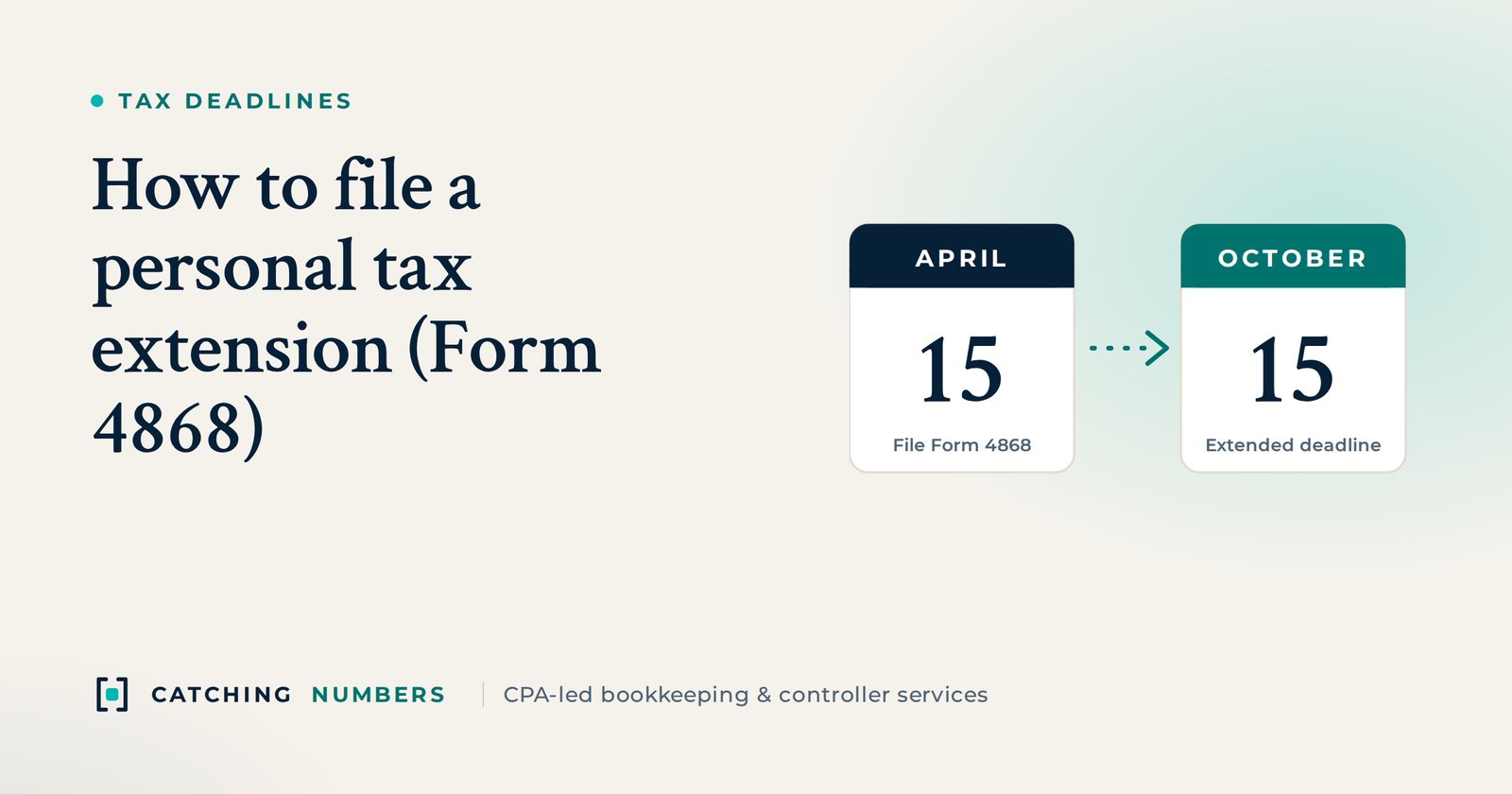
To get more time for your individual federal return, file Form 4868 (or make a payment marked as an extension payment) by the April deadline. That gives you an automatic six-month extension to file: for 2026 returns, from April 15, 2027 to October 15, 2027. It does not give you more time to pay, so estimate what you owe and pay it by April 15 to avoid the late-payment penalty and interest.
Key takeaways
- Form 4868 gives an automatic six-month extension to file, not to pay.
- For 2026 returns, filed in 2027, tax is due April 15, 2027 and the extended filing deadline is October 15, 2027. (For 2025 returns, the extended deadline was October 15, 2026.)
- A payment marked as an extension payment counts as your extension request.
- U.S. taxpayers living abroad get an automatic two months, to June 15.
- Filing late without an extension costs far more than paying late: 5% of the unpaid tax a month versus 0.5%.
When are the 2027 tax extension deadlines?
| Tax year | Return and payment due | Extended filing deadline |
|---|---|---|
| 2025 (filed in 2026) | April 15, 2026 | October 15, 2026 |
| 2026 (filed in 2027) | Thursday, April 15, 2027 | Friday, October 15, 2027 |
| 2026, living abroad | Tuesday, June 15, 2027 (interest from April 15) | Friday, October 15, 2027 |
When a deadline falls on a weekend or legal holiday, it moves to the next business day. Taxpayers in federally declared disaster areas may get additional time, so check the IRS’s disaster relief announcements.
Does an extension give you more time to pay?
No, and this is the most important rule. An extension gives you more time to file your return, not to pay your tax. Any tax you owe is still due by the April deadline. If you pay late, you’ll owe interest and a late-payment penalty on the unpaid balance, even if your extension was filed on time.
How do you file a tax extension?
- Estimate your tax. Work out roughly what you’ll owe for the year, using last year’s return and this year’s income records as a guide. Our estimated tax calculator can help with the safe harbor amount.
- File Form 4868 by the April deadline. You can file it electronically through tax software or a tax professional, through IRS Free File, or on paper.
- Or simply pay. If you make a payment through IRS Direct Pay, EFTPS or by card and indicate that it’s for an extension, the IRS treats it as your extension request, so no separate Form 4868 is needed.
- Pay as much as you can. Paying the estimated balance by April limits interest and penalties. If you can’t pay in full, you can apply for an IRS payment plan.
- File your complete return by October 15. There’s no second automatic extension, so plan your documents around that date.
What are the penalties for filing or paying late?
| Penalty | How it is figured |
|---|---|
| Failure to file | 5% of the unpaid tax for each month or part of a month the return is late, up to 25% |
| Minimum for returns more than 60 days late | The lesser of $535 (returns due in 2027, such as 2026 returns) or 100% of the unpaid tax. It was $525 for returns due in 2026; the IRS adjusts it each year |
| Failure to pay | 0.5% of the unpaid tax a month, up to 25%; 0.25% a month while an approved payment plan is in place |
| Both in the same month | The failure-to-file penalty is reduced by the failure-to-pay penalty for that month |
| Interest | Charged on unpaid tax from the original due date until paid, at a rate the IRS sets each quarter |
The takeaway: even if you can’t pay, file the extension (or the return) on time. The failure-to-file penalty is ten times the failure-to-pay penalty.
Living outside the U.S.?
U.S. citizens and resident aliens whose home and main place of business are outside the United States and Puerto Rico on the regular due date get an automatic two-month extension, to June 15, to file and pay, though interest still runs on unpaid tax from April 15. You can still file Form 4868 by June 15 to extend further, to October 15.
Waiting on a K-1?
If you own part of an S corporation or partnership that extends its own return, your Schedule K-1 may not arrive until September. In that case, extending your personal return is usually unavoidable. Read more in our guide to the S corp extension.
Does a federal extension extend your state return?
It depends on the state. Many states accept the federal extension automatically, some require their own form, and almost all still want the tax paid by the original due date. Check your state revenue department’s rules each year.
Need help?
We don’t prepare or file tax returns. For business owners, we keep the books closed and reconciled, so you and your tax preparer have accurate numbers for your estimate and your return. See our 2027 small business tax calendar for every other deadline, contact us or call +1 (646) 450-8036.
Frequently asked questions
What is the tax extension deadline for 2027?
For 2026 individual returns, you must request the extension by Thursday, April 15, 2027. The extended filing deadline is Friday, October 15, 2027.
Is a tax extension automatic?
Yes. You don’t need to give a reason; filing Form 4868 or making an extension payment by the due date is enough. The IRS only contacts you if the request is rejected.
Do I have to pay to file an extension?
Filing Form 4868 is free, and you can file it even if you can’t pay anything. You should still pay what you can by April 15, because penalties and interest apply to any unpaid balance.
Can I file an extension if I owe money and can’t pay?
Yes, and you should. Filing on time avoids the much larger failure-to-file penalty. You can then set up an IRS payment plan, which lowers the monthly late-payment penalty while it is in effect.
Does an extension increase my chance of an audit?
Not in itself. Millions of taxpayers extend every year, and a complete, accurate return filed by October is better than a rushed one filed in April.
How do I know my extension was accepted?
If you e-file Form 4868, you receive an acknowledgment. If you request it with a payment, keep the payment confirmation, which is your record that the extension was made.
Can I get more time after October 15?
Generally no. There is no second automatic extension for most taxpayers. Taxpayers abroad can ask for a discretionary extension to December 15 by letter, and disaster relief can extend deadlines for affected areas.
What if I’m owed a refund?
There is no failure-to-file penalty when you are due a refund, but you still need to file to get it. Filing promptly gets your money back sooner.
Does Form 4868 extend my business return too?
It covers Form 1040, including a Schedule C business. Partnerships, S corporations and C corporations extend their own returns with Form 7004.
Does an extension cover my FBAR?
The FBAR (FinCEN Form 114) is filed separately with FinCEN. It is due April 15 but gets an automatic extension to October 15 without any request.
Should I still make my first 2027 estimated tax payment in April?
Yes. Extending your 2026 return does not move the April 15, 2027 due date for the first 2027 estimated payment.