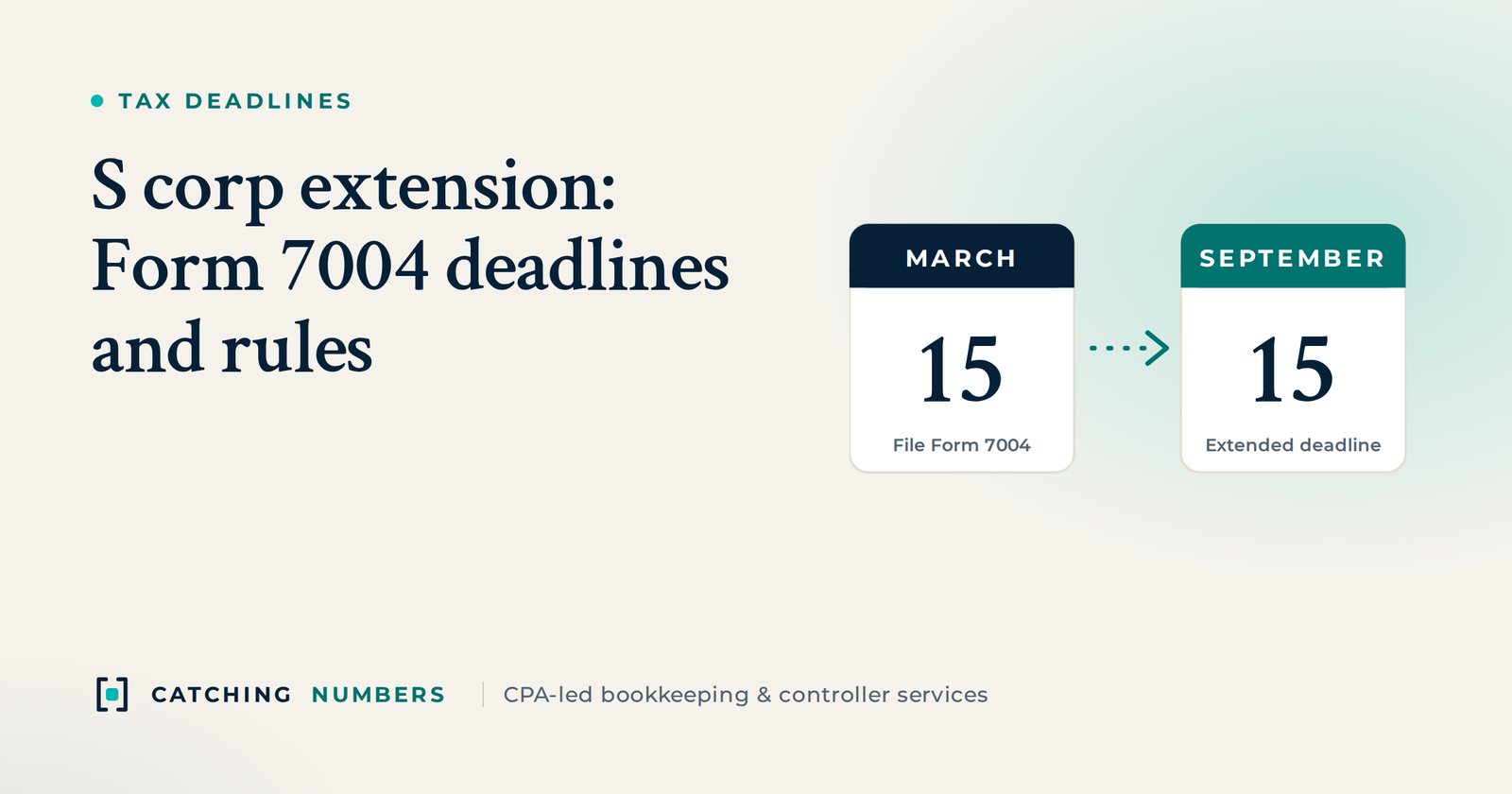
An S corporation gets an automatic six-month extension to file Form 1120-S by filing Form 7004 by the original due date. For a calendar-year S corp’s 2026 return, that moves the deadline from Monday, March 15, 2027 to Wednesday, September 15, 2027. The extension doesn’t give shareholders more time to pay their own income tax, which is still due April 15, 2027, and missing the deadline without an extension costs $260 per shareholder for every month the return is late (the amount for returns due in 2027), even if no tax is owed.
Key takeaways
- Form 7004 extends Form 1120-S by six months, from March 15 to September 15.
- It doesn’t give shareholders more time to pay their own tax, which is due in April.
- Late 1120-S penalties are charged per shareholder, per month, for up to 12 months, even when no tax is owed.
- An S corp that extends usually means its shareholders extend their personal returns too, because K-1s arrive later.
What is an S corp extension?
An S corp extension is an automatic six-month extension of time to file Form 1120-S. For a calendar-year S corporation, the return is due on March 15 and the extended deadline is September 15. A fiscal-year S corp’s return is due on the 15th day of the third month after its year ends. When either date falls on a weekend or legal holiday, the deadline moves to the next business day.
What are the S corp deadlines for 2027?
| Item | Due date (2026 tax year) |
|---|---|
| Form 1120-S, or Form 7004 to extend | Monday, March 15, 2027 |
| Schedule K-1s to shareholders | With the return: March 15, 2027, or September 15, 2027 if extended |
| Shareholders’ Form 1040 and any tax owed | Thursday, April 15, 2027 |
| Extended Form 1120-S | Wednesday, September 15, 2027 |
| Extended Form 1040 | Friday, October 15, 2027 |
| Form 2553 to elect S status for 2027 | Monday, March 15, 2027 |
How do you file an S corp extension?
File Form 7004, Application for Automatic Extension of Time To File Certain Business Income Tax, Information, and Other Returns, by the original due date of the return, using the form code for Form 1120-S. You can file it electronically or on paper. The extension is automatic (the IRS doesn’t need a reason), but it must be filed on time.
What an extension doesn’t extend
An S corporation is a pass-through entity, so in most cases the corporation itself doesn’t pay federal income tax. Its income passes through to the shareholders on Schedule K-1, and they pay the tax on their personal returns. That has two consequences:
- Shareholders’ tax is still due on the individual deadline. Extending the 1120-S doesn’t give shareholders more time to pay. Any tax they owe is due by the April deadline, even if they extend their own returns too. Our safe harbor tax calculator helps work out what to pay.
- Late K-1s can mean extending personal returns. If the S corp files in September, shareholders won’t have their K-1s until then, so they’ll usually need to file Form 4868 to extend their own returns as well.
In the less common cases where the S corporation does owe tax at the entity level (for example, built-in gains tax), that tax is due by the original March deadline. State rules vary too, particularly if the company has elected into a state pass-through entity tax.
How much is the penalty for filing Form 1120-S late?
For returns due in 2027, the late-filing penalty is $260 for each month or part of a month the return is late, up to 12 months, multiplied by the number of shareholders at any time during the year (Rev. Proc. 2025-32; it was $255 for returns due in 2026, per the Form 1120-S instructions). The amount is adjusted for inflation each year. If the corporation also owes tax, a separate penalty of 5% of the unpaid tax a month (up to 25%) is added.
For example, an S corp with three shareholders that files its 2026 return four months late without an extension faces $260 × 3 × 4 = $3,120, even with no tax due. Filing Form 7004 on time avoids it entirely. If a penalty has already been charged, your tax CPA can ask the IRS for relief for reasonable cause or, for a clean history, first-time abatement.
Common reasons to extend
- The books for the year aren’t closed or reconciled yet
- You’re waiting on information from banks, payment processors or other entities
- There were ownership changes, loans or distributions during the year that need to be sorted out
- Owner pay needs reviewing: whether the salary was reasonable and how owners draw vs salary payments were recorded
How do you avoid needing an extension?
Close the books every month during the year, so December is a normal close rather than a twelve-month cleanup. Run payroll correctly, including the owner’s health insurance on the W-2, keep shareholder distributions in proportion to ownership, and track each shareholder’s basis. With books closed by late January, your tax CPA can usually file by March 15.
We don’t prepare tax returns, but we close and reconcile the books so your tax CPA can file on time. If your year-end books are running late, contact us or call +1 (646) 450-8036. For background on the entity itself, see S corporation vs. C corporation, and our year-end close checklist.
Frequently asked questions
When is the S corp tax return due in 2027?
For calendar-year S corporations, the 2026 Form 1120-S is due Monday, March 15, 2027. With a timely Form 7004, the extended deadline is Wednesday, September 15, 2027.
Is an S corp extension automatic?
Yes. Form 7004 gives an automatic six-month extension as long as it is filed correctly by the original due date. The IRS doesn’t require a reason.
What form do I use to extend an S corp return?
Form 7004, the same form used by partnerships and C corporations, entering the code for Form 1120-S. Form 4868 is only for individual returns.
Is there a penalty for filing an S corp return late if no tax is owed?
Yes. The penalty is per shareholder per month, $260 for returns due in 2027 ($255 for returns due in 2026), for up to 12 months. It applies whether or not the corporation owes tax.
Does extending the S corp return extend my personal return?
No. Each return is extended separately. Shareholders file Form 4868 by April 15 if they need more time for their Form 1040.
Can I get more time after September 15?
No. The six-month extension is the maximum for Form 1120-S, so the return must be filed by September 15 for a calendar-year corporation.
When do shareholders get their K-1s?
The S corp must give each shareholder a Schedule K-1 by the date the 1120-S is filed, so no later than March 15, or September 15 if the return is extended.
Do state S corp returns have the same extension?
Not always. Some states accept the federal extension automatically, others need their own form, and many require any entity-level tax or pass-through entity tax to be paid by the original due date.
Can a late S corp penalty be removed?
Often, yes. The IRS can waive it for reasonable cause, and first-time abatement may be available if the company has a clean penalty history. Your tax CPA makes the request.
Is an S corp extension bad?
No. It is common and carries no penalty when filed on time. It is better than filing a return built on unfinished books, which can mean amended K-1s later.
What books does my tax CPA need for the 1120-S?
A closed, reconciled year with a balance sheet and profit and loss, payroll reports that tie to the W-2s, shareholder distributions and loans, fixed asset additions, and each shareholder’s basis information.