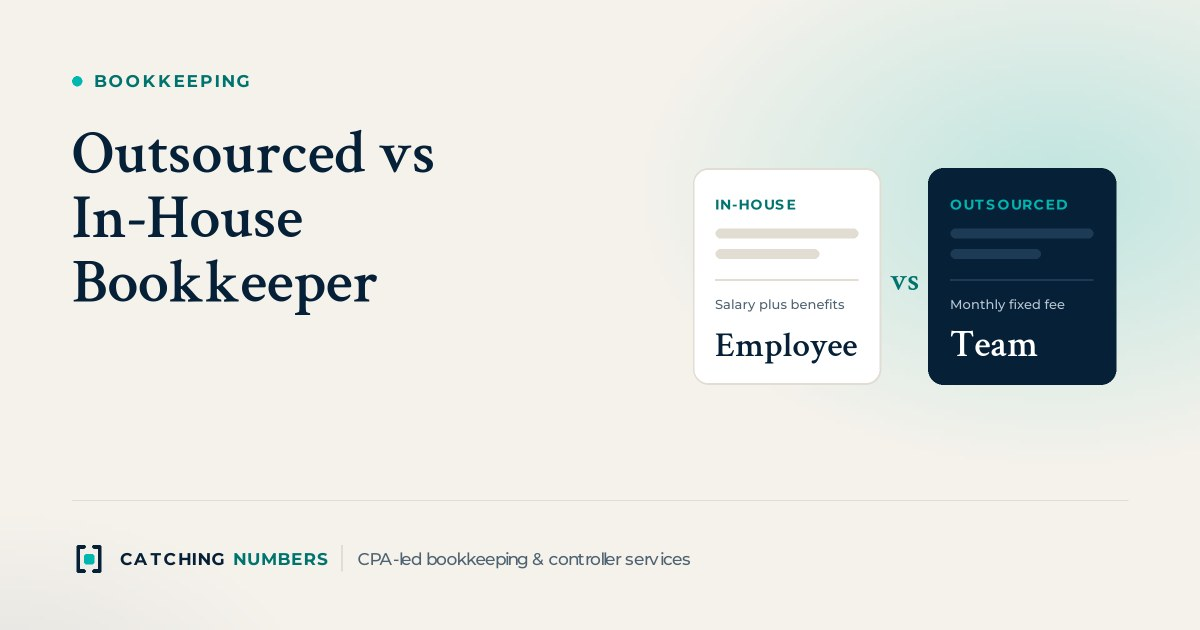
An in-house bookkeeper usually costs more than an outsourced one for a small business: the median bookkeeper in the US earned $50,670 a year in May 2025, before payroll taxes, benefits, software and time off, while outsourced bookkeeping starts at a few hundred dollars a month. In-house makes sense when you need someone on site every day for deposits, billing or inventory. Outsourcing makes sense when you need accurate monthly books, coverage when someone is out, and a second person reviewing the work. Many growing companies use both: an in-house clerk for daily tasks, and an outside team for the close and review.
Key takeaways
- The Bureau of Labor Statistics puts median pay for bookkeeping, accounting and auditing clerks at $50,670 a year, or $24.36 an hour, as of May 2025.
- Add employer payroll taxes, benefits, software, training and cover for vacation and turnover to get the real cost.
- A single bookkeeper has no one checking their work; an outsourced team builds in review.
- In-house wins when the work is daily and physical; outsourced wins when the work is monthly and needs review.
How much does an in-house bookkeeper cost?
Start with salary. The Bureau of Labor Statistics lists median pay of $50,670 a year for bookkeeping, accounting and auditing clerks as of May 2025. Pay is higher in expensive cities and for experienced full-charge bookkeepers.
Then add what the salary doesn’t show: employer Social Security and Medicare taxes, unemployment taxes, health and retirement benefits, paid time off, accounting software seats, training, and the cost of recruiting a replacement when someone leaves. And someone still has to review the books before investors, lenders or your tax CPA rely on them.
How do the two options compare?
| In-house bookkeeper | Outsourced bookkeeping | |
|---|---|---|
| Cost | Salary (median $50,670 a year) plus taxes, benefits and software | A monthly fee; ours starts at $199 a month for small books |
| Availability | On site, during working hours | Remote, on a fixed monthly calendar |
| Coverage | Work stops during vacation, illness or turnover | A team covers the work |
| Review | No one checks their work unless you hire a reviewer | Review built in; on our close and controller plans a CPA signs off |
| Skills | One person’s experience | A team that sees many businesses and systems |
| Daily on-site tasks | Yes: deposits, mail, inventory counts | No; these stay with your team |
| Scaling up or down | Hire, train or let go | Change plans |
When does an in-house bookkeeper make sense?
- You have enough daily transactions, invoices and bills to keep one person busy full time.
- The job includes on-site work: bank deposits, mail, receiving and inventory counts.
- Your team needs someone in the office to answer billing questions as they come up.
When does outsourcing make sense?
- Your books need a few days of work a month, not a full-time person.
- You need statements on a fixed date each month, even when someone is out.
- Investors, lenders or a board read your numbers, so the close needs review.
- You want accrual books, a month-end close or controller support without a senior hire.
Can you combine the two?
Yes, and growing companies often should. An in-house clerk handles daily entry, bills and deposits; an outside team reconciles, closes the month and reviews the work. That gives you a second set of eyes on the books, which a single bookkeeper can’t provide. See our outsourced controller and month-end close services.
What do we usually find when businesses switch?
In our experience, about 7 in 10 new clients arrive with at least one unreconciled bank or card account. The problems we fix most often are unreconciled accounts, uncategorized transactions, duplicate bank-feed entries and payroll recorded as one lump sum. Our cleanup and catch-up service fixes the history before monthly work starts.
Frequently asked questions
Is it cheaper to outsource bookkeeping?
For most small businesses, yes. Outsourced bookkeeping starts at a few hundred dollars a month, while a full-time bookkeeper’s median salary is $50,670 a year before taxes and benefits.
When should a small business hire a full-time bookkeeper?
When daily volume and on-site tasks fill a full-time role. Even then, keep an outside review of the monthly close, since one person can’t check their own work.
Is outsourced bookkeeping secure?
It can be. We work in your own software through accountant access, never shared passwords, with two-factor sign-in and background-checked staff. See how we keep your data secure.
How much does outsourced bookkeeping cost?
Ours starts at $199 a month for up to 2 accounts and 100 transactions. Larger books are quoted on volume and fixed in writing. See pricing.
Weighing a hire against outsourcing? Book a free consultation or call +1 (646) 450-8036.