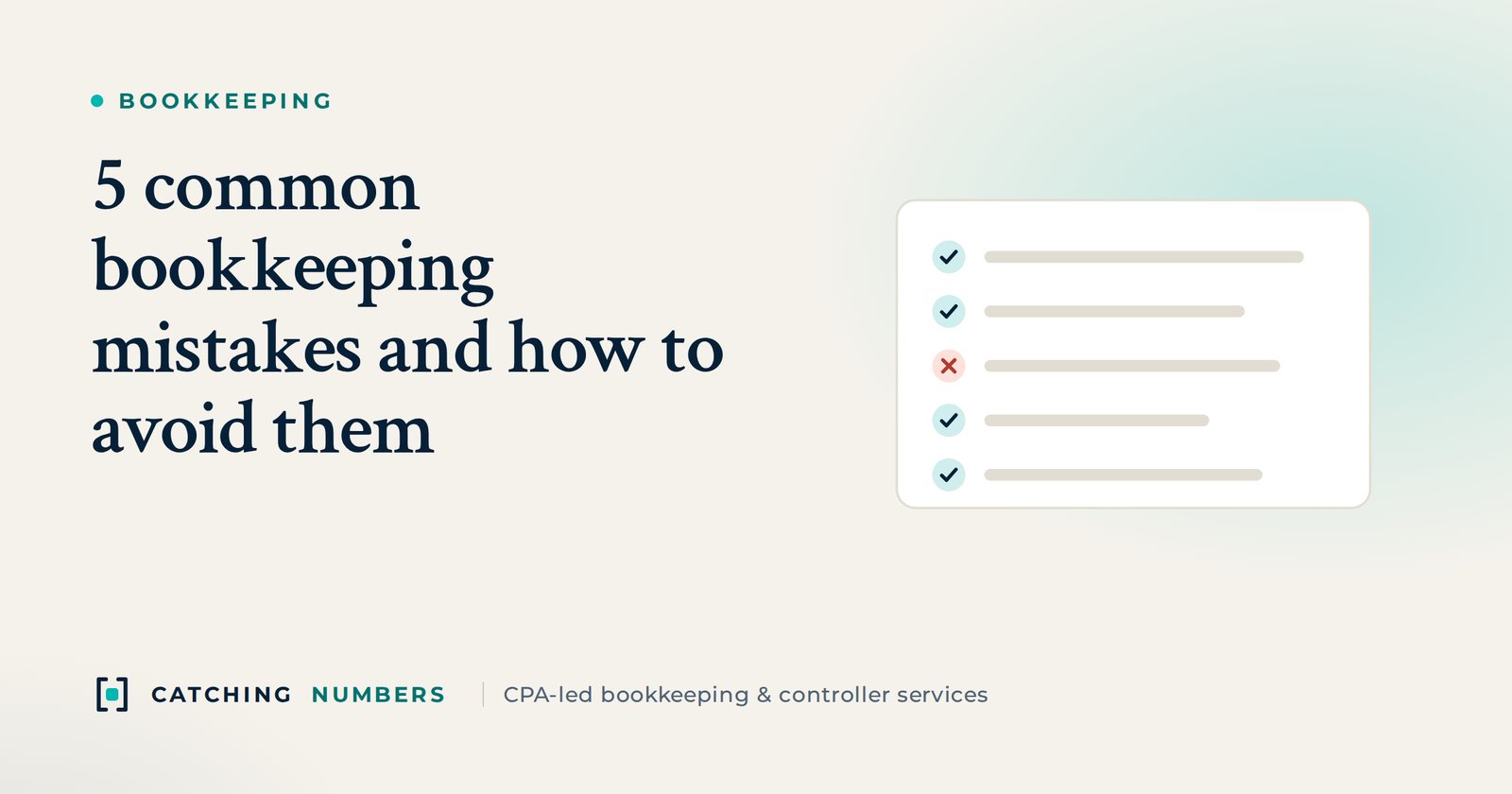
The five bookkeeping mistakes we see most often in small businesses are not keeping receipts, mixing personal and business money, skipping monthly reconciliations, leaving expenses unrecorded and categorizing transactions inconsistently. Each one is easy to prevent with a simple monthly habit, and each one gets more expensive the longer it is left, because it shows up later as missed deductions, wrong financial statements and a costly cleanup before tax season.
Key takeaways
- Keep every receipt, and keep business and personal money separate.
- Reconcile every bank, card and payment account every month.
- Record every expense and categorize it the same way every time.
- Keep supporting records for at least three years after you file, and longer in some cases.
- If several months are already behind, a one-time catch up gets you current before you fix the habits.
1. Not keeping receipts and records
Missing receipts and records lead to inaccurate financial reports, missed deductions, and real trouble if you’re ever audited. Keep every receipt and record organized and up to date. Cloud-based tools make this easy: snap a photo or forward an email receipt and it’s attached to the transaction in your books, in one place you can always get to.
The IRS generally expects you to keep records that support your income and deductions for as long as they may be needed for your return. See the IRS guidance on recordkeeping for businesses.
2. Mixing personal and business finances
Mixing personal and business money turns bookkeeping into a nightmare. It blurs which expenses belong to the business, leads to missed deductions, and distorts your view of how the business is actually doing. Open a separate business bank account, use a dedicated business credit card, and avoid paying business expenses with personal funds. When you take money out for yourself, record it properly as an owners draw or salary rather than as a business expense.
For an LLC or corporation, separation also matters legally: paying personal bills from the company account makes it harder to show the business is a separate entity.
3. Not reconciling accounts regularly
Reconciliation confirms that your books match your bank and credit card statements, and it’s how errors and discrepancies get caught while they’re still easy to fix. Reconcile every account monthly and investigate differences right away, not at year-end. Include payment processors such as Stripe, PayPal and Shopify Payments, and loan accounts, not just the main bank account. If you have fallen months behind, catch up bookkeeping brings every account back to a reconciled starting point.
4. Forgetting to record all expenses
Small expenses like parking, coffee meetings or software subscriptions are easy to forget, but they add up. Record every business expense, however small. A mobile app that captures receipts on the go makes this nearly effortless. Expenses paid personally for the business should be reimbursed through the company with the receipt attached, ideally under an accountable plan.
5. Categorizing expenses incorrectly
Miscategorized expenses produce inaccurate financial statements and can cost you deductions, for example when a legitimate business expense is coded as personal. Use a consistent chart of accounts and categorize the same types of transactions the same way every time. Bank rules in QuickBooks Online and Xero, and the automation in NetSuite, Sage Intacct and AI-native ledgers such as Rillet and Digits, can learn your patterns and handle much of this, but someone still needs to review what the rules did each month.
How long should you keep business records?
The IRS’s general rule is to keep records that support a return for three years from the date you filed it. Longer periods apply in some cases, according to the IRS page How long should I keep records?:
| Situation | Keep records for |
|---|---|
| Most returns | 3 years after filing |
| Income underreported by more than 25% of what the return shows | 6 years |
| Claim for a loss from worthless securities or a bad debt deduction | 7 years |
| Employment tax records | At least 4 years after the tax is due or paid, whichever is later |
| No return filed, or a fraudulent return | Indefinitely |
| Property and equipment | Until the period of limitations expires for the year you dispose of it |
Lenders, investors and state agencies can ask for longer, so many businesses simply keep digital records for seven years.
How do you know your books are behind?
- The last reconciled month is more than two months ago.
- An “Uncategorized” or “Ask my accountant” account keeps growing.
- The bank balance in your books doesn’t match the bank.
- You can’t say what last month’s profit was without guessing.
- Your tax CPA sends back a long list of questions every year.
Any one of these means it’s time to get current first and then put a monthly routine in place. Our step-by-step catch up bookkeeping guide walks through exactly how.
The bottom line
Bookkeeping may not be the most exciting part of running a business, but it’s essential to its financial health. Avoid these five mistakes and your records will be accurate, current, and actually useful for decisions.
For more on streamlining your books, read why cloud accounting is our preferred method. And if you’d rather hand the bookkeeping to a team that does it every day, see our bookkeeping and month-end close services.
Frequently asked questions
What is the most common bookkeeping mistake?
In our experience it is skipping monthly reconciliations. Without them, duplicate transactions, missing deposits and bank feed errors go unnoticed until year-end, when they are much harder to untangle.
How often should a small business do its bookkeeping?
Categorize transactions weekly if you can, and reconcile and close the books every month. A monthly close gives you financial statements you can use and keeps year-end from becoming a project.
Do I need to keep paper receipts?
No. The IRS accepts electronic records, including scanned or photographed receipts, as long as they are legible and complete. Attaching the image to the transaction in your accounting software is the easiest way to keep them.
Can I use my personal bank account for my business?
A sole proprietor legally can, but it makes bookkeeping and deductions much harder to prove. An LLC or corporation should always have its own account, because mixing funds weakens the separation between you and the business.
What happens if I paid a business expense with my personal card?
Keep the receipt and have the business reimburse you, then record the expense in the books. Recording it once, with the receipt attached, avoids both a missed deduction and a double count.
What is bank reconciliation?
It is matching every transaction in your books to your bank or card statement for the month, so the ending balances agree. Differences point to missing, duplicated or wrong entries that need fixing.
How do I fix months of bookkeeping I have fallen behind on?
Start from the last month that was reconciled, gather every bank, card and payment processor statement since then, and work forward month by month. If it is more than a few months, a fixed-fee catch up project is usually faster than doing it yourself.
Is bookkeeping software enough on its own?
Software and bank rules do most of the data entry, but they still make mistakes: transfers coded as income, duplicates from two connected feeds, or rules applied to the wrong vendor. Someone needs to review and reconcile every month.
What is a chart of accounts?
It is the list of categories your transactions are sorted into, such as revenue, cost of goods sold, rent and software. A short, consistent chart of accounts makes reports comparable from month to month.
How much do bookkeeping mistakes cost?
The cost shows up as missed deductions, extra fees from your tax preparer to sort things out, penalties for late or wrong filings, and decisions made on wrong numbers. Fixing a year of errors almost always costs more than a year of monthly bookkeeping would have.
When should I hire a bookkeeper?
When you spend more than a few hours a month on it, when your books are behind, or when you need accurate monthly numbers for a lender, investor or pricing decision. Our monthly bookkeeping starts at $199 a month.
Want your books caught up and kept clean? Book a free consultation or call +1 (646) 450-8036.