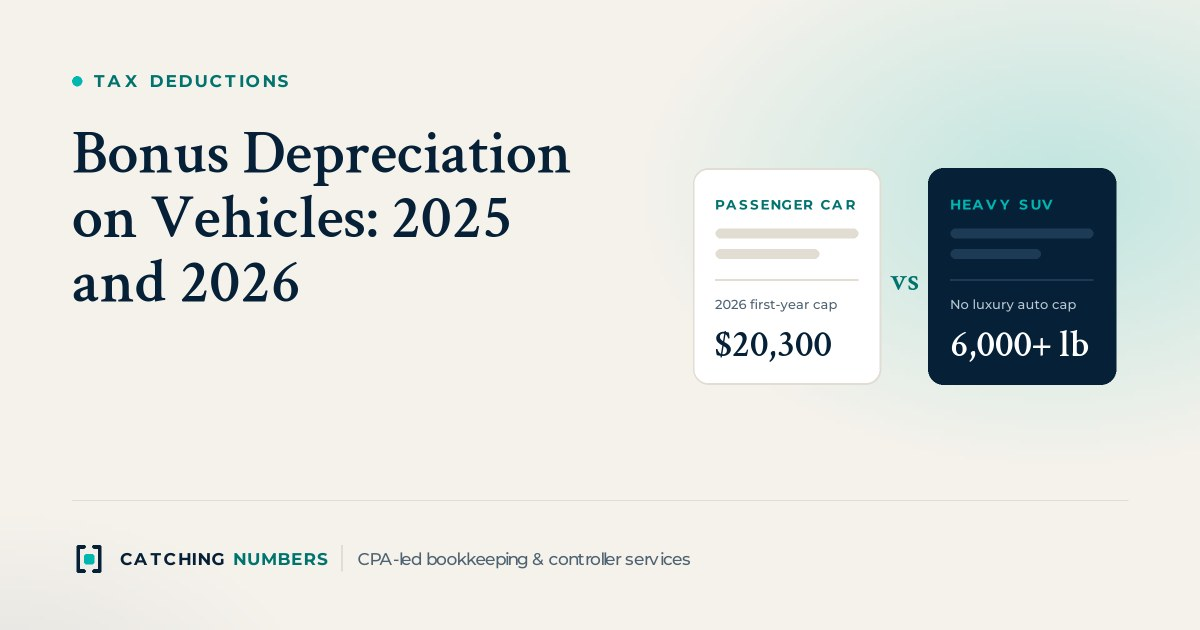
Bonus depreciation on vehicles is back at 100% for vehicles acquired after January 19, 2025, but your vehicle tax deduction for business depends on the vehicle’s weight, your business use percentage and the method you choose. Passenger cars are capped ($20,300 in year one for 2026), while heavy SUVs, pickups and vans over 6,000 lb can often be written off much faster. Either way, you need more than 50% business use and a mileage log.
Key takeaways
- The 2026 standard mileage rate is 72.5 cents per business mile for January 1 to June 30 and 76 cents from July 1, 2026 (it was 70 cents for 2025).
- Section 179 and bonus depreciation on a vehicle require more than 50% qualified business use, and commuting never counts.
- Passenger cars (6,000 lb or less) are capped at $20,200 in year one for 2025 and $20,300 for 2026 when bonus depreciation applies.
- Vehicles over 6,000 lb GVWR are not subject to those caps; heavy SUVs have a separate Section 179 cap ($31,300 for 2025, $32,000 for 2026), but 100% bonus depreciation can cover the rest.
- If business use later drops to 50% or below, or you sell the vehicle, part of the deduction comes back as income.
How does the vehicle tax deduction for business work?
You deduct the business share of a vehicle one of two ways. The standard mileage rate multiplies business miles by an IRS rate that already includes fuel, insurance, repairs and depreciation. The actual expense method multiplies what you really spent (fuel, insurance, repairs, lease payments or depreciation) by your business use percentage. Business tolls and parking are deductible under either.
| Period | Business rate per mile | Depreciation built into the rate |
|---|---|---|
| 2025 | 70 cents | 33 cents |
| January 1 to June 30, 2026 | 72.5 cents | 35 cents |
| July 1 to December 31, 2026 | 76 cents | 35 cents |
Can you switch between mileage and actual expenses?
Only one way. Per IRS Publication 463, you must choose the mileage rate in the first year a car you own is used for business; later you can switch to actual expenses, with straight-line depreciation. You cannot use the mileage rate after claiming Section 179, bonus or accelerated MACRS on the car, or if you run five or more cars at once. A leased car on the mileage rate stays on it for the whole lease.
Why does the more-than-50% business use rule matter?
Vehicles are “listed property.” Under IRC Section 280F(b), a vehicle must be used more than 50% in a qualified business use to claim Section 179 or bonus depreciation. At 50% or less, you get only straight-line depreciation on the business share.
Your business use percentage is business miles divided by total miles for the year. Commuting is not business use. Driving from home to your regular workplace is personal however far it is (Pub 463). Trips from your office to a client or job site are business.
How does bonus depreciation on vehicles work after the One Big Beautiful Bill Act?
The One Big Beautiful Bill Act made 100% bonus depreciation permanent for qualified property acquired after January 19, 2025. IRS interim guidance is in Notice 2026-11. For vehicles:
- Acquired after January 19, 2025: 100% bonus. Under a written binding contract, acquisition is generally when the contract became binding, not delivery.
- Acquired before January 20, 2025: the old phase-down applies, which is 40% if placed in service in 2025 and 20% if placed in service in 2026 (per Rev. Proc. 2026-15).
- Election: for the first tax year ending after January 19, 2025, you can elect 40% instead of 100%, or elect out of bonus entirely.
What are the luxury auto depreciation limits for 2025 and 2026?
A “passenger automobile” under Section 280F is a four-wheeled vehicle rated at 6,000 lb or less. Its total depreciation, including Section 179 and bonus, is capped each year. Section 168(k)(2)(F) adds $8,000 to the first-year cap when bonus applies.
| Year of ownership | Placed in service 2025, with bonus | 2025, no bonus | Placed in service 2026, with bonus | 2026, no bonus |
|---|---|---|---|---|
| 1st year | $20,200 | $12,200 | $20,300 | $12,300 |
| 2nd year | $19,600 | $19,600 | $19,800 | $19,800 |
| 3rd year | $11,800 | $11,800 | $11,900 | $11,900 |
| 4th year and later | $7,060 | $7,060 | $7,160 | $7,160 |
Example: a $60,000 sedan placed in service in 2026 and used 80% for business gets at most $16,240 in year one ($20,300 x 80%).
How does the 6,000 lb vehicle tax deduction work?
SUVs, pickups and vans with a gross vehicle weight rating (GVWR) over 6,000 lb are not “passenger automobiles,” so those caps do not apply, but the more-than-50% rule does. Two rules set the first-year deduction:
- Section 179 SUV cap. For an SUV rated over 6,000 lb and up to 14,000 lb, Section 179 is capped at $31,300 for tax years beginning in 2025 (Form 4562 instructions) and $32,000 for 2026 (Rev. Proc. 2025-32). Under Section 179(b)(5), the cap does not apply to vehicles seating more than 9 behind the driver, pickups with a cargo bed at least 6 feet long, or certain cargo vans with no seating behind the driver.
- Bonus depreciation has no SUV cap. For a heavy vehicle acquired after January 19, 2025, 100% bonus can cover the business share of the cost not expensed under Section 179.
The overall Section 179 limit is $2,500,000 for 2025 (reduced once qualifying purchases pass $4,000,000) and $2,560,000 for 2026 (phase-out starting at $4,090,000). Section 179 cannot exceed business taxable income; bonus can create a loss.
| First-year limit (100% business use, bonus applies) | Passenger car, 6,000 lb or less | Heavy SUV, over 6,000 lb GVWR | Heavy pickup or cargo van exempt from SUV cap |
|---|---|---|---|
| Placed in service 2025 | $20,200 total | Section 179 up to $31,300, then bonus on the rest (100% if acquired after Jan. 19, 2025) | Up to full cost via Section 179 or bonus |
| Placed in service 2026 | $20,300 total | Section 179 up to $32,000, then 100% bonus on the rest | Up to full cost via Section 179 or bonus |
A deduction is not a discount. A $70,000 truck still costs $70,000 in cash, and part of the tax saved often comes back through recapture. Buy a vehicle because the business needs it, then plan the deduction. Our estimated tax calculator shows how a large deduction changes quarterly payments.
What happens if business use drops or you sell the vehicle?
If business use falls to 50% or below in any later year of the recovery period, Section 280F(b)(2) requires you to include “excess depreciation” in income: the difference between what you deducted and what straight-line depreciation would have allowed. Section 179 benefits are recaptured the same way on Form 4797.
On a sale or trade-in, gain up to the depreciation taken is generally ordinary income under Section 1245. A heavy SUV fully written off and later sold for $40,000 can produce about $40,000 of ordinary income.
What does the IRS commonly disallow on vehicle deductions?
Vehicles fall under the strict substantiation rules of Section 274(d). Common problems:
- No mileage log, or a log rebuilt from memory months later.
- 100% business use claimed on the only car in the household.
- Commuting miles counted as business miles.
- A heavy SUV deduction on a vehicle whose GVWR is actually 6,000 lb or less.
- Standard mileage claimed on a vehicle that already took Section 179 or bonus depreciation.
A good log records the date, destination, purpose and miles of each business trip, plus year-start and year-end odometer readings. A mileage app works if you tag the purpose.
How is personal use of a company car taxed for S corp owners?
If your S corporation owns the vehicle and you drive it personally, including commuting, the value of that personal use is a taxable fringe benefit. IRS Publication 15-B treats a 2% shareholder like a partner for fringe benefit purposes, and the personal-use value belongs in your W-2 wages. Get the number to payroll before the last payroll of the year. If you own the car personally, the S corp can reimburse your business miles under an accountable plan.
What is the new car loan interest deduction?
The One Big Beautiful Bill Act also created a personal deduction for interest on a loan for a new personal-use vehicle, for 2025 through 2028. Per the IRS, it allows up to $10,000 a year, phases out above $100,000 of modified AGI ($200,000 joint), and requires a secured loan taken out after December 31, 2024 on a vehicle with final assembly in the United States. Used vehicles and leases do not qualify. It goes on Schedule 1-A with the VIN, and interest already deducted on Schedule C, E or F cannot be claimed twice.
How do you record a business vehicle in the books?
- Record the vehicle as a fixed asset. Book the price plus sales tax, title and fees to a Vehicles asset account, with the trade-in and loan on the same entry.
- Set up the loan as a liability. Split each payment between principal and interest using the lender’s schedule.
- Book depreciation for the books, not for the tax return. Books usually use straight line over useful life; your tax CPA calculates Section 179 and bonus on Form 4562. Track the two separately.
- Reimburse personal vehicles at the mileage rate. Reimburse logged miles on personal cars through an accountable plan.
In QuickBooks Online we typically post monthly depreciation journal entries from a fixed asset register. Xero has a fixed asset register that calculates book depreciation. NetSuite and Sage Intacct offer fixed asset modules, and NetSuite’s can carry an alternate depreciation book for tax alongside the book schedule. AI-native platforms such as Rillet and Digits can automate recurring entries. In every system we keep a vehicle register with cost, placed-in-service date, GVWR and business use. Our outsourced bookkeeping team sets this up.
Keep the bill of sale, loan agreement, a photo of the door sticker showing GVWR, the mileage log, receipts if you use actual expenses, and sale paperwork. For related deductions, see our guides to the home office deduction and business meals deduction rules.
What should you do before buying a business vehicle?
Confirm the business need, check the GVWR, estimate a realistic business use percentage, and review the numbers with your tax CPA before you sign. We keep the books tax-ready and work alongside your tax CPA; we do not prepare returns. If you need someone to own the fixed asset register and month-end entries, our outsourced controller service covers it.
Frequently asked questions
Can I take bonus depreciation on a used vehicle?
Yes, in many cases. Bonus depreciation can apply to used property as long as you did not use it before and did not buy it from a related party. The more-than-50% business use rule and the passenger car caps still apply.
What is the standard mileage rate for 2026?
The IRS set the 2026 business rate at 72.5 cents per mile in Notice 2026-10, then raised it to 76 cents for miles driven on or after July 1, 2026 in Announcement 2026-11 because of higher fuel prices. Use 72.5 cents for January to June and 76 cents for July to December. The 2025 rate was 70 cents.
Which vehicles qualify for the 6,000 lb tax deduction?
SUVs, pickups and vans with a gross vehicle weight rating over 6,000 lb are not subject to the passenger car depreciation caps. You find the GVWR on the sticker inside the driver’s door. The vehicle must still be used more than 50% for business to claim Section 179 or bonus depreciation.
Can I write off 100% of a heavy SUV in 2026?
Potentially yes, for the business share. Section 179 is capped at $32,000 for an SUV in 2026, but 100% bonus depreciation for vehicles acquired after January 19, 2025 has no SUV cap and can cover the rest. You also accept recapture if business use later drops to 50% or below or when you sell.
Is driving from home to my office deductible?
No. Driving between home and your main or regular place of work is commuting, which IRS Publication 463 treats as personal no matter how far it is. Trips from your workplace to clients, suppliers or job sites are business miles.
Should I use the standard mileage rate or actual expenses?
The mileage rate is simpler and often better for a modest car driven many miles. Actual expenses, especially with bonus depreciation, usually win for an expensive or heavy vehicle in its first year. Remember you must choose the mileage rate in the vehicle’s first business year to keep it as an option later.
What happens if my business use falls below 50%?
Under Section 280F(b)(2), you include in income the excess of the depreciation you claimed over what straight-line depreciation would have allowed. From that year on, you depreciate the vehicle straight line under the alternative depreciation system.
Do I need a mileage log if I use actual expenses?
Yes. You need the log to prove your business use percentage, which every actual expense and depreciation figure is multiplied by. Without it, the IRS can disallow the deduction entirely.
What is the Section 179 limit for 2026?
For tax years beginning in 2026, the Section 179 limit is $2,560,000, reduced dollar for dollar once qualifying property placed in service exceeds $4,090,000, per Rev. Proc. 2025-32. The 2025 limit was $2,500,000 with a $4,000,000 phase-out threshold.
Can I deduct car loan interest on a business vehicle?
If you are self-employed, the business share of car loan interest is a business expense under the actual expense method. The new $10,000 car loan interest deduction is a separate personal deduction for personal-use new vehicles, and interest already deducted on Schedule C, E or F cannot be claimed again.
Does the $8,000 bonus amount apply to every car?
It applies only to passenger automobiles (6,000 lb or less) when bonus depreciation is claimed. It raises the first-year cap from $12,200 to $20,200 for 2025 and from $12,300 to $20,300 for 2026. If you elect out of bonus or business use is 50% or less, the lower cap applies.
Should I buy a truck in December to cut my taxes?
Only if the business needs it. The vehicle must actually be placed in service, meaning ready and available for business use, by year end to count for that year. Spending cash to save a fraction of it in tax, and facing recapture later, rarely makes sense on its own.
Want your vehicle records tax-ready?
We set up fixed asset registers, loan schedules and mileage reimbursements so your tax CPA has everything at year end. Book a free consultation.