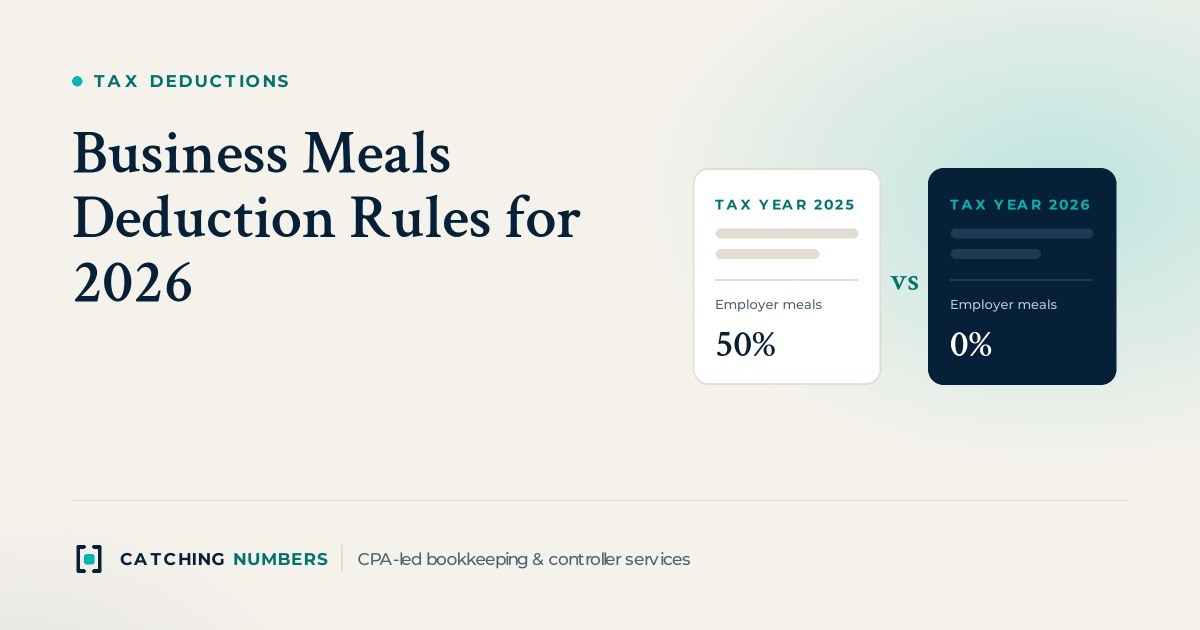
The business meals deduction is still 50% in 2026: a meal with a client or other business associate, or while traveling away from home for work, is generally 50% deductible if it is not lavish, you or an employee attend, and you record the amount, date, place, business purpose and attendees. Entertainment has been 0% since 2018. The 2026 change: convenience-of-employer meals and employer-operated eating facilities went from 50% to 0% for amounts paid after December 31, 2025. Company-wide holiday parties and a few other items stay 100% deductible.
Key takeaways
- Client and prospect meals and travel meals stay 50% deductible in 2026 under IRC 274(k) and 274(n).
- Entertainment such as game tickets, golf and club dues is 0% deductible, as it has been since 2018.
- From January 1, 2026, new IRC 274(o) makes convenience-of-employer meals and on-premises cafeteria costs 0% deductible, with exceptions for restaurants and certain fishing operations.
- Holiday parties and picnics mainly for employees, meals reported as wages, and food sold to customers remain 100% deductible.
- Separate GL accounts for the 50%, 100% and 0% buckets save your tax CPA hours at year end.
Are business meals deductible in 2026?
Yes, most of them, at 50%. Section 274(n)(1) of the Internal Revenue Code caps the deduction for food and beverages at 50% of the cost, and nothing in the One Big Beautiful Bill Act (P.L. 119-21, signed July 4, 2025) changed that general rule. What changed on January 1, 2026 is narrower: certain meals employers give their own staff moved from 50% to 0%.
Under IRC 274(k) and the final regulations at Treas. Reg. 1.274-12, a meal qualifies for the 50% deduction only if all of these are true:
- It is an ordinary and necessary expense of running the business.
- It is not lavish or extravagant under the circumstances.
- You, or an employee of the business, are present when the food or drinks are served.
- It is provided to you or a business associate: a current or prospective customer, client, supplier, employee, agent, partner or professional adviser.
- You can show the amount, date, place, business purpose and who attended.
Tax and tip are part of the meal and 50% deductible. The ride to the restaurant is not part of the meal, according to IRS Publication 463.
What is the business meals deduction for each type of meal in 2025 and 2026?
How common categories compare for tax years 2025 and 2026, based on IRC 274, Treas. Reg. 1.274-12, Pub 463 and Pub 15-B (checked October 21, 2026).
| Meal or expense type | Tax year 2025 | Tax year 2026 |
|---|---|---|
| Meal with a client, prospect or other business associate | 50% | 50% |
| Your own meals while traveling away from home (actual cost or per diem M&IE) | 50% | 50% |
| Travel meals of workers under DOT hours of service limits | 80% | 80% |
| Entertainment (tickets, golf, club dues, shows) | 0% | 0% |
| Holiday party or picnic primarily for employees (not just highly compensated staff) | 100% | 100% |
| Meals reported as taxable wages to employees | 100% | 100% |
| Food sold to customers, including restaurant meals for food service staff | 100% | 100% |
| Free food for the general public (promotional) | 100% | 100% |
| Meals for the convenience of the employer (IRC 119(a)) | 50% | 0% |
| Employer-operated eating facility or cafeteria and its food | 50% | 0% |
| Office snacks and coffee in a break room | 50% | 50% or 0% (see below) |
| Business gifts to clients | Up to $25 per person | Up to $25 per person |
Why is entertainment no longer deductible?
The Tax Cuts and Jobs Act removed the deduction for entertainment, amusement and recreation for amounts paid after December 31, 2017. IRC 274(a) now disallows the cost of activities generally considered entertainment, and of facilities used for them, even when there is a real business reason. Box seats, a round of golf with a client, concert tickets and country club dues are all 0%.
One wrinkle: food and drinks bought separately from the entertainment, or shown as a separate line on the bill, can still be a 50% business meal if they meet the rules above.
How are meals deducted when you travel for business?
When business travel keeps you away from home long enough to need sleep or rest, your own meals are 50% deductible, even when you eat alone. You can deduct actual cost or use a per diem rate for meals and incidental expenses (M&IE). Pub 463 lets employees and self-employed people use the standard meal allowance, but you still need records of the time, place and business purpose of the trip, and the 50% limit still applies.
For employers paying per diems, IRS Notice 2026-60 sets the high-low method rates for travel on or after October 1, 2026: $329 per day for high-cost localities and $230 for other places in the continental US, of which $86 and $74 are treated as meals for the 50% limit. If you pay no meal costs on a travel day, the incidental-expenses-only rate is $5 per day and is not subject to the 50% limit. Workers subject to Department of Transportation hours of service limits, such as interstate truck drivers, can deduct 80% of travel meals under IRC 274(n)(3).
Reimbursements under an accountable plan are not taxed to the employee, and the business deducts them subject to the 50% limit. See our post on accountable plan reimbursements for setup.
Which meals are 100% deductible?
The 50% limit does not apply to the exceptions in IRC 274(n)(2) and 274(e). Pub 463 lists them, and Treas. Reg. 1.274-12(c) gives examples. The ones small businesses use most:
- Recreational and social events for employees. A holiday party, summer picnic or similar outing mainly for employees who are not highly compensated. If only highly compensated employees are invited, the food falls back to 50%.
- Meals treated as compensation. Food you report as taxable wages on the employee’s W-2 (with limits for officers, directors and 10% owners).
- Food sold to customers. A restaurant or caterer’s cost of food it sells, including meals its own food service employees eat at work.
- Items available to the public. Free food at a promotional event, to the extent the general public mainly consumes it.
- Client-reimbursed meals. If you are self-employed, give your client adequate records and get reimbursed, the 50% limit moves to the client.
What changed for employer-provided meals in 2026?
New IRC 274(o), originally scheduled by the 2017 tax law and amended by section 70305 of the One Big Beautiful Bill Act, applies to amounts paid or incurred after December 31, 2025. It allows no deduction for:
- Operating an employer-operated eating facility under IRC 132(e)(2), such as an on-site cafeteria, and food or drinks associated with it, including de minimis food.
- Meals furnished on the premises for the convenience of the employer under IRC 119(a), such as meals that keep staff on call for emergencies.
IRS Publication 15-B (2026) confirms the 50% deduction that applied through 2025 is gone. Employees can still exclude these meals from income.
The One Big Beautiful Bill Act exempts two groups from 274(o). First, food sold to customers (IRC 274(e)(8)), so restaurants that feed their own staff keep a full deduction. Second, every crew meal category in IRC 274(n)(2)(C), which stays 100% deductible: commercial vessel crews, offshore oil and gas platforms, and a new category for fishing, fish processing and fish tender vessels and certain remote fish processing facilities north of 50 degrees latitude (new IRC 274(n)(2)(C)(v)).
Can you deduct office snacks and coffee in 2026?
Through 2025, the regulations treated break room coffee, soda, chips and donuts for all employees as 50% deductible. For 2026 the answer depends on whether your break room or pantry is an employer-operated eating facility under IRC 132(e)(2). If it is, 274(o) makes the food 0%. If it is not, the food is still a business expense subject to the 50% limit.
Accounting firms disagree on how a simple office pantry is treated, and as of October 2026 we have not seen IRS regulations under 274(o) that settle it. Book snacks and coffee to their own account so your tax CPA can apply 50% or 0% at year end.
What about client gifts?
Business gifts are a separate bucket. Under IRC 274(b), you can deduct up to $25 per recipient per year. Incidental costs such as engraving, gift wrap and shipping do not count toward the $25, and items costing $4 or less with your name permanently imprinted, like branded pens, are excluded from the limit.
What does the IRS commonly disallow?
- Meals with no business associate and no travel, such as an owner’s daily lunch near the office.
- Meals with no record of who attended or why, supported only by a card statement.
- Entertainment coded as meals, such as a golf outing or sporting event booked to a meals account.
- Meals deducted at 100% that only qualify for 50%, or employee meals deducted in 2026 that 274(o) now disallows.
How should you set up your chart of accounts for meals?
Your tax CPA applies the percentages, but only quickly if the books already separate the buckets. We set up these accounts:
- Meals 50%. Client, prospect and vendor meals, plus travel meals and per diem M&IE.
- Meals 100% employee events. Holiday parties, picnics and team outings open to all staff.
- Office snacks and employee meals (review). Pantry, coffee service, catered office lunches and overtime dinners, so the 2026 treatment can be decided in one place.
- Entertainment nondeductible. Tickets, golf, club dues and shows.
- Business gifts. So the $25 per person limit can be applied.
In QuickBooks Online and Xero, create these as separate expense accounts and add bank rules so recurring vendors land in the right one. In NetSuite and Sage Intacct, use separate GL accounts rather than only a department or dimension. In AI-native platforms such as Rillet and Digits, map the categories once and review the automated coding at each monthly close. If your meals have been lumped into one account for years, a QuickBooks cleanup can reclass the current year before your CPA starts.
Set your corporate card or spend tool to require an itemized receipt photo and a memo on every meal charge: who attended, their company and the business purpose. Treas. Reg. 1.274-5 requires receipts for lodging and other travel expenses of $75 or more, but we capture one for every meal. Keep the records at least as long as the IRS can examine the return, generally three years from filing. This is the kind of monthly discipline we build into outsourced bookkeeping.
What should you do next?
Before year end, move convenience-of-employer meals and cafeteria costs into their own account, code holiday party invoices to the 100% bucket, and flag entertainment. A smaller meals deduction raises taxable income, so rerun your quarterly payments with our estimated tax calculator. Then confirm your treatment with your tax CPA. If you are also reviewing other owner deductions this year, see our guides to the vehicle deduction and bonus depreciation and the home office deduction.
Frequently asked questions
Are business meals 100% deductible in 2026?
Generally no. Client and travel meals are 50% deductible in 2026. The temporary 100% deduction for restaurant meals applied only to amounts paid in 2021 and 2022. Specific exceptions, such as employee holiday parties and food sold to customers, are still 100%.
Can I deduct a meal I eat alone?
Only when you are traveling away from home overnight on business, in which case it is 50% deductible. Your everyday lunch near your office or home is a personal expense, even if you work while you eat.
Is a holiday party tax deductible?
Yes. Food and drinks at a holiday party or similar social event primarily for employees are 100% deductible under IRC 274(e)(4) and Treas. Reg. 1.274-12. If the event is mainly for highly compensated employees, the food is limited to 50%, and if clients are the main guests, entertainment portions are not deductible.
Can I deduct meals with employees?
Employees count as business associates, so a genuine business meal with staff can be 50% deductible. Starting in 2026, meals furnished on your premises for your convenience under IRC 119(a), and food tied to an employer-operated eating facility, are not deductible at all. Ask your tax CPA where a routine catered team lunch falls.
What records do I need for a business meal?
Keep the itemized receipt and note the amount, date, place, business purpose and the names and business relationship of the people who attended. A card statement alone shows the amount and place but not the purpose or attendees, which is where most disallowed meals fail.
Are tips and sales tax on a business meal deductible?
Yes. Pub 463 treats taxes and tips as part of the cost of the meal, so they are deductible at the same 50% rate. Transportation to and from the meal is not part of the meal cost.
Is the per diem meal allowance subject to the 50% limit?
Yes. Whether you deduct actual meal costs or the standard meal allowance, the 50% limit applies to the meals portion. The $5 per day incidental-expenses-only rate is not subject to the 50% limit.
Can I deduct food bought at a sporting event with a client?
The tickets are nondeductible entertainment. Food and drinks bought separately, or shown as a separate line on the bill, can be treated as a 50% business meal if you meet the other meal rules.
Do restaurants lose the deduction for staff meals in 2026?
No. The One Big Beautiful Bill Act carved food sold to customers out of IRC 274(o), and the regulations let a restaurant deduct 100% of food its food service employees eat at the worksite. Restaurant owners should still keep staff meals in a separate account.
How much can I deduct for client gifts?
Up to $25 per recipient per year under IRC 274(b). Wrapping and shipping costs do not count toward the limit, and branded items costing $4 or less that you hand out widely are excluded.
Are lavish meals deductible?
Not the lavish or extravagant part. Pub 463 says a meal is not lavish just because it exceeds a fixed dollar amount or takes place at a deluxe restaurant; the test is whether the cost is reasonable for the facts and circumstances.
Does the 2026 change apply to fiscal year companies?
Yes. IRC 274(o) applies to amounts paid or incurred after December 31, 2025, so a fiscal year company feels it partway through its year. Costs before January 1, 2026 keep the old 50% treatment, so split the account by date.
Sources: 26 U.S.C. 274, Treas. Reg. 1.274-12, Treas. Reg. 1.274-5, IRS Pub 463 (2025), IRS Pub 15-B (2026), IRS Notice 2026-60, IRS: How long should I keep records?
Want meals coded right before year end?
We keep your books tax-ready, with meals, entertainment and employee events split so your tax CPA can work fast. Book a free consultation.