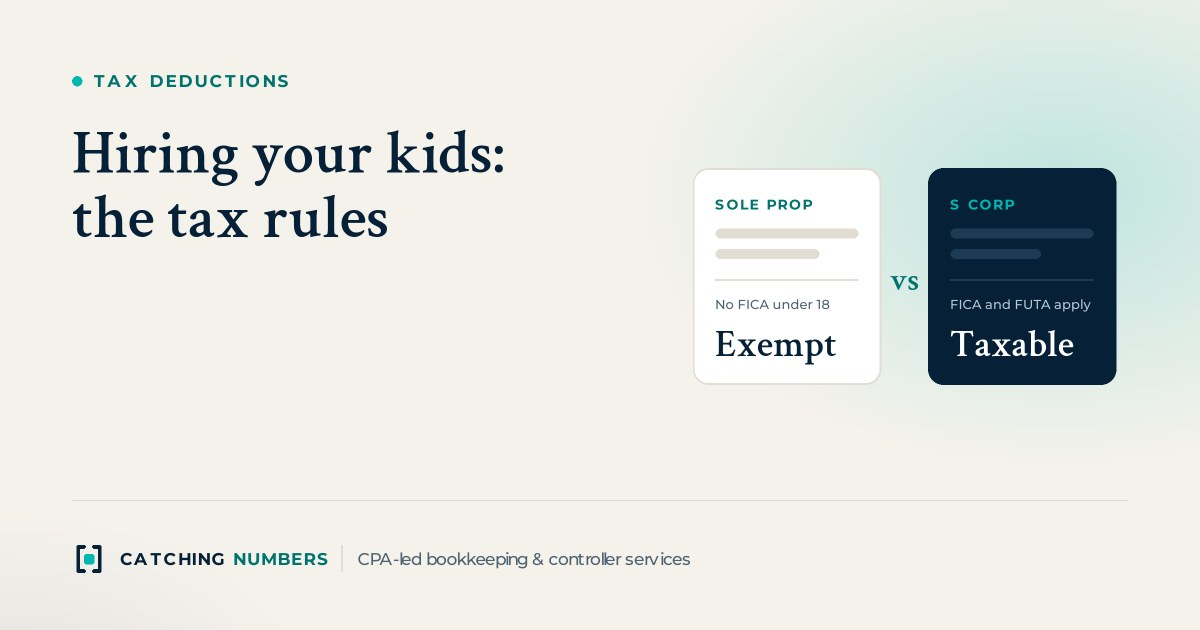
The hiring your children tax deduction is real: if your child does genuine work for your business and you pay a reasonable wage for that work through payroll, the wages are a deductible business expense, and the child can earn up to the standard deduction ($15,750 for 2025 and $16,100 for 2026) with no federal income tax. If your business is a sole proprietorship or a partnership owned only by the child’s parents, wages to a child under 18 are also free of Social Security and Medicare tax, and wages to a child under 21 are free of federal unemployment (FUTA) tax. Those payroll tax breaks disappear if the business is an S corporation or C corporation.
Key takeaways
- Wages to your child are deductible only when they pay for real, age-appropriate work at a rate a similar business would pay.
- A child under 18 working for a parent’s sole proprietorship (or a partnership where every partner is a parent) is exempt from Social Security and Medicare tax; FUTA is exempt until age 21.
- S corporations and C corporations get the income tax deduction but must withhold and pay FICA and FUTA on a child’s wages like any other employee.
- A dependent child’s standard deduction covers earned income up to $15,750 for 2025 and $16,100 for 2026, and earned income is not subject to the kiddie tax.
- Timesheets, a job description, real payroll and a W-2 are what make the deduction hold up.
How does the hiring your children tax deduction work?
Wages you pay your child are treated like wages paid to anyone else on your team. The IRS tests for deducting pay, laid out in Publication 535, are that the pay is an ordinary and necessary business expense, that it is reasonable, and that it is for services actually performed.
“Reasonable” generally means what a similar business would pay for the same or similar services. A 15 year old who packs ecommerce orders, files receipts, photographs products or cleans the office can be paid a market rate for that work. A seven year old “managing social media” at $40 an hour is a different story.
The tax benefit comes from shifting income. The business deducts the wages at the parent’s marginal rate, and the child pays little or nothing on them because of the child’s own standard deduction. For a sole proprietor, the deduction also reduces net earnings subject to self-employment tax.
Which businesses get the FICA and FUTA exemptions?
The payroll tax exemptions depend on who legally owns the business. According to the IRS guidance on family employees (also in Publication 15, section 3), payments for the services of a child under 18 who works for a parent are not subject to Social Security and Medicare taxes if the business is a sole proprietorship or a partnership in which each partner is a parent of the child. Payments to a child under 21 are not subject to FUTA tax in the same situations.
If the business is a corporation, a partnership with any partner who is not the child’s parent, or an estate, the child’s wages are subject to income tax withholding, Social Security, Medicare and FUTA regardless of age. A single-member LLC owned by a parent and taxed as a disregarded entity is treated like a sole proprietorship for these family exceptions under Treasury Regulation 301.7701-2(c)(2)(iv). An LLC that has elected S corporation status is a corporation for this purpose, so the exemptions do not apply.
| Entity (tax year 2026, checked October 21, 2026) | Income tax deduction for wages | Social Security and Medicare (FICA) | FUTA |
|---|---|---|---|
| Sole proprietorship or single-member LLC owned by a parent | Yes, if reasonable pay for real work | Exempt while child is under 18 | Exempt while child is under 21 |
| Partnership or multi-member LLC where every partner is the child’s parent | Yes, if reasonable pay for real work | Exempt while child is under 18 | Exempt while child is under 21 |
| Partnership or LLC with any non-parent partner | Yes, if reasonable pay for real work | Taxable at any age | Taxable at any age |
| S corporation (including an LLC taxed as an S corp) | Yes, if reasonable pay for real work | Taxable at any age | Taxable at any age |
| C corporation | Yes, if reasonable pay for real work | Taxable at any age | Taxable at any age |
If you run an S corporation (see S corp vs C corp), hiring your kids still works: the business deducts the wages and the child still uses their own standard deduction. You simply pay normal payroll taxes on the wages, so the savings are smaller.
How much can your child earn tax free in 2025 and 2026?
A child you claim as a dependent gets a limited standard deduction: the greater of $1,350 or earned income plus $450, capped at the regular single standard deduction. The One Big Beautiful Bill Act (P.L. 119-21) raised the 2025 single standard deduction to $15,750, and the IRS set it at $16,100 for 2026 in its 2026 inflation adjustments (Rev. Proc. 2025-32).
| Figure | 2025 (returns filed in 2026) | 2026 |
|---|---|---|
| Single standard deduction (cap for a dependent with wages) | $15,750 | $16,100 |
| Dependent standard deduction formula | Greater of $1,350 or earned income plus $450 | Greater of $1,350 or earned income plus $450 |
| IRA contribution limit (traditional and Roth combined) | $7,000 or taxable compensation, if less | $7,500 or taxable compensation, if less |
| Kiddie tax unearned income threshold | $2,700 | $2,700 |
So a child with no other income who earns $15,750 in wages for 2025 has a standard deduction of $15,750 and no federal income tax. Income tax withholding still technically applies to a child’s wages at any age, but a child who owed no tax last year and expects none this year can generally claim exemption from withholding on Form W-4. If the child also has investment income, the math changes, so run the numbers with your tax CPA. To see how moving wages off your own return affects your quarterly payments, try our estimated tax calculator.
Does the kiddie tax apply to wages you pay your child?
No. The kiddie tax applies to a child’s unearned income, such as interest, dividends and capital gains, above $2,700. Wages are earned income, so they are taxed at the child’s own rates.
Can your child open a Roth IRA with the wages?
Yes, and this is often the best part. IRA contributions require taxable compensation, and wages count. Per the IRS IRA contribution limits page, the 2026 limit is the lesser of $7,500 or the child’s taxable compensation ($7,000 for 2025). There is no age limit. A child who earns $4,000 can contribute up to $4,000. For minors, brokerages typically offer a custodial Roth IRA managed by a parent until the child reaches adulthood. Contributions for 2026 can be made until April 15, 2027, the regular due date of the return, per Publication 590-A.
What does the IRS disallow when parents pay their kids?
The deduction is legitimate when it is documented. These are the patterns that get it thrown out:
- Pay with no real work. Allowance relabeled as wages, or a child on payroll who never actually did anything for the business.
- Unreasonable pay. Rates far above what you would pay an unrelated person for the same task, especially for very young children whose work has limited value.
- No records. No timesheets, no job description, a lump sum at year end, or money that never actually left the business account.
- Personal chores. Mowing your home lawn or babysitting siblings is personal, not business, work.
What child labor laws apply when you employ your own kids?
Federal child labor rules still matter. Under the Department of Labor’s Fact Sheet #43, children of any age may generally work for a business entirely owned by their parents, but those under 16 may not work in mining or manufacturing, and those under 18 may not work in any occupation the Secretary of Labor has declared hazardous. Outside the parental exemption, 14 and 15 year olds are limited to 3 hours on a school day, 18 hours in a school week, and work between 7 a.m. and 7 p.m. (9 p.m. from June 1 through Labor Day). States have their own rules, including work permits in many states, and the stricter standard applies.
How do you set it up and record it in the books and payroll?
- Write a job description. List the tasks, the expected hours and a pay rate you can back up with what you would pay an outside worker.
- Onboard the child like any employee. Collect Form W-4 and Form I-9, and add the child in your payroll provider, flagged as a family employee so the system applies the right FICA and FUTA treatment for your entity type.
- Track time. Keep timesheets showing dates, hours and tasks.
- Pay on a regular schedule. Run wages through payroll into an account in the child’s name, not as cash or a year-end lump sum.
- Record it in the right accounts. Whether your books are in QuickBooks Online, Xero, NetSuite, Sage Intacct or an AI-native platform such as Rillet or Digits, post the payroll journal to wages expense (a separate “family wages” sub-account makes year-end review easy) and payroll tax expense, not to owner draws.
- File the year-end forms. Issue a W-2 to the child by January 31 (February 1, 2027 for 2026 wages, since January 31 falls on a Sunday), file it with the Social Security Administration, and file any state wage reports.
Check state payroll rules too. States set their own withholding and unemployment insurance treatment for family employees, and they do not always follow the federal exemptions. Your payroll provider or tax CPA can confirm your state’s rules.
Keep this documentation for each year:
- Job description and how you set the pay rate
- Signed timesheets with dates, hours and tasks
- Payroll registers, pay stubs and W-2
- Bank records showing payments into the child’s account
- Examples of the work: photos, files, logs or emails
- Any work permit your state requires
We do not prepare tax returns. Our outsourced bookkeeping team keeps family wages, payroll and owner pay cleanly separated so your tax CPA can confirm the treatment quickly. If you are also paying yourself, read our guide to owner’s draw vs salary. Other documented deductions in this series include the home office deduction, the Augusta rule and accountable plan reimbursements. Our pricing page shows how engagements are scoped.
Frequently asked questions
How old does my child have to be to work in my business?
Federal law has no minimum age for a child working in a business entirely owned by their parents, apart from the mining, manufacturing and hazardous occupation limits. The practical limit is the tax one: the work has to be real and worth what you pay. Very young children can only do a narrow range of tasks, so pay should be modest.
How much can I pay my child tax free in 2026?
A dependent child with only earned income can earn up to $16,100 in 2026 with no federal income tax, because the standard deduction covers it. For 2025 the figure is $15,750. Payroll taxes depend on your entity type, and state income tax may still apply.
Do I have to pay Social Security tax on my child’s wages?
Not if the child is under 18 and the business is a sole proprietorship, a parent-owned single-member LLC, or a partnership where every partner is the child’s parent. In an S corporation or C corporation, Social Security and Medicare apply at any age.
Can an S corp hire the owner’s children?
Yes. The S corporation deducts reasonable wages for real work, and the child uses their own standard deduction. The difference is that the corporation must withhold and pay Social Security, Medicare and FUTA on the wages, because the family employee exemptions apply only to sole proprietorships and parent-only partnerships.
Does my child need a W-2?
Yes. A child employee gets a W-2 like any other employee, even when no Social Security or Medicare tax was withheld. The W-2 is also the proof of earned income the child needs for a Roth IRA contribution.
Can I pay my child as a 1099 contractor instead?
The classification has to match the facts. A child working on your schedule, with your tools, under your direction is normally an employee. Paying through payroll also gives you the cleanest records and lets a sole proprietorship use the family FICA and FUTA exemptions, which apply to wages.
Can I still claim my child as a dependent if I pay them?
Generally yes, if the child remains your qualifying child, which does not depend on how much the child earns. The child must still not provide more than half of their own support. Confirm the dependency tests with your tax CPA.
Does my child have to file a tax return?
For 2025, a single dependent must file if earned income was more than $15,750, unearned income was more than $1,350, or gross income exceeded certain combined limits in IRS Publication 501. A child who had income tax withheld may want to file anyway to get a refund.
What is the Roth IRA limit for a child in 2026?
The lesser of $7,500 or the child’s taxable compensation for 2026. For 2025 it was the lesser of $7,000 or taxable compensation. There is no age limit for contributing.
Is the kiddie tax a problem if I hire my kids?
No. The kiddie tax only applies to unearned income such as interest and dividends above $2,700. Wages are earned income and are taxed at the child’s own rates.
What happens to FUTA when my child turns 18?
In a sole proprietorship or parent-only partnership, Social Security and Medicare start to apply once the child turns 18, but FUTA stays exempt until the child turns 21. In a corporation, both apply at every age.
What records should I keep if I hire my kids?
Keep a job description, timesheets with tasks and hours, payroll records, the W-2, and bank records showing wages paid into the child’s own account. Samples of the work itself help show the job was real and the pay was reasonable.
Want family payroll set up right in your books?
Book a free consultation. We will keep wages, payroll and owner pay clean and tax-ready so your tax CPA can confirm the treatment without a scramble.