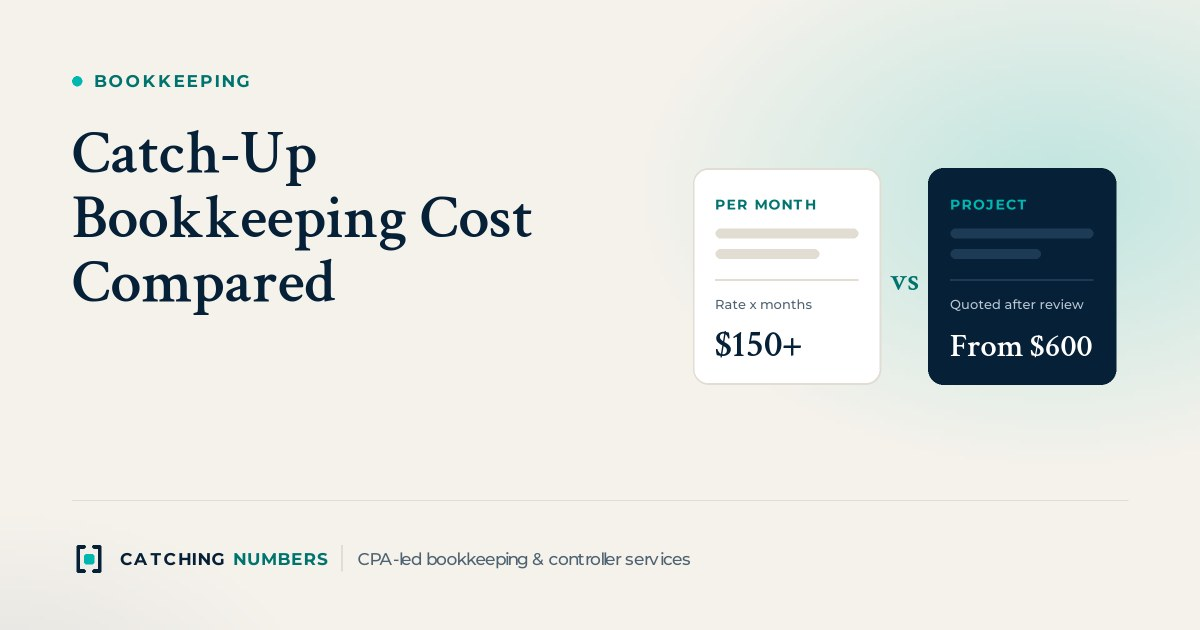
If your books are 8 months behind, the firms that publish a per-month rate would charge roughly $1,200 to $1,600 for a simple business, and about $2,400 or more if you have 100 to 500 transactions a month. Firms that price catch-up as a one-time project start at $600 to $1,000 and quote after a review. We compared 7 firms using only the prices on their own websites, checked on November 16, 2026. We are one of the firms listed.
Key takeaways
- Catch-up bookkeeping is priced three ways: a rate per month behind, a one-time project fee, or included with an annual subscription.
- Per-month pricing is the easiest to compare: $200 a month behind at Merritt, and $150, $300 or $600 a month behind at Catching Numbers depending on volume.
- Transaction volume, the number of accounts, payment processors and accrual-basis books move a quote more than anything else.
- Published turnarounds range from 7 days to about a month, counted from when the firm has your statements and access.
How much does catch-up bookkeeping cost at each firm?
The table shows each firm’s published catch-up pricing, what that means if you are 8 months behind, and whether you keep working in your own accounting software. Where a firm doesn’t publish a price, we say so rather than guess.
| Firm | How catch-up is priced | Published price | If you are 8 months behind | Your software |
|---|---|---|---|---|
| Catching Numbers | Per month behind, by monthly transaction volume | $150, $300 or $600 a month behind (under 100, 100 to 500, or 500 to 2,000 transactions a month); $499 minimum | $1,200, $2,400 or $4,800 before add-ons for extra accounts, processors or accrual books | Stays in yours: QuickBooks Online, Xero, NetSuite, Sage Intacct and others |
| Merritt Bookkeeping | Per month behind | $200 a month behind; $100 for a month that needs fewer than 20 transactions entered | $1,600, or less if some months are mostly complete | QuickBooks only |
| Intuit Expert Cleanup | One-time project, varies with months to clean up | As low as $600 | Quoted | QuickBooks Online |
| Bookkeeper360 | One-time project | From $1,000 | Quoted | Not stated on its pricing page |
| Xendoo | Monthly catch-up plan | Starting at $295 a month, no onboarding or setup fee | Quoted | Not stated for catch-up |
| Bench | Included with an annual plan | January 2026 to today included free with an annual plan, which starts at $1,910 a year paid upfront; earlier periods included with a paid subscription | Included, as all 8 months fall in 2026, if you sign an annual plan | Ongoing books move to Bench’s own platform |
| RemoteBooksOnline | Flat rate by months and transaction volume | Not published; quote or online estimator | Quoted | QuickBooks Online, QuickBooks Desktop or Xero |
To see your own number, our catch-up bookkeeping cost calculator applies our rates to your months behind, accounts and volume in about a minute.
Why do catch-up quotes vary so much?
Two businesses that are both 8 months behind can get very different quotes. These are the factors that move the price most:
- Transactions a month. Every transaction has to be matched to a statement and categorized, so volume drives most of the work.
- Number of accounts. Each bank, card and loan account is reconciled separately, month by month.
- Payment processors and marketplaces. Stripe, Shopify, Amazon and PayPal payouts have to be split into sales, fees and refunds.
- Cash or accrual books. Accrual books add bills, invoices and adjustments for every month.
- What is already in the file. Duplicate bank-feed entries, wrong opening balances and payroll booked as one lump sum all take time to unwind.
In our cleanup work, a typical client is 6 to 12 months behind, most quotes land between $1,500 and $5,000, and about 7 in 10 new clients arrive with at least one bank or card account that has never been reconciled.
Which pricing model is right for you?
- Per month behind (Merritt, Catching Numbers). You can work out the cost before you call anyone. It suits most small businesses with ordinary volume.
- One-time project (Intuit Expert Cleanup, Bookkeeper360). The firm reviews your file and quotes a fixed fee. It suits messy files where the work is hard to predict.
- Included with a subscription (Bench). Catch-up is folded into an annual plan. It can be good value if you want that firm’s ongoing service and its platform, but you are committing to a year.
Whichever model you choose, get the scope and the fee in writing before work starts.
What should a catch-up quote include?
- Every bank, credit card and loan account reconciled to its statement for every month
- Uncategorized and duplicate transactions fixed
- Payment processor payouts split into sales, fees and refunds
- Payroll recorded as wages, taxes and benefits, not one lump sum
- A profit and loss statement and balance sheet you can hand to your tax CPA
- A stated turnaround, and what happens if records are missing
Our guide to how catch-up bookkeeping works, step by step covers the records you will need to gather.
How long does catch-up bookkeeping take?
Usually a few weeks to a month once the firm has your statements and access. Intuit says its cleanup is typically done within 30 days of receiving your documents, Bench says 2 weeks to a month, and RemoteBooksOnline advertises up to 12 months cleaned in 7 days. Most of our cleanups are finished within one month. Missing statements are the usual cause of delay.
When are we the right fit, and when aren’t we?
We are a good fit if you want to stay in your own accounting software, want a CPA to review the finished books, and may want monthly bookkeeping afterwards. We work in QuickBooks Online, Xero, NetSuite, Sage Intacct and other systems. See our catch-up and cleanup service.
Another firm may suit you better if most of your missing months have very few transactions (Merritt’s $100 rate for those months is hard to beat), or if you already want Bench’s platform for ongoing books and are happy with an annual plan.
Frequently asked questions
Is catch-up bookkeeping a one-time fee?
Yes, at most firms. Catch-up is billed once for the months that are behind, separately from any monthly bookkeeping afterwards. The exception in this comparison is Bench, which includes catch-up with an annual plan.
How do I know how many months behind I am?
Count back to the last month where every bank and card account was reconciled to its statement. If you have never reconciled, a firm will usually start from the beginning of the current tax year, or earlier if your tax CPA needs it.
Can I catch up my books myself?
Yes, if you have a few months and low volume. Download every bank and card statement, match each transaction, and reconcile each account month by month. Once you are more than a few months behind or have payroll and processors, a firm is usually faster and cheaper than your own time.
What records do I need for catch-up bookkeeping?
Bank, credit card and loan statements for every month, payroll reports, payment processor reports, and access to your accounting software. Receipts help for larger expenses, but statements are what the work depends on.
Should I catch up before my tax CPA starts?
Yes. Your tax CPA works from your profit and loss statement and balance sheet, so reconciled books make their work faster and usually cheaper. Start at least a month before their deadline.
Want a fixed quote for your catch-up? Book a free file review or call +1 (646) 450-8036.